Inland Fisheries, Reservoir Aquaculture & Blue Economy: India's Freshwater Frontier

Integrating advanced techniques for higher fish production in reservoirs, enhancing livelihood and food security across India.
G
Gopi
4 mins read
Boosting fisheries, empowering livelihoods

Introduction

India's fisheries sector has emerged as one of the fastest-growing segments of its agricultural economy — recording a 106% increase in national fish production since 2013-14, reaching a record 197.75 lakh tonnes in 2024-25. As the world's second largest fish producer and aquaculture nation, India's growth story is increasingly driven not by marine fisheries but by inland freshwater systems — reservoirs, ponds, and wetlands covering over 31.50 lakh hectares. Budget 2026-27's focus on integrated development of fisheries in 500 reservoirs and Amrit Sarovars signals a structural shift: from subsistence fishing to value-chain-driven rural enterprise.

"Aquaculture productivity in Indian reservoirs can be tripled — from 100 kg to 300 kg per hectare — through integrated value chain development." — ICAR-CIFRI Study


India's Fisheries Sector: Key Statistics

IndicatorData
Global rank — fish production2nd
Global rank — aquaculture production2nd
Total fish production (2024-25)197.75 lakh tonnes
Growth since 2013-14106%
Share of inland fisheries75% of total production
Reservoir area31.50 lakh hectares
Fish production from reservoirs~18 lakh tonnes
Current reservoir productivity100 kg/hectare
Productivity in 200650 kg/hectare
ICAR-CIFRI potential estimate300 kg/hectare

Inland Fisheries: Structure & Geography

Reservoir classification for fisheries management:

CategorySizeManagement Focus
Small< 1,000 hectaresCommunity-based, cooperative management
MediumUp to 5,000 hectaresCluster-based, NFDB support
Large> 5,000 hectaresIndustrial-scale aquaculture + cage culture

State-wise significance:

StateDistinction
Madhya PradeshMaximum reservoir area (~6 lakh hectares)
Tamil NaduHighest number of reservoirs (8,000+)
JharkhandModel cooperative-based cage culture (Chandil reservoir)
Arunachal PradeshAmrit Sarovar ornamental fisheries (Dine Dite Rijo)

Technology: Cage Culture in Reservoirs

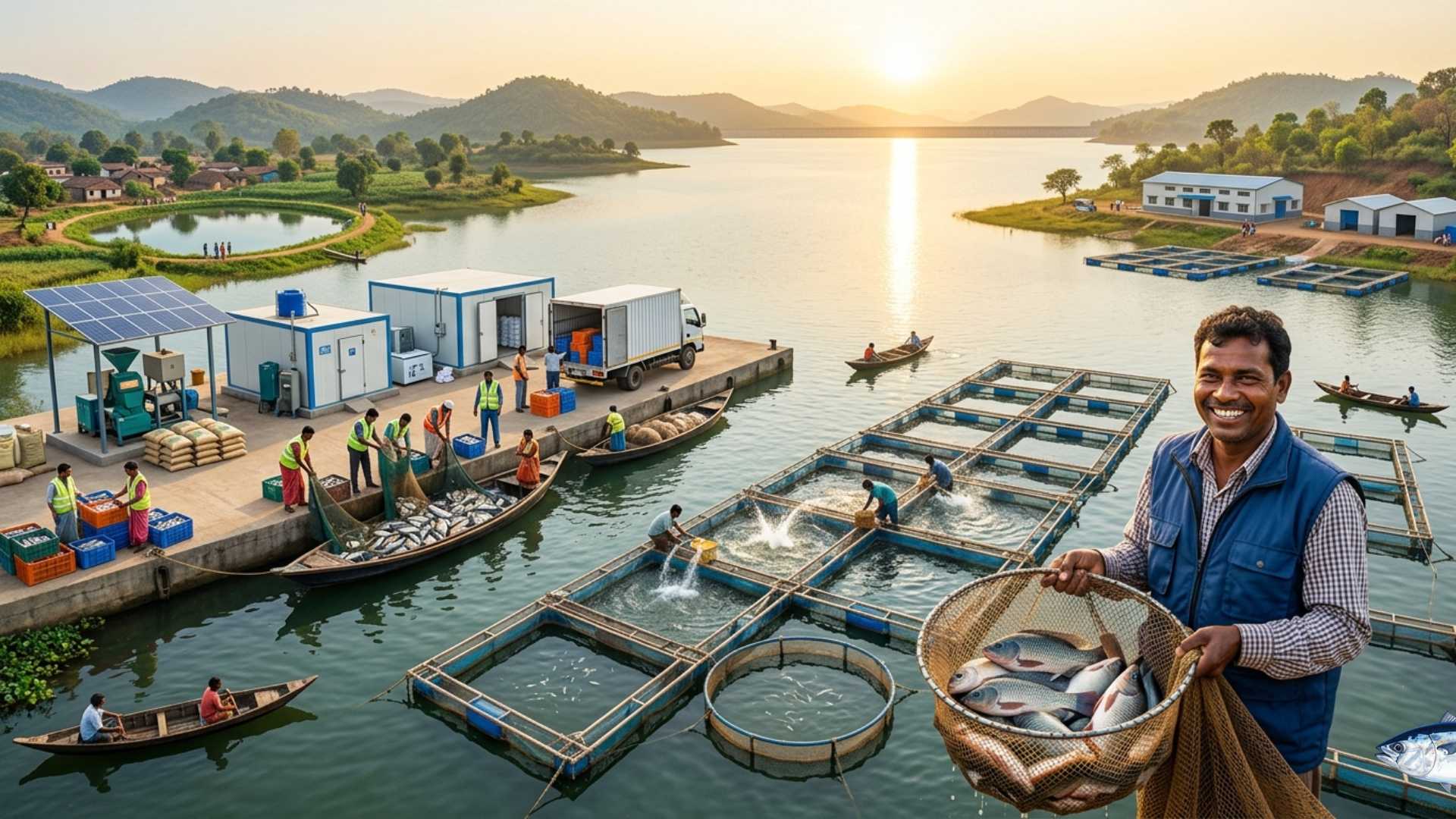
What is cage culture? Floating or stationary enclosures of synthetic netting/mesh anchored in reservoirs — allowing natural water flow while enabling controlled fish rearing.

Advantages:

FeatureBenefit
Mesh structureNatural oxygen and nutrient exchange
Anchoring systemDepth and position control
Feeding/monitoringEasier management, disease control
Circular cages (newer)Species diversification, better water circulation

Key species:

  • Indian Major Carps (core): Catla, Rohu, Mrigal
  • Additional species (need-based): Tilapia, Pangasius

Policy Framework: Flagship Programmes

ProgrammeFocusContribution
Blue Revolution (BR)Integrated fisheries developmentSeed, feed, infrastructure support
PM Matsya Sampada Yojana (PMMSY)End-to-end fisheries value chainSubsidised inputs, market linkage
Mission Amrit SarovarPond conservation + community management10,000 cubic metre ponds; aquaculture integration
NFDB Cluster StrategyReservoir ecosystem competitivenessEnd-to-end solutions, hatcheries, cold chain

Value Chain Approach: What Is Needed

ICAR-CIFRI's vision of 300 kg/hectare productivity requires moving beyond production to a full value chain:

Value Chain NodeInfrastructure Required
Input supplyHatcheries, feed mills
ProductionCage culture, stocking support
Post-harvestIce plants, cold storage, refrigerated trucks
Market accessAuction centres, retail outlets, berthing platforms
AggregationFish Farmer Producer Organisations (FFPOs), cooperatives
FinanceCooperative credit, PMMSY subsidy

Cluster-based model in action:

  • NFDB announced Halalai and Indra Sagar dams cluster in Madhya Pradesh
  • Identifies sectoral gaps in production, productivity, processing
  • Aggregates farmers through cooperatives for economies of scale
  • To be replicated across states and UTs

Mission Amrit Sarovar: Community Water & Fisheries

  • Core vision: conserve surface and groundwater through district-level pond development
  • Design standard: minimum 1 acre pondage, 10,000 cubic metre holding capacity
  • Key innovation: mapping of user groups for community-based pond management
  • Fisheries integration: ornamental fish culture, stocking, aquaculture
  • Success case: Dine Dite Rijo, Upper Subansiri, Arunachal Pradesh — retention basin converted to ornamental fisheries hub

Livelihoods & Food Security Dimension

Who benefits:

  • Millions of fish farmers in eastern, central, and peninsular India
  • Economically backward and water-scarce regions — direct/indirect employment
  • SC/ST communities with traditional fishing rights
  • Women SHGs increasingly involved in fish processing and marketing

Case study — Bimal Chandra Oran, Jharkhand:

  • Fish farmer, Saraikela district; Chandil reservoir ecosystem
  • Member of CBVMSS cooperative
  • Set up 2 cages; received subsidised seed, feed, capacity-building training
  • Cultivated Tilapia and Pangasius
  • Annual production: 3 tonnes; Annual turnover: ₹3 lakh+
  • Demonstrates cooperative + cage culture + marketing support model working at ground level

Challenges

ChallengeDetail
Multiplicity of ownershipMultiple agencies hold fishing rights — data gaps, coordination failure
Low productivity baselineStill at 100 kg/ha vs. 300 kg/ha potential
Cold chain gapsPost-harvest losses high — ice plants, refrigeration infrastructure weak
Climate vulnerabilityReservoir levels depend on monsoon — drought risk
Invasive species riskTilapia, Pangasius introduction needs ecological monitoring
Market accessRemote reservoirs lack auction centres, retail linkage

Broader Significance: Blue Economy & Viksit Bharat 2047

  • Blue Economy vision: sustainable use of ocean and freshwater resources for economic growth
  • Inland fisheries as rural enterprise ecosystem — not just food production
  • Protein security: fish as affordable animal protein for nutritionally vulnerable populations
  • Export potential: India's seafood exports at ~$7 billion; inland aquaculture can add value
  • SDG alignment: SDG 2 (Zero Hunger), SDG 1 (No Poverty), SDG 14 (Life Below Water)

Conclusion

India's reservoir fisheries represent an underleveraged frontier of rural economic transformation. The shift from subsistence fishing to cage culture, cooperatives, and value chain integration — enabled by PMMSY, Blue Revolution, and the Amrit Sarovar mission — has already doubled productivity in two decades. The ICAR-CIFRI vision of tripling it further is achievable, but only if the cluster-based, end-to-end value chain approach moves from pilot to national scale. For the millions of fish farmers in India's eastern and central heartland, reservoirs are not just water bodies — they are the blue infrastructure of food security, livelihood dignity, and rural prosperity.

Quick Q&A

Everything you need to know

Reservoirs and Amrit Sarovars play a transformative role in India's inland fisheries sector, which contributes nearly 75% of total fish production. Reservoirs, spread over more than 31.5 lakh hectares, serve as major freshwater resources that support aquaculture and capture fisheries. The increasing productivity—from 50 kg/ha in 2006 to about 100 kg/ha today—demonstrates their growing importance in boosting national fish output, which has reached 197.75 lakh tonnes. Amrit Sarovars, developed under Mission Amrit Sarovar, further expand the scope of fisheries by utilizing local water bodies for economic and ecological benefits.

Beyond production, their socio-economic relevance is profound. These water bodies provide livelihoods to millions, especially in economically backward and water-scarce regions. They enhance food and nutritional security by supplying protein-rich food and create employment opportunities in allied sectors like feed supply, marketing, and processing. The integration of fisheries into these water systems aligns with the vision of Viksit Bharat@2047 by empowering rural communities.

Moreover, their decentralized nature promotes inclusive development. Community participation in Amrit Sarovar management and cooperative-based reservoir fisheries ensures equitable access and sustainability. Thus, reservoirs and ponds are not just ecological assets but also engines of rural economic transformation.

The focus on integrated development and value chain strengthening stems from the need to maximize economic returns and reduce inefficiencies in the fisheries sector. While India has achieved impressive growth in production, post-harvest losses, fragmented supply chains, and limited market access often reduce profitability for fish farmers. By developing infrastructure such as hatcheries, feed mills, cold storage, ice plants, and retail outlets, the government aims to create an end-to-end ecosystem that enhances productivity and income.

Another key reason is to improve market access and price realization. Fish Farmer Producer Organizations (FFPOs) and cooperatives play a crucial role in aggregating produce, enabling economies of scale, and strengthening bargaining power. This reduces the exploitation by middlemen and ensures better income stability for small and marginal fishers. The cluster-based approach by the National Fisheries Development Board (NFDB) further enhances competitiveness by identifying and addressing localized gaps in production and processing.

Strategically, this approach supports sustainable and inclusive growth. It promotes diversification of species, adoption of modern technologies, and better resource utilization. By integrating production with processing and marketing, India can also enhance its export potential, thereby contributing to economic growth and rural development simultaneously.

Cage culture technology has revolutionized reservoir fisheries by enabling controlled and intensive aquaculture within natural water bodies. These cages, made of synthetic mesh and anchored or suspended in reservoirs, allow for continuous water exchange, ensuring adequate oxygen and nutrient flow. This controlled environment facilitates better feeding practices, disease management, and monitoring, thereby significantly improving fish survival and growth rates.

The technology has directly contributed to doubling productivity levels. Fish productivity in reservoirs has increased from around 50 kg/ha in 2006 to nearly 100 kg/ha today. This has been supported by government initiatives such as the Blue Revolution and Pradhan Mantri Matsya Sampada Yojana (PMMSY), which provide subsidies for quality seed, feed, and infrastructure. The introduction of species like Tilapia and Pangasius, alongside traditional Indian major carps, has further enhanced output and diversification.

Additionally, cage culture promotes efficient resource utilization. It allows farmers to utilize underexploited water bodies without requiring land ownership, making it particularly beneficial for marginalized communities. Innovations such as circular cages are improving scalability and adaptability. Thus, cage culture is a key technological driver in achieving higher productivity and sustainable aquaculture growth.

The case of Bimal Chandra Oran from Jharkhand exemplifies the transformative potential of reservoir fisheries. As a member of a cooperative society in the Chandil reservoir, he adopted cage culture technology with support in the form of subsidized seed, feed, and capacity-building training. Starting with just two cages, he successfully cultured species like Tilapia and Pangasius, demonstrating the viability of scientific aquaculture practices in rural settings.

The economic outcomes have been significant. Over time, he achieved an annual production of around three tonnes of fish, generating a turnover exceeding ₹3 lakh. This not only improved his livelihood but also created ripple effects in the local economy through employment and increased demand for allied services. The cooperative model ensured access to markets, reducing dependency on intermediaries and stabilizing income.

This example highlights key success factors. These include institutional support, technology adoption, skill development, and market linkage. It underscores how targeted government interventions and community-based approaches can empower individual farmers and scale up fisheries development across regions.

Despite its potential, reservoir-based fisheries development faces several structural and operational challenges. One major issue is the multiplicity of agencies controlling fishing rights, which complicates governance and data collection. This fragmentation often leads to inefficiencies in policy implementation and conflicts among stakeholders. Additionally, lack of adequate infrastructure such as cold storage and transportation facilities hampers the value chain, leading to post-harvest losses.

Environmental and ecological concerns also need careful consideration. Overstocking, introduction of non-native species, and intensive aquaculture practices can disrupt local ecosystems and biodiversity. Water quality degradation and disease outbreaks pose further risks to sustainability. Moreover, small and marginal fishers often lack access to capital, technology, and training, limiting their ability to benefit from modernization initiatives.

However, these challenges can be mitigated through targeted interventions. Strengthening institutional coordination, promoting sustainable aquaculture practices, and enhancing capacity-building initiatives are essential. The cluster-based approach and integrated value chain development offer promising solutions, but their success will depend on effective implementation, monitoring, and community participation.

The cluster-based approach aims to enhance efficiency and competitiveness by treating a group of reservoirs as an integrated unit. Under this model, the National Fisheries Development Board (NFDB) identifies sectoral gaps in production, processing, and marketing within a defined cluster. For instance, the recently announced cluster for Halalai and Indra Sagar dams in Madhya Pradesh focuses on creating end-to-end solutions, including infrastructure development and institutional strengthening.

This approach offers multiple advantages. By aggregating fish farmers through cooperatives and FFPOs, it enables economies of scale, reduces costs, and improves market access. It also facilitates better planning and resource allocation, as interventions can be tailored to the specific needs of the cluster. Infrastructure such as hatcheries, feed mills, and cold chains can be developed more efficiently, benefiting all stakeholders within the ecosystem.

In the long run, the cluster model supports sustainable and inclusive growth. It promotes technological adoption, improves data collection, and enhances coordination among agencies. By replicating this model across states and union territories, India can unlock the full potential of its reservoir fisheries and move closer to achieving higher productivity targets, such as the ICAR-CIFRI projection of 300 kg/ha.

Attribution

Original content sources and authors

Sign in to track your reading progress

Comments (0)

Please sign in to comment

No comments yet. Be the first to comment!