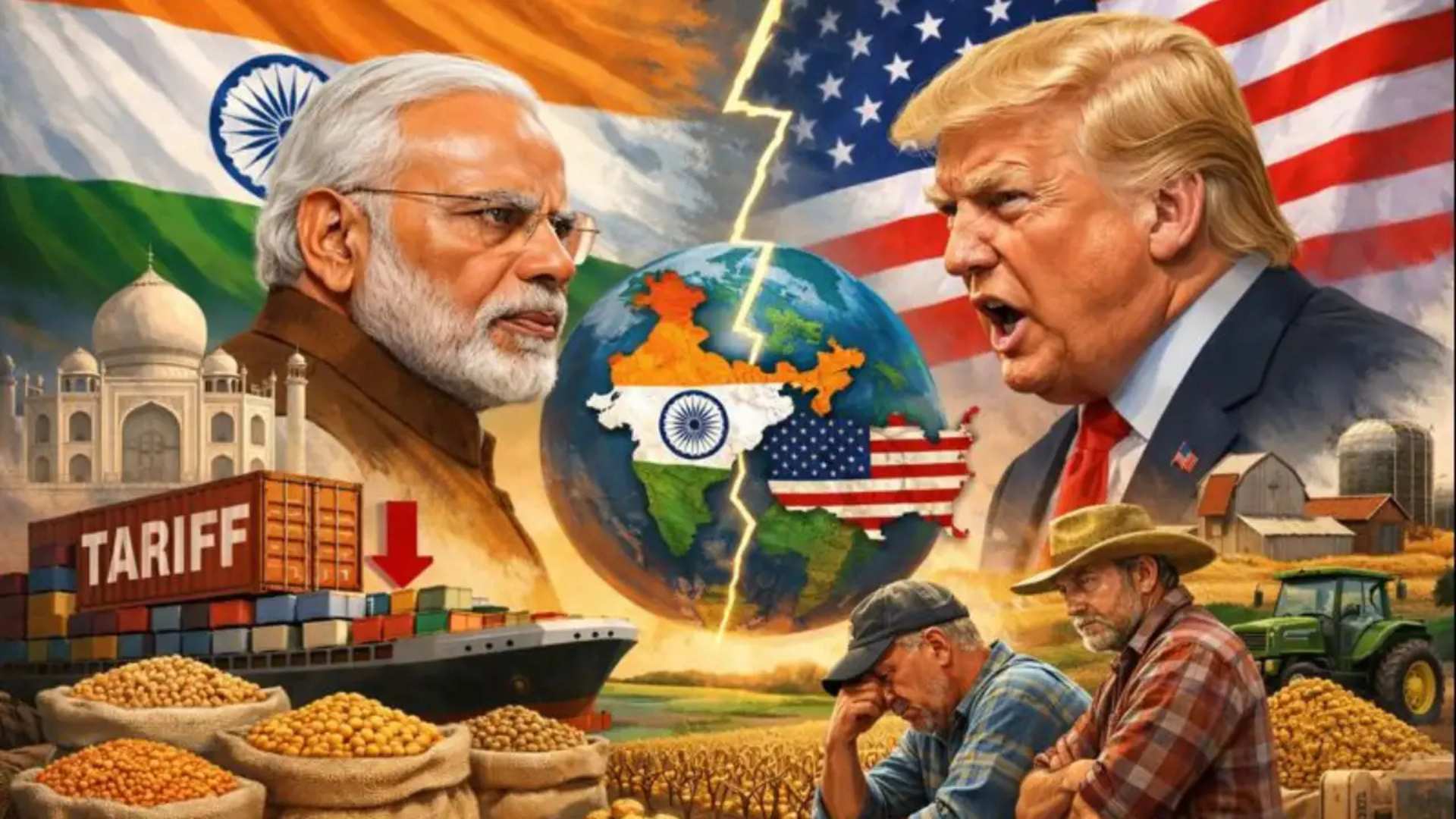
Pulses in India–US Trade Deal: Agricultural Sensitivities and Strategic Trade Dynamics
1. Context: Inclusion of Pulses in India–US Trade Fact-Sheet
The recent inclusion of “certain pulses” in the India–US trade deal fact-sheet has generated concern among sections of India’s agricultural community. Pulses were not part of the earlier joint statement for the interim framework, and the lack of clarity regarding specific varieties has intensified apprehensions.
Sources indicate that the US has been pressing for zero-duty access for lentils and yellow peas. Currently, India imposes 10% duty on lentils, while a 30% tariff on yellow peas was announced on December 30, 2025, effective November 1. Any reduction or elimination of tariffs may alter competitive dynamics in India’s pulses market.
Pulses are politically and economically sensitive in India due to their dual role: as a key protein source for consumers and as an income source for small and marginal farmers. Trade liberalisation in this segment must therefore balance food security, inflation control, and farmer welfare.
Trade negotiations involving agricultural commodities require balancing consumer interests and farmer protection. If tariff changes are undertaken without calibrated safeguards, it may create domestic price instability and rural distress.
2. India’s Changing Position in US Pulses Trade
India has historically been an important buyer of US pulses, though its relative importance has fluctuated over time. In 2015, India imported 142.16 million, retaining this position.
However, India’s share later declined due to high US prices, diversification of import sources, and increased domestic production (e.g., kabuli chana). Between 2021 and 2023, India slipped to ninth position among US pulses importers.
In 2024, India imported $74–76 million worth of pulses from the US, making it the fourth-largest buyer after Mexico, Canada, and the EU. Traditionally, India accounts for 8–12% of total US pulses exports, depending on policy conditions.
Trade Position:
- 2015 imports: $136.19 million
- 2016 imports: $142.16 million
- 2024 imports: $74–76 million
- Share in US exports: 8–12%
India’s role in US pulses trade has been policy-sensitive rather than structural. Shifts in tariffs or procurement policy significantly influence bilateral trade flows.
3. India’s Pulses Import Structure and Major Suppliers
India’s pulses imports are diversified, with Canada, Australia, Russia, Myanmar, and Mozambique emerging as major suppliers. Imports from the US remain comparatively small.
In 2023–24, India imported 1.67 million tonnes of lentils, of which ~1.58 million tonnes (95%) came from Australia and Canada. In 2024–25, lentil imports declined to 1.21 million tonnes, with Australia and Canada accounting for ~90%.
Yellow peas have dominated pulses imports in recent years:
- 2023–24: 1.16 million tonnes, with 83% from Canada and Russia.
- 2024–25: 2.16 million tonnes (all-time high), with 82% from Canada and Russia.
During the duty-free window (December 2023–October 2025), India imported 4.06 million tonnes of yellow peas:
-
Canada: 2.21 million tonnes (48%)
-
Russia: 1.19 million tonnes
-
US: 22,275 tonnes
Key Import Data:
- Lentils (2023–24): 1.67 million tonnes
- Yellow peas (2024–25): 2.16 million tonnes
- US share during duty-free period: 22,275 tonnes
India’s pulses import basket is already diversified and dominated by specific partners. Any preferential treatment to one exporter may reconfigure existing supply chains and price competitiveness.
4. US Pulses Production and Export Dependence
According to USDA data, in calendar year 2024, the US harvested pulses over 2.4 million acres, producing approximately 1.6 million metric tonnes.
Of this, 1.22 million tonnes (around 76%) were exported, valued at $1.12 billion, highlighting strong export dependence. Production is concentrated in North Dakota and Montana, which together account for over 80% of US dry pea and lentil output. Washington and Idaho are also significant producers.
These states border Canada, a major global pulses exporter and key supplier to India. Exports are crucial for farm incomes in these regions, explaining political advocacy for improved market access to India.
US Production & Exports (2024):
- Production: 1.6 million metric tonnes
- Harvested area: 2.4 million acres
- Exports: 1.22 million tonnes (76%)
- Export value: $1.12 billion
High export dependence makes US pulses politically sensitive in trade negotiations. Domestic political economy in exporting states shapes bilateral trade diplomacy.
5. Tariff Politics and Bilateral Trade Negotiations
Two US Senators (Steve Daines and Kevin Cramer) urged favourable pulse provisions in trade negotiations, citing the 30% import tariff on yellow peas as placing US producers at a competitive disadvantage.
Their advocacy reflects how agricultural tariffs become focal points in trade diplomacy. For India, tariff flexibility is often used to manage domestic supply shortages and price inflation.
However, pulses are also essential to India’s food security strategy. Excessive imports at zero duty may depress domestic prices, affecting farmer incomes, especially in pulse-growing states.
Tariff Issues:
- Lentils duty: 10%
- Yellow peas tariff (announced Dec 30, 2025): 30%
Trade policy in agriculture operates at the intersection of food security, farmer welfare, and international commitments. Ignoring domestic sensitivities can generate rural political backlash.
6. Strategic Implications for India
Pulses are a critical component of India’s nutritional security, especially for low-income households relying on plant protein. Therefore, imports are often allowed to moderate prices during shortages.
At the same time, India has invested in boosting domestic pulses production to reduce import dependence. Over-liberalisation may undermine these gains by discouraging domestic cultivation.
From a GS-III perspective (Agriculture, Food Security, External Sector), the issue highlights:
- The tension between consumer welfare and producer protection.
- The role of tariffs as price stabilisation tools.
- The impact of trade agreements on domestic agricultural markets.
Long-term stability requires calibrated import policies that protect farmers while ensuring affordable food. A purely trade-centric approach may overlook structural agricultural objectives.
Conclusion
The inclusion of pulses in the India–US trade framework underscores the sensitivity of agricultural commodities in bilateral agreements. While the US seeks greater market access for export-dependent producers, India must balance food security, inflation management, and farmer incomes.
Going forward, a calibrated approach—combining tariff flexibility, safeguard mechanisms, and domestic productivity enhancement—will be essential to align trade diplomacy with sustainable agricultural development.