
Introduction
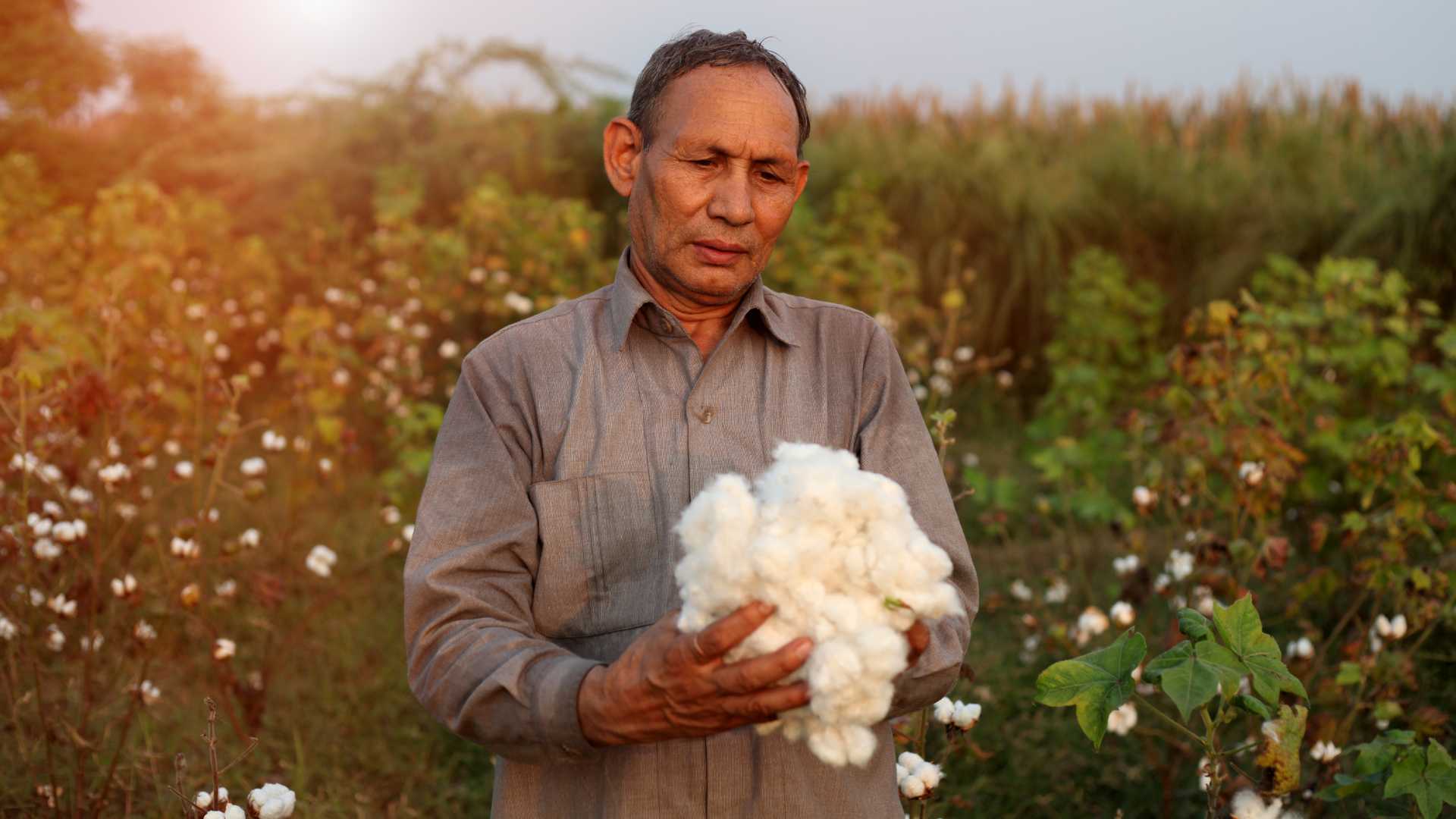
India is the world's largest cotton producer — yet the crop that once drove an agrarian revolution through Bt technology is now at the centre of a deepening farm crisis, with pink bollworm resistance, MSP inaccessibility, and climate shocks pushing farmers toward abandonment.
"Soon there may be no cotton farms in Haryana — those still growing cotton are holding on by a thread, mostly for its by-products." — Vinay Mehla, Assistant Scientist, CCSHAU
| Indicator | Figure |
|---|---|
| National Cotton Area Decline (2019-20 to 2024-25) | 14.84% |
| Production Fall | 36.07 mn bales → 29.72 mn bales |
| Haryana Area Decline | 0.72 mn ha → 0.40 mn ha (↓44%) |
| Average Loss per Acre (Haryana, Kharif 2024-25) | ₹15,143 |
| Yield Collapse (Sirsa) | 714 kg/ha (2019) → 264 kg/ha (2022) |
Background: The Bt Cotton Story — Promise and Collapse
Phase 1: The Bt Revolution (Early 2000s)
India introduced Bt cotton — genetically modified with Bacillus thuringiensis (Bt) genes — in 2002. It initially delivered:
- Protection against American bollworm, spotted bollworm, and pink bollworm
- Yield surge from 300 kg/hectare to over 500+ kg/hectare
- Rapid adoption — India became world's largest cotton producer by area
Phase 2: Resistance and Collapse (Post-2014)
- Pink bollworm (Pectinophora gossypiella) developed significant Bt resistance by the early 2010s
- Yields in Haryana fell from 10-12 quintals/acre (pre-resistance) to less than 4 quintals/acre currently
- Sirsa district yield: 714 kg/hectare (2019) → 264 kg/hectare (2022); partial recovery to 534 kg/hectare (2024) — still far below pre-crisis levels
"Pre-pink bollworm, yields ranged from 10-12 quintals per acre; now they are less than half of that. Last year's floods exacerbated the situation." — Vinay Mehla, Assistant Scientist, CCSHAU Department of Agricultural Economics
Cost-Return Analysis: The Economics of Loss
Data from CCSHAU's 'Economics of Important Kharif Crops in Haryana-2025' report:
| Cost/Return Component | Amount (₹ per acre) |
|---|---|
| Variable Cost (seeds, fertiliser, diesel, harvesting) | 22,821 |
| Total Cost (incl. land rental, transport, management) | 40,024 |
| Gross Returns (incl. by-products) | 24,882 |
| Net Loss per Acre | ₹15,143 |
| Average Yield | 4 quintals/acre |
| Market Price Realised | ₹5,000–6,200/quintal |
| MSP for Cotton (2024-25) | ~₹7,800/quintal |
District-wise net loss (Haryana):
| District | Net Loss per Acre (₹) |
|---|---|
| Hisar | 17,515 |
| Fatehabad | 17,315 |
| Charkhi Dadri | 15,276 |
| State Average | 15,143 |
| Rewari | 9,548 |
Key Issues
1. MSP: Policy on Paper, Absent in Practice
The MSP for cotton is set at approximately ₹7,800/quintal — yet farmers are selling at ₹6,200/quintal to private buyers. Government procurement agencies reject cotton citing quality standards, leaving farmers with no effective MSP access. This is a classic case of MSP policy-implementation gap — announced but not operationalised.
2. Pest Resistance: A Biotechnology Governance Failure
Bt cotton's resistance to pink bollworm was always time-limited — yet India lacked a structured Insect Resistance Management (IRM) protocol. No mandatory refuge areas (non-Bt cotton strips to slow resistance development) were enforced. The result: resistance emerged faster than anticipated, and no successor technology (Bt II, RNAi-based cotton) has been commercially approved.
3. Input Cost Inflation vs. Output Price Stagnation
- In 2005: 1 quintal of foodgrain = 10 grams of gold
- Today: fraction of that purchasing power
- In 2005: 1 quintal = 1 barrel of diesel; Today: 3 quintals needed per barrel
This terms of trade deterioration for farmers — rising input costs, stagnant output prices — is the structural driver of agrarian distress, independent of pest problems.
4. Crop Insurance: Promised but Undelivered
Farmers enrolled in crop insurance schemes (PM Fasal Bima Yojana) report non-payment of claims despite documented crop losses — a governance failure in the insurance delivery architecture.
5. Water Paradox: Cotton Decline Driving Paddy Surge
Cotton is a relatively water-efficient Kharif crop compared to paddy. But as cotton becomes unviable, farmers are shifting to paddy — a water-intensive crop — accelerating groundwater depletion, particularly in already water-stressed districts like Sirsa.
| Crop | Sirsa Area (hectares) | Change |
|---|---|---|
| Cotton | Declining (–34.62% since 2020) | Crisis-driven exit |
| Paddy | 1,00,300 (2020) → 1,55,650 (2024) | +55.18% surge |
This is precisely the opposite of what the Haryana government's 'Mera Pani-Meri Virasat' scheme intends — incentivising water-efficient crops over paddy.
Government Schemes: Incentives Failing to Attract
| Scheme | Incentive | Status |
|---|---|---|
| Mera Pani-Meri Virasat | ₹8,000/acre for water-wise crops (maize, pulses, cotton) over paddy | Low uptake — cotton itself is failing |
| Desi Cotton Incentive | ₹3,000/acre for local varieties | Few takers — lower prices, labour-intensive, inconsistent demand |
| INM/IPM Programme | ₹2,000/acre (max ₹4,000/farmer) | Insufficient to offset ₹15,000+ losses |
| PM Fasal Bima Yojana | Crop insurance | Claims frequently unpaid |
The core problem: incentives are too small relative to the scale of loss. A ₹3,000/acre incentive cannot offset a ₹15,143/acre loss.
Cascading Impact: Beyond the Farm
1. Textile and Industrial Supply Chain
Cotton is the primary raw material for India's ₹11 lakh crore textile industry. Declining domestic production will:
- Increase raw cotton imports — worsening trade balance
- Raise input costs for spinning mills and handloom weavers
- Threaten India's position as a textile export powerhouse
2. Farm Labour Displacement
Cotton is uniquely labour-intensive at harvest — primarily employing women from marginal communities for picking. As cotton acreage declines:
- Seasonal employment for farm labourers collapses
- Paddy mechanisation further displaces local labour
- Migration to urban areas accelerates, straining city infrastructure
3. Groundwater Depletion
The shift from cotton to paddy is accelerating groundwater extraction in already water-stressed Haryana districts — directly undermining the state's long-term water security and the Central government's groundwater conservation objectives.
4. Scheduled Caste Marginalisation
Cotton picking is traditionally performed by SC communities. Their seasonal income of ₹10,000–15,000/Kharif season is being eliminated — deepening social and economic marginalisation of already vulnerable communities.
Analytical Dimensions
1. GM Crop Governance Gap
India has no approved second-generation GM cotton varieties despite Bt resistance being documented for over a decade. The regulatory gridlock at GEAC (Genetic Engineering Appraisal Committee) around next-generation traits (RNAi, Bollgard III) reflects the broader failure of India's agricultural biotechnology governance.
2. MSP as a Political Tool, Not a Procurement System
The legal guarantee of MSP has been a long-standing demand of farmer unions (Samyukta Kisan Morcha). The cotton case demonstrates exactly why — MSP without mandatory procurement is an aspirational price, not a floor price.
3. Monoculture Risk and Crop Diversification
Bt cotton's rapid spread created a near-monoculture in India's cotton belt — maximising short-term yields but eliminating genetic diversity and making the entire system vulnerable to a single pest breakthrough. This is a textbook case of ecological and agricultural risk concentration.
4. Climate Vulnerability
2024-25 floods in Haryana's cotton belt compounded the pest damage — highlighting how climate change acts as a threat multiplier on crops already weakened by pest resistance and economic stress.
Conclusion
India's cotton crisis is not a single-cause problem — it is the convergence of biotechnology failure (Bt resistance), governance failure (MSP inaccessibility, insurance non-payment), policy contradiction (anti-paddy incentives failing as cotton collapses into paddy), and structural economic distress (input cost inflation outpacing output prices). The consequences extend far beyond the farm — threatening the textile industry, groundwater security, farm labour livelihoods, and India's agricultural trade balance. Addressing this crisis requires an emergency multi-pronged response: fast-tracking next-generation GM cotton approvals, operationalising MSP through mandatory procurement, restructuring crop insurance delivery, adequately funding local variety development, and designing incentive schemes commensurate with the scale of farm losses. Cotton's decline in Haryana is a warning signal — if unheeded, it portends a broader agrarian collapse in India's semi-arid farming regions.