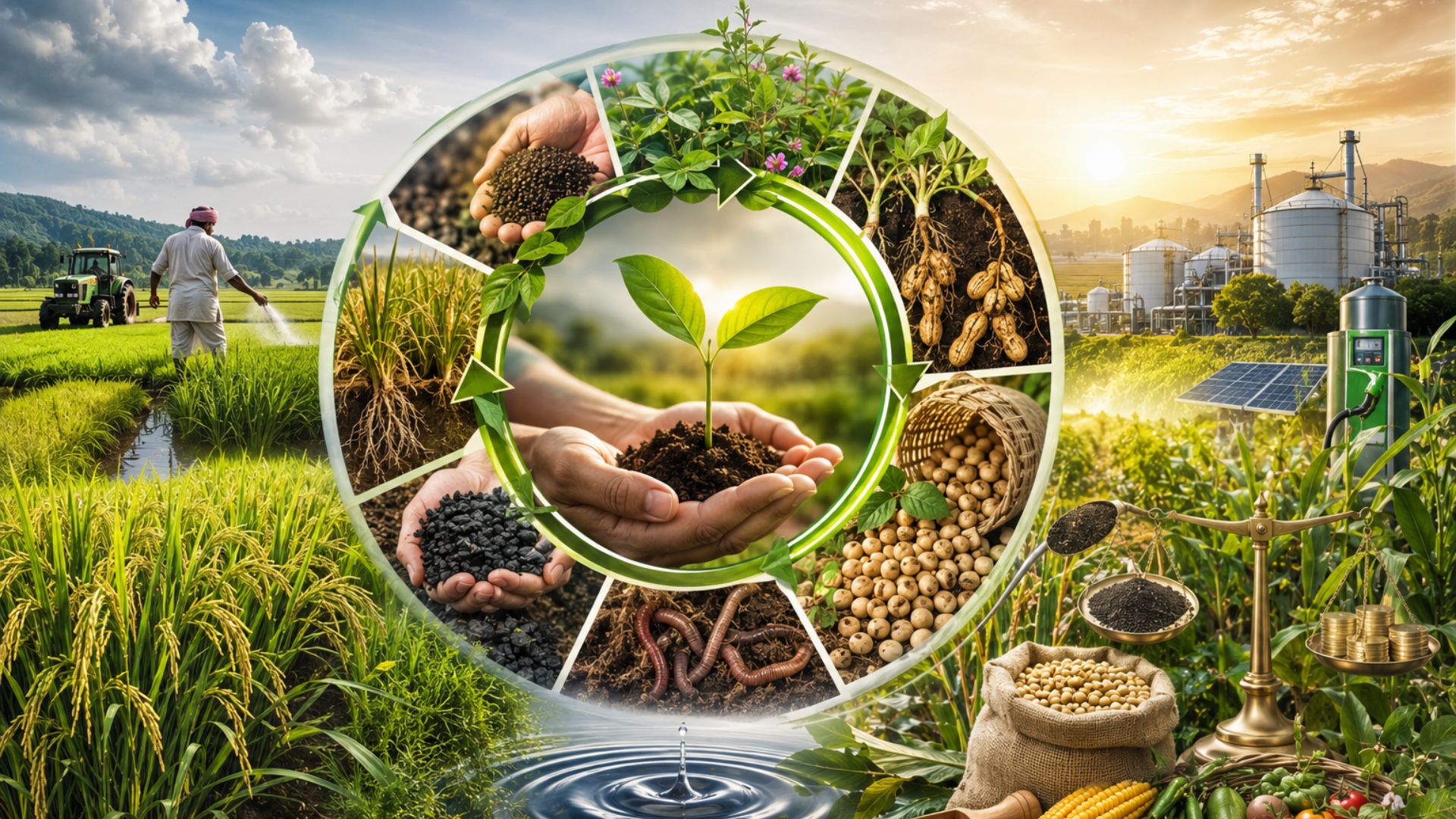
India's Fertilizer Trap: Breaking the Cycle of Dependence

"The more fertilizers we use, the more they deplete the soil's organic matter — pushing farmers to add even more fertilizers."
Rising fuel and fertilizer costs, compounded by the ongoing West Asia conflict, have brought India's fertilizer vulnerability into sharp focus. India imports nearly 20% of its urea and almost entirely depends on imports for phosphatic fertilizers due to the absence of domestic rock phosphate reserves. But the deeper crisis is not just about supply — it is about a self-reinforcing cycle of inefficiency that threatens soil health, food security, and the public exchequer simultaneously.
The Scale of the Problem
India's Fertilizer Burden:
- Annual fertilizer subsidy: ₹2 lakh crore
- Over two-thirds lost to pollution — not harvested as food
- Urea import share: ~20% (rest produced domestically)
- Phosphatic fertilizers: almost entirely imported
- Urea prices: doubled (Dec 2025–Apr 2026)
- Overall fertilizer prices: up 46% in same period
Despite decades of increasing supply, India's national fertilizer demand never saturates. Excessive use depletes soil organic matter and water-holding capacity, reducing yields and compelling farmers to apply even more — this is the fertilizer trap.
A proposed alternative — green ammonia produced from solar-powered electrolysis of water — exists in principle, but is not sustainable in water-stressed regions, limiting its applicability across much of India.
Why the Trap Deepens: Policy Failures
The root cause is structural policy misalignment, not farmer behaviour:
- MSP announced for 23 crops; actual procurement limited to rice, wheat, and sugarcane — farmers rationally grow only these three, which together consume over two-thirds of all urea in India
- This destroys traditional pulse-cereal crop rotations that sustained Indian agriculture for millennia without synthetic fertilizers
- India now produces twice the rice it needs — 40% exported, 9% diverted to grain-based bioethanol, creating direct food-versus-fuel competition for land, water, fertilizers, and subsidies
- Neem-coated urea, meant to improve nitrogen-use efficiency, failed to prevent most urea from escaping as ammonia into air
- The nutrient-based subsidy scheme excluded urea entirely, nullifying its efficiency intent
In 2017, the Prime Minister called for halving fertilizer use within five years in his Mann ki Baat address. Consumption has only increased — a direct result of the absence of inter-ministerial coordination.
The Pulse Solution India Is Missing
Pulse-cereal rotations are agronomically validated, not merely traditional:
- Most pulses fix atmospheric nitrogen, requiring zero urea or just 10% of what cereals demand
- They leave residual nitrogen in soil for the following crop
- Ideal for rain-fed areas facing deficit monsoons
- India has the world's largest vegetarian population yet imports ~20% of its pulses due to declining cultivation
- Telangana has witnessed a halving of pulses production since Statehood — a regional indicator of the national trend
- Shifting 20% of rice area to pulses could simultaneously save urea, conserve water, and address chronic protein malnutrition
Dalhan Aatmanirbharta Mission (Oct 2025):
- Target: 350 lakh tonnes pulse production in 5 years
- MSP procurement assured for Tur, Urad, Masoor — 4 years
- Budget: ₹11,440 crore
- Ground reality (April 2026):
  → Pulse sowing area grew only 1.26% (vs 10% decline between 2021-22 and 2024-25)
  → Groundnut sowing up only 1.3% — leguminous oilseeds faring no better
- Supreme Court (March 2026): called for better implementation
Soybean — the one legume that scaled up with low urea inputs — does not leave fixed nitrogen for the next crop, making it only a partial substitute.
Enhancing Efficiency: What the Science Says
- Coordinated crop trials show up to half the recommended fertilizer dose can be replaced by manure, biochar, or compost without yield loss
- India's rice germplasm research demonstrates potential to double nitrogen-use efficiency in grain yield per unit of urea
- Organics should form the basal dose; synthetic fertilizers used only as top-up after exhausting local organic sources
- The Union government recently directed states to promote green manure — but without explicitly linking it to fertilizer savings, diluting the intent
Way Forward
- Expand MSP procurement beyond rice, wheat, and sugarcane to actively incentivise pulse and legume cultivation at scale
- Disincentivise grain-based bioethanol — permit fermentation only from molasses or waste biomass to end food-fuel competition
- Triple recycling of manure, compost, and biochar; make organics the default basal input
- Revive the Interministerial National Nitrogen Steering Committee — its tenure lapsed before a single recommendation was acted upon
- Invest in improved crop varieties with higher nitrogen-use efficiency — farmer-accessible, not capital-intensive
- Strengthen Dalhan Mission implementation with district-level procurement infrastructure, as directed by the Supreme Court
Conclusion
India spends ₹2 lakh crore annually on fertilizer subsidies and loses most of it to pollution rather than food production. The fertilizer trap is policy-made, not inevitable. Breaking it requires moving decisively beyond supply-side management toward efficiency, crop diversification, and genuine inter-sectoral coordination. The science exists. The traditional knowledge is documented. The Supreme Court has flagged implementation gaps. What remains is the institutional will to act — before the next price shock forces the issue.
Attribution
Original content sources and authors


Syllabus classification
How this article maps to GS papers
Main syllabus
GS3AgricultureQuick Q&A
What is meant by the ‘fertilizer trap’ in the Indian agricultural context, and how does it affect long-term food security?
In India, this trap has emerged because urea-driven cultivation is concentrated around rice, wheat, and sugarcane. These crops are heavily incentivised through procurement systems and subsidies. As a result, farmers continue monocropping instead of traditional pulse-cereal rotations. This creates nutrient depletion and dependency on subsidised fertilizers.
Its implications for food security are serious:
- Declining soil fertility threatens future yields
- High subsidy burdens strain public finances
- Increased imports of fuel and phosphates expose India to global shocks
- Pollution damages ecosystems and human health
Why is improving fertilizer use efficiency considered more important than merely increasing fertilizer supply in India?
The nitrogen cycle is highly inefficient. Much of urea is lost as ammonia emissions, while phosphatic fertilizers are washed away into water bodies. Therefore, adding more supply only increases fiscal burden and environmental degradation without proportionate gains.
Efficiency matters because:
- It lowers import dependence on gas and phosphates
- Reduces subsidy costs
- Improves sustainability of farming systems
- Mitigates climate change and pollution
What are the structural reasons behind India’s continued overconsumption of urea despite policy interventions?
Another reason is the incomplete design of subsidy reform. The nutrient-based subsidy system excluded urea, keeping it artificially cheap. Neem-coated urea improved some efficiency but could not address systemic losses. Inter-ministerial fragmentation has further prevented integrated policy implementation.
Structural drivers include:
- Crop procurement bias
- Subsidised urea prices
- Weak promotion of crop diversification
- Poor integration across agriculture, food, and energy sectors
Critically analyse whether India’s fertilizer subsidy regime supports food security or undermines sustainability.
However, the current design undermines sustainability. Subsidies disproportionately favour urea, encouraging overuse and nutrient imbalance. This leads to groundwater contamination, ammonia emissions, declining soil health, and fiscal inefficiency. Since most benefits accrue to water-intensive cereals, subsidies indirectly discourage diversification.
Critical issues:
- Promotes input-intensive farming
- Encourages monocropping
- Creates ecological externalities
- Crowds out investment in organics and research
How can pulse-based agriculture act as a solution to India’s fertilizer and nutrition challenges?
From a nutrition perspective, pulses are essential because India has the world’s largest vegetarian population. Protein deficiency remains widespread, and reduced pulse cultivation has worsened this. India still imports nearly 20% of its pulse requirement, despite its domestic demand.
Benefits include:
- Saves urea and irrigation water
- Improves soil fertility naturally
- Addresses protein malnutrition
- Suitable for rain-fed areas
If you were advising the Government of India, what integrated strategy would you recommend to improve fertilizer efficiency and agricultural resilience?
Second, India should institutionalise organic nutrient recycling. Manure, compost, and biochar should become the basal nutrient source, with chemical fertilizers used only as supplementary inputs. Research should focus on improved crop varieties with high nitrogen-use efficiency rather than only high-tech solutions.
Recommended steps:
- Revive the Interministerial National Nitrogen Steering Committee
- Expand pulse procurement and crop insurance
- Triple compost and biochar recycling
- Discourage grain-based ethanol
- Promote low-input germplasm adoption
Practice questions
1 question for mains preparation