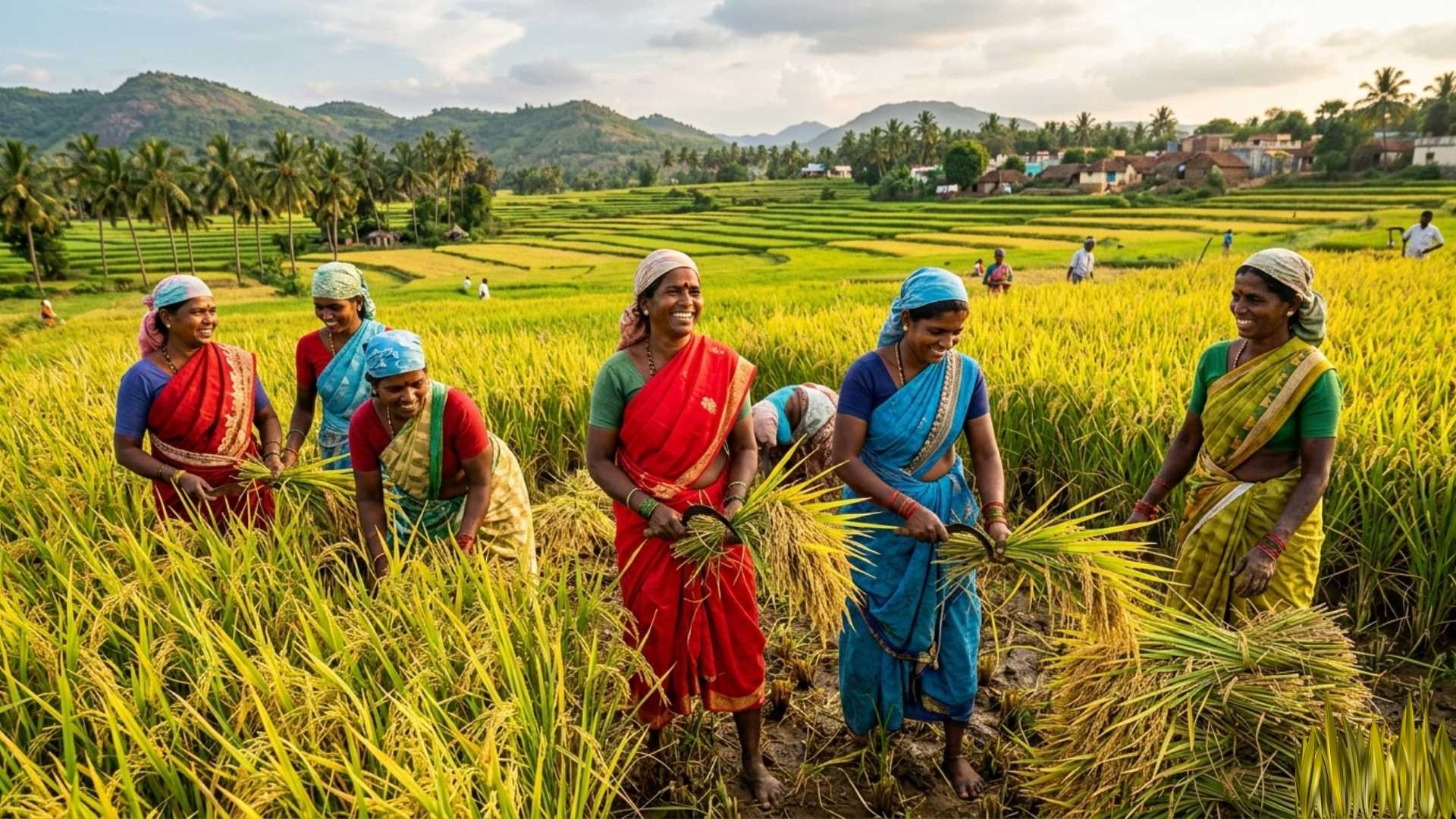
Empowering Women Farmers for a Resilient Future
Context
- International Women’s Day (March 8, 2026) focuses on the demand for equal rights and justice for women and girls.
- 2026 is also the International Year of the Woman Farmer, highlighting the need to recognise women’s role in agriculture and food systems.
- Despite strong legal provisions, women farmers in India remain largely invisible in land ownership, policy recognition, and welfare access.
Women in Agriculture: The Structural Paradox
Women play a central role in India’s agri-food systems, but their contributions remain largely unrecognised.
- Women are involved in sowing, transplanting, weeding, harvesting, post-harvest processing, livestock care, and household food provisioning.
- However, most land titles remain in men’s names, which means women are rarely officially recognised as “farmers”.
This creates a structural disconnect: Women perform farming activities but lack legal identity as farmers, resulting in exclusion from many agricultural benefits.
Gap Between Legal Rights and Ground Reality
India has introduced several legal reforms to ensure gender equality, especially in property rights.
Legal framework
- Hindu Succession (Amendment) Act, 2005 gives daughters equal inheritance rights in property.
- Constitutional guarantees ensure equality before law and non-discrimination.
Reality on the ground
However, several barriers prevent women from exercising these rights:
- Patrilineal inheritance traditions
- Social norms favouring male ownership
- Lack of legal awareness among women
- Administrative hurdles in land registration
- Family pressure against claiming property rights
As a result, women’s names rarely appear in land records, limiting their legal authority and economic agency.
Consequences of Lack of Land Ownership
Without land titles, women face systematic exclusion from agricultural support systems.
Women farmers often struggle to access:
- Institutional credit
- Crop insurance
- Irrigation schemes
- Agricultural extension services
- Climate-resilient technologies
- Government agricultural subsidies
Most schemes require proof of land ownership, which automatically excludes many women cultivators.
Thus, policy design unintentionally reinforces gender inequality.
Feminisation of Agriculture
A major structural change in Indian agriculture is the feminisation of agriculture.
Reasons
- Male migration to urban areas for employment
- Women increasingly managing farms and households simultaneously
Implications
In theory, this could improve women’s empowerment. However, in practice it creates several burdens:
- Increased workload
- Time poverty
- Limited access to labour-saving technologies
- Lack of childcare and care infrastructure
Women therefore manage both productive work (farming) and reproductive work (household care).
Impact on Women’s Health and Nutrition
Heavy agricultural workloads combined with limited resources lead to serious health challenges.
Major issues
- High levels of anaemia among women of reproductive age
- Micronutrient deficiencies
- Poor dietary diversity
Typical rural diets remain cereal-dominated, with insufficient intake of:
- Pulses
- Fruits
- Vegetables
- Animal-source foods
This creates a paradox:
Women who produce food for the nation often remain nutritionally insecure themselves.
Intergenerational Impact of Malnutrition
Poor nutrition among women has long-term consequences for future generations.
Maternal undernutrition leads to:
- Low birth weight
- Child stunting
- Poor cognitive development
- Increased vulnerability to diseases.
Thus, improving women’s nutrition is central to national human capital development.
India’s Right-to-Food Framework
India has established a strong legal framework for food security.
Key law
National Food Security Act (NFSA), 2013
Major provisions include:
- Subsidised cereals through Public Distribution System (PDS)
- Supplementary nutrition through Anganwadi services
- Maternity benefits for pregnant and lactating women
- Mid-Day Meal Scheme (PM POSHAN)
Several states have also introduced:
- Millets in PDS
- Fortified food distribution
- Local nutrition programmes
However
Despite these programmes, women’s nutritional outcomes remain uneven due to:
- Cereal-centric food distribution
- Weak integration of nutrient-rich foods
- Overburdened frontline workers
- Digital access barriers in welfare delivery.
The Concept of “Limited Right to Food”
Even though legal entitlements exist, many women cannot fully access or control these benefits.
This creates a “limited right to food”.
Key Priorities for Empowering Women Farmers
1. Recognising Women Farmers in Policy and Data
2. Strengthening Women’s Land and Resource Rights
3. Aligning Food Systems with Nutrition Goals
4. Access to Technology and Extension Services
Role of Institutions
M.S. Swaminathan Research Foundation (MSSRF)
World Food Programme (WFP)
Way Forward
Real empowerment of women farmers requires rights, recognition and resources.
Key actions:
- Recognise women as farmers, not just helpers
- Ensure land ownership and asset rights
- Improve access to agricultural inputs and technologies
- Strengthen nutrition-sensitive food systems
- Promote women’s leadership in agri-food governance
When women gain knowledge, legal rights and institutional support, they can drive:
- Climate-resilient agriculture
- Biodiversity conservation
- Nutrition-secure food systems
Conclusion
Empowering women farmers is essential not only for gender equality, but also for food security, agricultural sustainability and national nutrition outcomes. Recognising women’s rights to land, resources and food is therefore a critical step toward building a more equitable and resilient agri-food system in India.
Attribution
Original content sources and authors
Syllabus classification
How this article maps to GS papers
Main syllabus
GS3AgricultureQuick Q&A
What is meant by the “feminisation of agriculture” in India, and what structural factors have contributed to this trend?
Despite performing a significant share of agricultural work, women farmers often lack formal recognition. In many rural areas, land titles and property ownership remain concentrated in men’s names, due to patrilineal inheritance traditions, social norms, and bureaucratic hurdles. This creates a paradox where women are actively engaged in farming activities but are not officially recognised as “farmers” in land records or policy frameworks.
This structural gap has far-reaching implications. Without formal land ownership, women face barriers in accessing institutional credit, crop insurance, irrigation schemes, and agricultural extension services. For example, many government schemes require land ownership documents to determine eligibility, thereby excluding women cultivators who manage farms but lack legal titles. Recognising women as farmers under policy frameworks such as the National Policy for Farmers is therefore essential for improving gender equity and strengthening agricultural productivity.
Why is secure land ownership for women considered crucial for improving agricultural productivity, gender equity, and food security?
From an economic perspective, land ownership enables women to access institutional credit, crop insurance, irrigation facilities, and extension services. Without land documentation, women are often excluded from these benefits even though they actively cultivate the land. Studies across developing countries show that when women farmers have equal access to productive resources, farm productivity can significantly increase, contributing to higher household incomes and improved food security.
Secure land rights also have broader social implications. Women with land ownership are more likely to invest in children's education, nutrition, and healthcare. For example, research by organisations such as the Food and Agriculture Organization (FAO) and the World Food Programme (WFP) shows that empowering women farmers improves household nutrition outcomes. Therefore, strengthening women’s land rights is not only a matter of gender justice but also a key strategy for achieving sustainable agricultural development.
How does the lack of recognition of women as farmers affect their access to agricultural schemes, credit, and technological support?
This exclusion affects women’s ability to adopt modern agricultural technologies. Without access to institutional credit or subsidies, women farmers may struggle to purchase high-quality seeds, fertilisers, irrigation equipment, or mechanised tools. As a result, their productivity remains constrained. Furthermore, agricultural training and extension programmes are often designed with male farmers in mind, limiting women’s participation and access to technical knowledge.
The absence of formal recognition also reduces women’s bargaining power in markets and local governance institutions. For example, women who lack official farmer status may find it difficult to participate in farmer producer organisations (FPOs) or cooperative societies. Addressing this issue requires policy reforms that recognise farmers based on their agricultural activities rather than land ownership alone, as suggested in the National Policy for Farmers.
What are the key reasons behind the persistent malnutrition and anaemia among women in rural India, despite improvements in food security programmes?
Dietary patterns in many rural households also contribute to nutritional deficiencies. Although food security schemes such as the National Food Security Act (NFSA) provide subsidised cereals through the Public Distribution System (PDS), these diets often remain heavily cereal-based. They lack sufficient quantities of pulses, fruits, vegetables, and animal-source foods that provide essential micronutrients like iron, zinc, and vitamins.
Social and cultural factors further exacerbate the problem. In many households, women and girls eat last and receive smaller portions of nutritious foods. Limited healthcare access, poor awareness about nutrition, and inadequate sanitation also contribute to high anaemia levels. These factors create an intergenerational cycle where maternal undernutrition leads to low birth weight and stunting among children, reinforcing long-term health challenges.
Critically analyse the effectiveness of India’s right-to-food framework in addressing gender inequalities in food and nutrition security.
However, the framework has several limitations when viewed through a gender lens. One major criticism is the cereal-centric nature of food distribution. The Public Distribution System primarily supplies rice and wheat, while nutrient-rich foods such as pulses, millets, fruits, and vegetables are not consistently included. This limits the ability of the programme to address micronutrient deficiencies among women and children.
Implementation challenges also affect outcomes. Overburdened frontline workers, limited community awareness, and gaps in digital infrastructure can reduce the effectiveness of welfare schemes. While digitalisation improves efficiency in many cases, it can exclude women who lack digital literacy, documentation, or reliable internet connectivity. Therefore, strengthening the right-to-food framework requires integrating nutrition-sensitive agriculture, diversifying food baskets, and ensuring that women farmers are central participants in food system governance.
Provide examples of community-based initiatives that can empower women farmers and improve nutrition outcomes in rural areas.
Another example is the establishment of women’s seed banks. These community-managed seed systems allow women farmers to conserve and exchange traditional crop varieties that are adapted to local climatic conditions. Such initiatives enhance biodiversity, improve resilience to climate change, and reduce dependence on expensive commercial seeds.
Women-led collectives and self-help groups have also been successful in strengthening women’s participation in agricultural markets. Organisations supported by institutions such as the M.S. Swaminathan Research Foundation (MSSRF) and the World Food Programme (WFP) demonstrate that when women farmers receive training, credit, and organisational support, they become key drivers of climate-resilient and nutrition-sensitive agriculture.
If you were designing a policy to strengthen the role of women farmers in India’s agri-food systems, what key interventions would you prioritise?
The second priority would involve improving women’s access to productive resources. Policies should ensure that women farmers can access institutional credit, irrigation facilities, agricultural extension services, and climate-resilient technologies. Providing labour-saving tools can reduce drudgery and allow women to balance agricultural and household responsibilities more effectively.
Finally, nutrition-sensitive agriculture should be integrated into rural development policies. Public procurement programmes can encourage women farmers to grow pulses, millets, fruits, and vegetables and supply them to government nutrition programmes such as mid-day meals and Anganwadi services. By linking agricultural production with nutritional goals, policymakers can simultaneously address gender inequality, food security, and rural development challenges.
Practice questions
2 questions for mains preparation