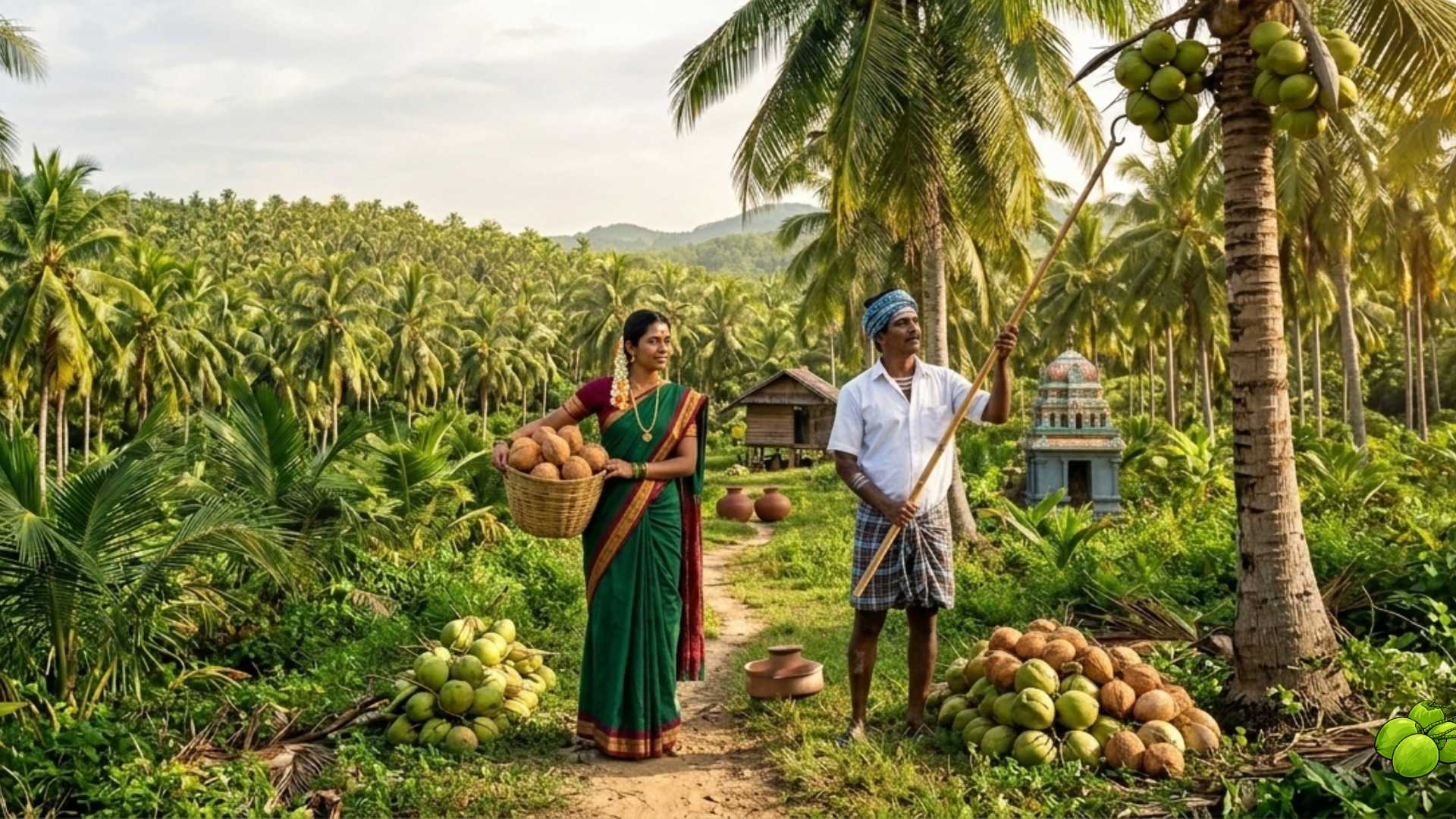
Emphasizing Sustainability in Coconut Cultivation
“Agriculture is the backbone of the Indian economy.” — Mahatma Gandhi
The Coconut Promotion Scheme (2026–27) seeks to rejuvenate old, non-productive gardens with high-yield varieties and expand coastal plantations. While welcomed by farmers, the scheme must be evaluated in the context of climate stress, disease vulnerability, institutional design failures, and value-chain constraints.
India, the world’s largest producer and consumer of coconuts, faces a paradox: high productivity but high prices, indicating structural supply-side stress rather than mere yield deficiency.
Why it matters: Coconut supports millions of smallholders in Kerala, Tamil Nadu, Karnataka, Andhra Pradesh and beyond. Its future directly affects rural livelihoods, agri-economy stability, and coastal ecosystem resilience.
I. Coconut Economy in India: Structural Overview
Key Facts
- India: Largest global producer and consumer
- Productivity per palm: Higher than Sri Lanka, Philippines, Indonesia
- Hybrid palms (Dwarf × Tall): 250–300 tender nuts/tree (Anaimalai, TN)
- Domestic prices: ~3× increase since 2024
Institutional Framework
- Coconut Development Board (CDB)
- Central Plantation Crops Research Institute (CPCRI)
- National Horticulture Board (NHB)
- Tamil Nadu Agricultural University (TNAU)
High domestic prices despite strong productivity signal supply instability, not inefficiency. Structural vulnerabilities—climate change and disease—are reducing effective output and increasing market volatility.
II. Climate Change and Agro-Ecological Stress
Projected Climate Impacts (CPCRI Research)
Temperature rise:
- 1.6–2.1°C by 2050
- Up to 3.2°C by 2070
- Increased vapour pressure deficit (VPD)
- Intensified drought stress
Regions Becoming Less Suitable
- Interior Karnataka & Andhra Pradesh
- South interior Tamil Nadu
- East coast belts
Vulnerable but Potential Zones
- Western Ghats belt (Kerala, Coastal Karnataka, Western TN)
Key Concept: Vapour Pressure Deficit (VPD) – Difference between moisture in air and maximum moisture air can hold; high VPD accelerates plant water loss.
Climate change shifts coconut from a productivity issue to a resilience issue. This links directly to India’s climate adaptation commitments under the Paris Agreement and SDG-13 (Climate Action).
III. Disease Crisis: Root Wilt and Beyond
Root Wilt Disease
- Severe in Alappuzha (Kerala), Pollachi (TN)
- Devastates plantations irreversibly
- Reduces yield and tree lifespan
Policy Implication
-
Distribution of generic high-yield seedlings is insufficient. Need:
- Wilt-tolerant varieties (West Coast)
- Heat & drought-resilient genotypes (East Coast & Interior)
Disease outbreaks represent biosecurity failures in perennial agriculture. This has implications for agricultural R&D funding, early warning systems, and decentralized research extension models.
IV. Reimagining the Coconut Promotion Scheme
1. Research & Genetic Improvement
-
Strengthen CPCRI & TNAU
-
Establish mother palm gardens
-
Mass multiplication via:
- FPOs
- Cooperatives
- Certified private nurseries
2. Input Support: DBT vs Physical Distribution
Problem:
- Substandard microbial inputs
- Poor storage reduces viability
Solution:
-
Direct Benefit Transfer (DBT)
-
Farmer autonomy in choosing:
- Irrigation
- Soil amendments
- Labour for rejuvenation
Key Governance Principle: Trust-based delivery improves efficiency.
Shifting to DBT aligns with India’s JAM architecture (Jan Dhan–Aadhaar–Mobile) and reduces leakages, strengthening cooperative federalism and fiscal prudence.
V. Value Addition: Structural Bottlenecks
Current Issues
- Production barely meets domestic demand.
- Encouraging FPO processing units without market linkage → financial risk.
- Equipment underutilization.
Policy Overlap & Confusion
- NHB’s Cluster Development Programme (₹150 crore)
- CDB’s 25% capital subsidy
- Compliance-heavy framework discourages private players
Case Study
- Banana cluster in Southern TN – largely on paper.
India’s agri-policy often suffers from scheme fragmentation and compliance overload. This reduces private participation and weakens last-mile effectiveness.
VI. Governance Lessons: “Smaller but Better”
Instead of large centralized clusters:
-
Pilot cooperative-based models
-
Marketing partnerships with established FMCG firms
-
Focused geography-based specialization:
- Tiptur – Ball copra
- Anaimalai – Tender coconuts
- Pollachi – Coconut oil
Concept: Decentralized, demand-driven cluster design
This aligns with Atmanirbhar Bharat in agriculture, promoting localized value chains rather than top-down bureaucratic architecture.
VII. Constitutional and Policy Linkages
- Article 48 – Organization of agriculture on modern scientific lines
- Directive Principles: Rural livelihood protection
- National Mission on Sustainable Agriculture (NMSA)
- SDG-2 (Zero Hunger), SDG-13 (Climate Action)
The scheme is not merely agricultural—it intersects with food security, climate justice, and rural employment stability.
VIII. Key Reform Directions
Immediate
- Develop climate-resilient, wilt-tolerant varieties
- Establish region-specific breeding programs
- Replace input distribution with DBT
Medium-Term
- Rationalize overlapping subsidies
- Simplify compliance norms
- Independent evaluation metrics
Long-Term
-
Integrate coconut strategy with:
- Climate adaptation planning
- Coastal zone management
- Agri-export policy
“Resilience is not about resisting change, but adapting wisely.”
Conclusion: Beyond Productivity to Resilience
The Coconut Promotion Scheme must move beyond yield enhancement to embrace climate resilience, disease resistance, institutional reform, and market realism.
If implemented with scientific rigor, farmer trust, and governance accountability, it can secure India’s global leadership in coconut cultivation. If not, it risks becoming another well-funded but structurally misaligned intervention.
Agricultural reform in the era of climate change must prioritize resilience over mere productivity, and institutional coherence over fiscal allocation.
Attribution
Original content sources and authors
Syllabus classification
How this article maps to GS papers
Main syllabus
GS3AgricultureQuick Q&A
What are the key objectives of the Coconut Promotion Scheme, and how does it differ from earlier interventions in the coconut sector?
Earlier interventions by the Coconut Development Board (CDB) focused on rejuvenation and expansion into non-traditional regions such as Gujarat and Assam. These efforts helped partially offset losses in traditional belts like Kerala and Tamil Nadu due to disease. However, the new scheme must move beyond mere distribution of seedlings and inputs. It should prioritize climate-resilient, drought-tolerant, and wilt-resistant varieties, especially given projections of temperature rise and increasing vapour pressure deficit.
Thus, the distinguishing challenge for this scheme lies not in boosting output alone but in addressing structural vulnerabilities — climate change, disease prevalence, and institutional design flaws in previous programmes.
Why is climate change and disease a greater concern than productivity in India’s coconut sector?
Research by the Central Plantation Crops Research Institute (CPCRI) projects temperature increases of up to 3.2°C by 2070. Higher temperatures without proportional rainfall increases will intensify drought stress. Additionally, root wilt disease has devastated plantations in regions like Alappuzha and Pollachi, threatening farmer livelihoods.
Therefore, the real crisis is not low yield but climate vulnerability and disease susceptibility. If unaddressed, productivity gains from new seedlings may be temporary. Long-term sustainability requires genetic improvement, water management innovations, and disease control mechanisms.
How can the Coconut Promotion Scheme be redesigned to ensure long-term sustainability rather than short-term output gains?
Second, implementation should move from centralized input distribution to Direct Benefit Transfers (DBT). Many subsidy-driven input schemes fail due to poor storage and substandard biological products. Trusting farmers to allocate resources — whether for irrigation, soil amendments, or labour — can enhance efficiency.
Finally, smaller pilot clusters in regions like Tiptur (copra) or Pollachi (oil) with marketing partnerships involving FMCG firms can provide scalable models. Sustainability depends on aligning production, resilience, and market integration.
Critically analyse the performance of cluster-based value addition programmes in the coconut sector.
The experience of idle processing equipment and the underperformance of schemes like the banana cluster in southern Tamil Nadu illustrate structural weaknesses. Large, centrally designed clusters often overlook local realities, seasonal supply variations, and marketing linkages.
Moreover, overlapping subsidy schemes (e.g., CDB’s 25% capital subsidy) create confusion and redundancy. While cluster development has theoretical merit, its execution must be decentralized, demand-driven, and supported by assured marketing channels. Otherwise, it risks becoming a paper-based achievement rather than a transformative intervention.
As a policy advisor visiting Pollachi or Alappuzha, how would you assess ground realities and suggest corrective measures?
Corrective measures would include:
- Mass multiplication of wilt-tolerant varieties
- Community-based disease management programmes
- Localized irrigation support to counter drought stress
Long-term resilience would require integrating research, farmer cooperatives, and market partnerships. Policies must reflect ground realities rather than relying solely on official reports. A bottom-up, consultative approach can ensure that the scheme addresses real crises rather than cosmetic productivity targets.
What lessons can be drawn from the expansion of coconut cultivation into non-traditional areas like Gujarat and Assam?
This example highlights the importance of scientific mapping and flexible policy design. It also underscores the need for region-specific varietal selection rather than uniform seed distribution. However, expansion alone cannot compensate for systemic disease outbreaks in core regions.
Thus, while geographical diversification is a useful strategy, it must complement — not substitute — efforts toward climate resilience, disease resistance, and institutional reform in traditional coconut-growing zones.
Practice questions
1 question for mains preparation