INTRODUCTION
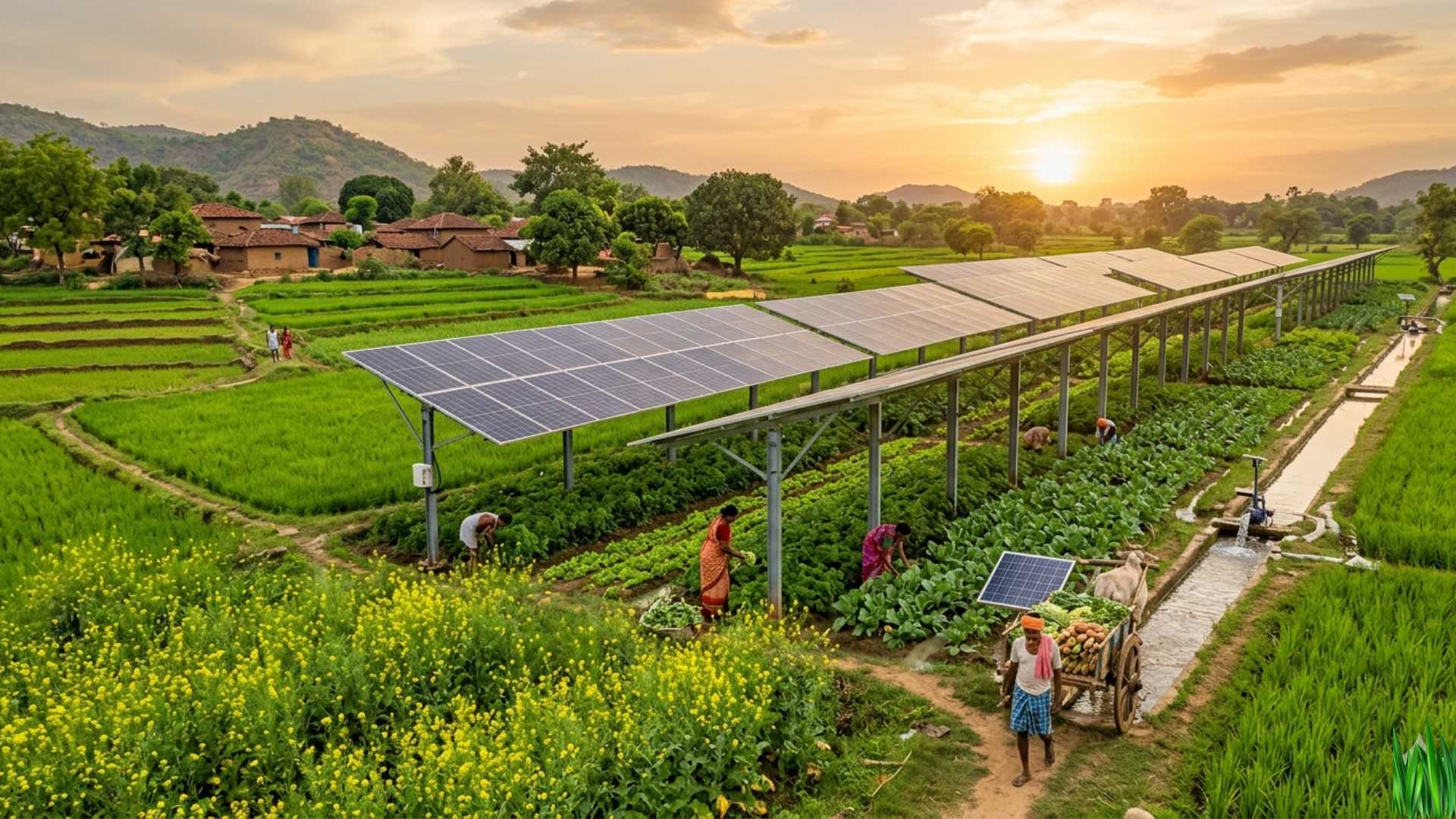
India’s target of 300 GW solar capacity by 2030 and its commitment to net-zero by 2070 have intensified pressure on land resources. With over 50% of land under agriculture, balancing energy expansion with food security is a critical policy challenge. The PM-KUSUM scheme (₹5,000 crore in 2026–27) reflects a renewed push toward decentralised solarisation. In this context, Agri-Photovoltaics (AgriPV) emerges as an innovative solution enabling dual use of land for both farming and energy generation.
BACKGROUND: PM-KUSUM SCHEME
The PM-KUSUM scheme aims to promote solar energy in the agricultural sector through decentralised interventions.
- Provides solar pumps and decentralised solar plants
- Enhances farmer income through sale of surplus electricity
- Reduces dependence on diesel and grid electricity
- Promotes energy access and sustainability in rural areas
CONCEPT OF AGRI-PHOTOVOLTAICS (AgriPV)
AgriPV refers to the integration of solar photovoltaic systems with agricultural activities on the same land.
- Solar panels are mounted above or between crops
- Enables simultaneous crop production and electricity generation
- Optimises land use efficiency
Quote: “AgriPV represents a shift from land-use competition to land-use synergy” — IRENA
TYPES OF AGRI-PV SYSTEMS
| Type | Description | Suitability |
|---|---|---|
| Elevated Systems | Panels mounted at height above crops | Suitable for mechanised farming |
| Row-based Systems | Panels placed between crop rows | Suitable for mixed cropping |
| Vertical Systems | Upright panels capturing sunlight from both sides | Suitable for arid regions |
| Greenhouse-integrated | Panels integrated with greenhouse structures | Suitable for horticulture |
CROP SELECTION AND AGRO-CLIMATIC SUITABILITY
Crop selection is crucial due to variation in sunlight availability under solar panels.
- Shade-tolerant crops perform well under panels
- Sunlight-intensive crops grow better between panel rows
- Requires region-specific planning based on climate and irrigation
| Region | Suitable Crops |
|---|---|
| Madhya Pradesh | Tomato, onion, garlic, turmeric, tulsi |
| Karnataka & Maharashtra | Ragi, jowar, grapes, banana, brinjal |
SIGNIFICANCE OF AGRI-PV IN INDIA
AgriPV offers multiple economic, environmental, and developmental benefits.
- Enhances farmer income through diversified revenue streams
- Reduces land-use conflict between agriculture and solar projects
- Improves water-use efficiency by reducing evapotranspiration
- Protects crops from extreme weather conditions
- Supports rural infrastructure like cold storage and food processing
- Contributes to decarbonisation of the farm sector
BUSINESS MODELS IN AGRI-PV
Various institutional arrangements can support AgriPV deployment.
- Farmer-owned systems enabling self-consumption and power sales
- Cooperative/FPO-based aggregation improving access to finance
- Developer-led models based on leasing and revenue sharing
- State-led models supporting local energy needs
CURRENT STATUS IN INDIA
AgriPV is currently in a nascent stage with limited large-scale deployment.
- Around 50 pilot projects across different states
- Ongoing evaluation of crop compatibility and economic feasibility
- Lack of large-scale replication due to limited empirical evidence
CHALLENGES IN SCALING AGRI-PV
Several economic, technical, and regulatory barriers hinder widespread adoption.
- High capital costs due to specialised structures
- Uncertainty in crop yield under shaded conditions
- Lack of standardised design and technical benchmarks
- Regulatory ambiguity in land classification and tariffs
- Issues related to land ownership and revenue-sharing agreements
- Limited access to finance and institutional support
POLICY MEASURES AND WAY FORWARD
Scaling AgriPV requires targeted policy interventions and institutional support.
- Inclusion under PM-KUSUM 2.0 framework
- Proposal for National Agri-Photovoltaics Mission (10 GW target)
- Provision of viability gap funding (VGF)
- Clear regulatory frameworks for land use and tariffs
- Promotion of cluster-based development models
- Capacity building through farmer training and extension services
COMPARISON: TRADITIONAL SOLAR VS AGRI-PV
| Parameter | Traditional Solar | Agri-PV |
|---|---|---|
| Land Use | Single-purpose | Dual-purpose |
| Farmer Role | Passive | Active |
| Income | Limited | Diversified |
| Environmental Impact | Neutral | Positive |
CONCLUSION
AgriPV presents a viable pathway to reconcile India’s competing demands of energy expansion and food security. With robust policy support, financial incentives, and region-specific planning, it can evolve from pilot projects into a scalable model. Its integration into PM-KUSUM 2.0 can strengthen rural livelihoods while advancing India’s clean energy transition.
UPSC MAINS QUESTION (15 MARKS)
“Agri-photovoltaics (AgriPV) offers a sustainable solution to the land-use conflict between agriculture and renewable energy expansion in India.” Critically examine.