1. Apple Cultivation in Kashmir: Agro-Climatic Context and Economic Significance
Kashmir is one of India’s most important temperate fruit-growing regions, with apple cultivation spread across diverse altitudes ranging from 1,500 m to over 2,600 m above sea level. These altitude variations create distinct microclimates that directly influence flowering, fruit set, and yield. Apple trees require adequate winter chilling hours, protection from frost, and sufficient summer heat accumulation, making altitude a decisive production factor.
Apple is cultivated over 1.08 lakh hectares in the region, producing approximately 11 lakh tonnes annually and supporting the livelihoods of nearly 27 lakh people. This makes apple cultivation not merely an agricultural activity but a socio-economic backbone of the valley.
However, despite having one of the largest apple-growing areas in India, productivity remains modest compared to developed apple-growing regions. The structural inefficiencies in orchard design, planting material, and management systems have constrained yield potential.
The governance logic here is clear: when a crop sustains millions yet underperforms in productivity, systemic reform becomes essential. Ignoring altitude-specific management and structural inefficiencies risks income stagnation, rural distress, and reduced competitiveness in national and global markets.
Key Statistics:
- Area under apple: 1.08 lakh ha
- Production: 11 lakh tonnes
- Livelihood dependence: 27 lakh people
- Altitude range: 1,500–2,600+ m
2. Structural Bottleneck: Traditional Seedling-Based Orchards
For decades, apple orchards in Kashmir have been dominated by seedling-based trees. These trees are tall, vigorous, widely spaced, and slow to bear fruit, often taking 6–8 years to produce commercial yields. Average productivity remains limited to 10–12 tonnes per hectare.
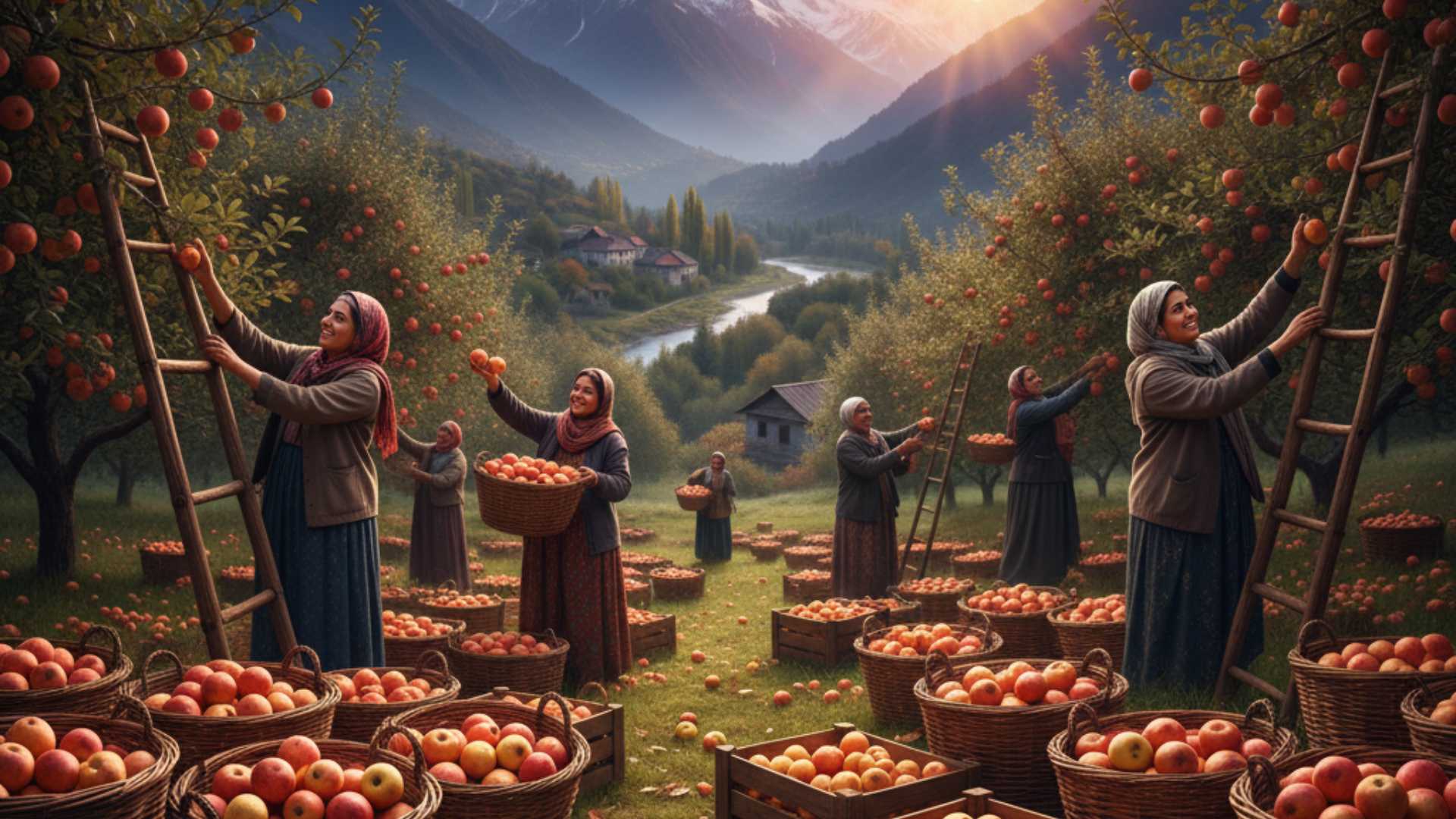
Such orchards require heavy pruning, ladder-based harvesting, and intensive labour. Dense canopies restrict uniform pesticide spraying, aggravating pest and disease pressure. For small and fragmented landholdings, low-density planting leads to inefficient land utilisation and low returns.
Rising labour costs, delayed income realisation, and vulnerability to climatic stress have made traditional orcharding increasingly unviable. Consequently, the region is witnessing a gradual shift toward modern clonal rootstock-based systems.
"These trees take 6–8 years to produce a commercial crop and yield just 10–12 tonnes per hectare, making them unviable for small landholdings." — Dr. Wasim Hassan Raja
The developmental implication is that delayed returns reduce capital turnover for farmers, increasing vulnerability to shocks. If traditional systems persist without reform, smallholders may exit cultivation or face declining profitability.
Challenges of Traditional Systems:
- Long gestation period (6–8 years)
- Low productivity (10–12 t/ha)
- High labour intensity
- Poor pest management efficiency
- Inefficient land use
3. Rootstock Innovation and High-Density Orchards
Modern high-density orchards are based on clonal rootstocks such as M-9, MM-106, and MM-111. Rootstock forms the foundational root system and lower trunk, determining tree size, precocity, disease resistance, and yield efficiency.
Dwarf clonal rootstocks like M-9 significantly reduce tree height, enhance uniformity, and accelerate fruit-bearing to 2–4 years. Productivity can increase up to 40 tonnes per hectare, with better fruit colour, size uniformity, and marketability.
Clonal propagation ensures genetic uniformity, facilitating standardised canopy management and improved input efficiency. These systems represent a technological shift from land-extensive to land-efficient horticulture.
"Dwarf clonal rootstocks like M-9… can raise productivity to 40 tonnes per hectare and yield marketable fruit within 2–4 years." — Dr. Raja
The policy relevance lies in transforming horticulture from subsistence-oriented to commercially competitive. Failure to adopt improved rootstocks could leave farmers exposed to global competition and climate volatility.
Comparative Productivity:
- Traditional: 10–12 t/ha
- High-density (M-9 based): up to 40 t/ha
- Fruiting begins: 2–4 years (vs. 6–8 years)
4. Climate Change and the Need for Altitude-Specific Research
Kashmir’s apple production is climate-sensitive. Declining snowfall and warmer winters threaten the accumulation of required chilling hours, potentially affecting flowering and fruit set.
Dwarf clonal rootstocks offer relative resilience to erratic rainfall, heat stress, and soil-borne diseases such as root rot and collar rot. However, systematic altitude-specific studies on rootstock performance remain limited, even as climate zones shift within the valley.
Research institutions like ICAR-CITH are developing indigenous rootstocks tolerant to drought, temperature fluctuations, and replant stress, with some nearing release.
The governance challenge is anticipatory adaptation. Without climate-responsive varietal research and microclimatic mapping, productivity may decline as ecological thresholds shift.
Climate Concerns:
- Reduced chilling hours
- Erratic rainfall
- Heat stress
- Soil-borne diseases
5. Economic Viability and Adoption Constraints
Despite introduction in 1989–90, modern high-density orchards remain limited, with only 836 hectares covered under the High-Density Plantation scheme in J&K.
The main constraints include:
- High capital cost (approx. ₹1.75 lakh per kanal for M9-based systems)
- Limited availability of quality clonal rootstocks
- Need for trellising and staking infrastructure
- Requirement of technical expertise
Government interventions under:
- Mission for Integrated Development of Horticulture (MIDH)
- Holistic Agriculture Development Program
have provided subsidies, nursery strengthening, and financial assistance to improve adoption.
High upfront investment creates entry barriers for smallholders. Without institutional support and credit access, technological transition may remain confined to progressive farmers.
Scheme Coverage:
- Area under high-density plantation: 836 ha
- Investment: ₹1.75 lakh per kanal
6. Farm-Level Transformation: Income and Productivity Gains
Case studies from Anantnag and Budgam districts illustrate tangible economic benefits. High-density orchards can yield up to 4 tonnes per kanal, compared to 1 tonne per kanal in conventional systems.
By the third year, a single M9 tree may produce 2.5 boxes, generating profits of approximately ₹1.5 lakh per kanal (excluding expenses). Gala apples fetch ₹900–1,500 per box, depending on quality.
However, these systems require precision management—trickle irrigation, fertigation, canopy training (modified central leader system), branch bending, and professional pruning. Mismanagement can sharply reduce productivity.
The lesson is that technology adoption must be accompanied by capacity building. High-density orchards are knowledge-intensive; without training and extension support, expected yield gains may not materialise.
Yield Comparison:
- Conventional: 1 tonne/kanal
- High-density: up to 4 tonnes/kanal
Market Prices:
- ₹900–1,500 per box
- Profit potential: ₹1.5 lakh per kanal
7. Way Forward: Sustainable Intensification of Horticulture
Kashmir’s apple sector is at a structural transition point—from extensive, seedling-based orchards to intensive, high-density, climate-resilient systems. Institutional research, subsidy support, and farmer training are critical to scaling this transformation.
Future priorities include:
- Development of indigenous climate-resilient rootstocks
- Altitude-specific performance mapping
- Expansion of nursery infrastructure
- Skill-based extension services
- Strengthened credit and insurance frameworks
Sustainable intensification of apple cultivation can enhance farmer incomes, optimise land use, and strengthen India’s competitiveness in temperate horticulture.
Conclusion
The shift to clonal rootstocks and high-density orchards in Kashmir reflects a broader paradigm of technology-driven agricultural transformation. Aligning research, policy support, and farmer capacity-building will determine whether the region moves from area dominance to productivity leadership in apple cultivation.
A climate-resilient, knowledge-intensive horticulture system can secure rural livelihoods while ensuring long-term ecological and economic sustainability.