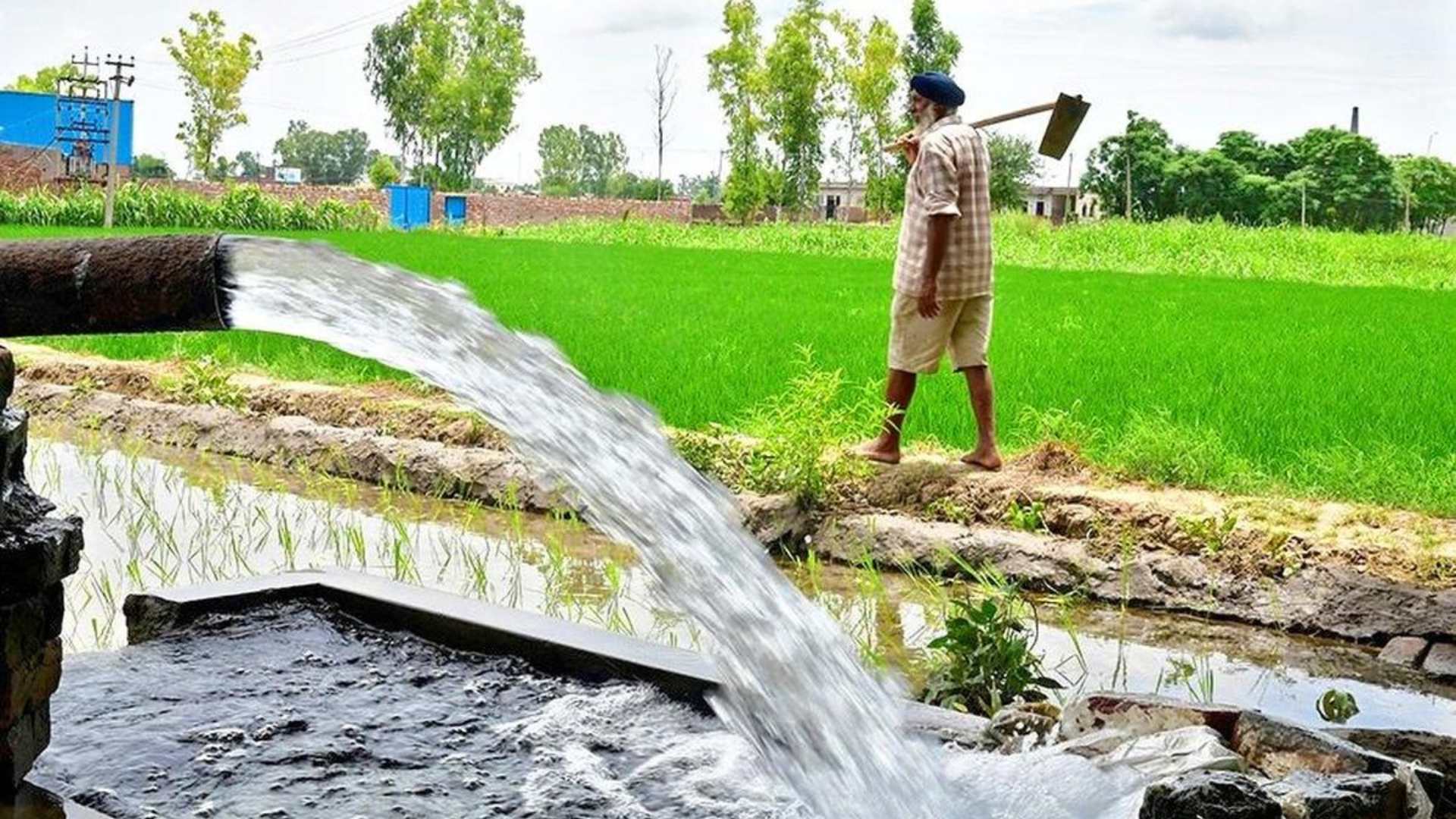
Water-Energy-Food Nexus: India's Triple Crisis

Introduction
1. The Global Warning
"The global food system is fundamentally misaligned with hydrological realities." — World Bank, Nourish and Flourish (2025)
Current agricultural water systems can sustainably support food production for only one-third of the projected global population by 2050 if inefficiencies persist. The crisis is not absolute scarcity — it is systemic mismanagement of water within food systems.
2. India's Paradox
"India is effectively a water-stressed food exporter — growing thirsty crops in depleted regions and shipping the water abroad invisibly."
India produces water-intensive crops like rice and sugarcane in groundwater-stressed zones, exporting vast volumes of virtual water while depleting domestic aquifers. Punjab and Haryana's groundwater tables are falling at over 1 metre annually — driven not by drought, but by free electricity that makes extraction artificially costless.
3. The Energy Dimension
"Energy systems underpin food and water security far more than policy frameworks typically acknowledge." — IEA, Sheltering from Oil Shocks (2026)
India imports 85–90% of its crude oil. The IEA's 2026 plan warns that energy disruptions cascade rapidly into food and water crises — making energy demand management as critical to food security as irrigation infrastructure itself.
Key Data
| Dimension | Data Point |
|---|---|
| Global food system sustainability | Only ~1/3 of 2050 projected population supportable under current inefficiencies |
| Global agriculture spending (2023) | ₹55 lakh crore total — yet only ₹2.2 lakh crore directed to irrigation infrastructure |
| India's crude oil import dependency | 85–90% of requirement |
| Annual agriculture electricity subsidy (India) | ₹1.5 lakh crore+ |
| Punjab/Haryana groundwater decline | Exceeds 1 metre annually |
| Poverty reduction potential | 10% agri productivity gain → up to 3% poverty reduction |
The Core Paradox: Mismanagement, Not Scarcity
The World Bank's Nourish and Flourish identifies the crisis as systemic misalignment — not shortage. Globally, of ₹55 lakh crore spent on agriculture in 2023, only ₹2.2 lakh crore went toward irrigation infrastructure. The bulk of spending perpetuates inefficient production rather than building water-resilient systems. India mirrors this globally skewed priority.
This is a classic nexus failure:
- Free/subsidised electricity → zero marginal cost → unbounded groundwater extraction
- Agricultural incentives lock farmers into water-intensive crop choices
- Energy policy inadvertently drives water depletion
- Governance silos prevent any single ministry from seeing — or solving — the full picture
The IEA Dimension: Energy Shocks Cascade into Food Crises
The IEA's Sheltering from Oil Shocks plan reveals a chain of vulnerability that agricultural policy rarely accounts for:
Oil shock → higher diesel prices → costlier irrigation & food transport → power shortages → disrupted farm operations → food price inflation → fiscal stress on import bill → wider macroeconomic instability
The IEA's specific demand-side measures — promoting remote work, reducing non-essential travel, improving transport efficiency — may appear urban-centric, but their agricultural implication is systemic: when urban oil demand falls during a crisis, it eases inflationary pressure on diesel, stabilises rural input costs, and indirectly protects farmer margins.
This reframes the problem: energy demand management in cities is not separate from food security in villages — it is part of the same resilience architecture.
Analytical Sections
① Why Current Policy Fails
- Fragmented governance: Water, energy, and agriculture ministries operate in silos — no single institution sees the full nexus
- Perverse incentives: Subsidised electricity makes groundwater extraction artificially cheap; farmers have no signal to conserve
- The solar trap: PM-KUSUM promotes solar-powered pumps — but zero marginal cost energy, whether from subsidies or solar, can lead to equal or greater overuse if not governed by smart metering, water accounting, and grid-linked controls
- Misallocated fiscal spending: Of ₹1.5 lakh crore+ in annual agri electricity subsidies, a significant share deepens inefficiency rather than building resilience
- The fiscal-inflation chain: Inefficient water use amplifies energy vulnerability → oil shocks raise import bill → fiscal deficit widens → inflation rises → food insecurity deepens. Each link in this chain is a policy failure point
- Climate amplification: Erratic monsoons + oil shocks = compounded, simultaneous vulnerability across all three systems
② The Way Forward (Integrated Framework)
| Reform Pillar | Specific Intervention |
|---|---|
| Crop diversification | Shift water-intensive crops out of stressed zones; reduces both water demand and irrigation energy load |
| Energy-water pricing reform | Replace free electricity with targeted DBT + smart metering; restores economic signals without harming farmer incomes |
| Precision irrigation + governed solar | PM-KUSUM + smart controls + water accounting + grid-linked incentives to prevent zero-cost overuse |
| Urban demand management | Remote work, public transport, efficient logistics → reduces oil demand → stabilises agri input costs and inflation |
| Nexus governance | Integrated institutional framework linking water, energy, and agriculture ministries with shared data systems and planning processes |
Attribution
Original content sources and authors

Syllabus classification
How this article maps to GS papers
Main syllabus
GS3AgricultureQuick Q&A
What is meant by the Water-Energy-Food (WEF) nexus, and how is it reflected in India’s current development trajectory?
India’s current development model reflects significant nexus imbalances. For instance, subsidised electricity for irrigation has led to excessive groundwater extraction, especially in states like Punjab and Haryana. This has encouraged the cultivation of water-intensive crops such as rice in ecologically unsuitable regions. Simultaneously, irrigation systems rely heavily on electricity and diesel, linking agricultural productivity to energy availability and pricing.
The nexus also manifests in India being a ‘virtual water exporter’, where it exports water-intensive crops despite domestic water stress. This indicates a misalignment between resource endowments and production patterns. Therefore, understanding the WEF nexus is essential for designing integrated policies that ensure sustainable resource use, economic growth, and long-term resilience against climate and energy shocks.
Why is India described as a ‘water-stressed food exporter’, and what are the implications of this paradox?
The implications of this paradox are multifaceted. First, it leads to ecological degradation, particularly in states like Punjab and Haryana, where groundwater levels are falling at alarming rates (often over one metre annually). Second, it distorts resource allocation by incentivising crops that are not aligned with regional agro-climatic conditions. Third, it increases India’s vulnerability to climate change, as water-intensive agriculture becomes unsustainable under erratic monsoon patterns.
Economically, this model is inefficient because it relies on hidden subsidies, such as free electricity for irrigation, which impose a heavy fiscal burden. Strategically, it weakens long-term food and water security. Addressing this paradox requires crop diversification, rational pricing mechanisms, and aligning agricultural policies with ecological realities.
How do energy policies, particularly electricity subsidies, influence groundwater depletion in India?
This dynamic is particularly visible in states like Punjab and Haryana, where the Green Revolution entrenched the cultivation of water-intensive crops. Farmers use electric pumps extensively to irrigate fields, often extracting more water than is naturally replenished. This creates a ‘tragedy of the commons’ scenario, where individual incentives lead to collective resource depletion.
The issue is further compounded by the absence of metering and pricing mechanisms. Without accurate measurement of electricity use, it becomes difficult to regulate consumption or promote efficiency. Reforming this system through Direct Benefit Transfers (DBT), smart metering, and rational pricing can restore economic signals while protecting farmer incomes. Such measures can align energy use with sustainable water management, addressing the nexus challenge holistically.
What are the potential impacts of global oil shocks on India’s food and water security systems?
This directly affects agricultural production costs, as farmers rely on diesel-powered pumps and machinery. Higher fuel costs can reduce profitability, discourage cultivation, and ultimately impact food supply. Additionally, oil shocks can lead to power shortages, as energy systems face constraints, further disrupting irrigation and agricultural operations.
The ripple effects extend to the broader economy, contributing to inflation, fiscal stress, and supply chain disruptions. For example, increased transportation costs can raise food prices, affecting urban and rural consumers alike. The IEA’s emphasis on demand-side management—such as reducing non-essential travel and improving efficiency—highlights the need for systemic resilience. Thus, oil shocks are not merely energy concerns but critical threats to food and water security.
Can you provide a real-world example illustrating the failure of integrated resource management in India?
This situation is driven by a combination of policy distortions. Minimum Support Price (MSP) incentives encourage rice production, while free electricity for irrigation enables excessive groundwater extraction. The absence of effective water pricing or regulation exacerbates the problem. As a result, groundwater levels are declining rapidly, threatening long-term agricultural sustainability.
This case highlights the consequences of managing water, energy, and agriculture in silos. While each policy aims to achieve a specific objective—food security, farmer welfare, or energy access—their combined effect is unsustainable. It underscores the need for a nexus-based approach that aligns incentives across sectors, promotes crop diversification, and ensures sustainable resource use.
Critically analyse the role of subsidies in agriculture in addressing or aggravating the WEF nexus crisis in India.
However, these subsidies often create perverse incentives. For example, free electricity encourages excessive groundwater extraction, while fertiliser subsidies can lead to soil degradation and water pollution. The scale of these subsidies is also significant, with India spending over ₹1.5 lakh crore annually on electricity subsidies alone. This represents a substantial fiscal burden with limited long-term sustainability benefits.
A more effective approach would involve targeted and efficient subsidy mechanisms, such as Direct Benefit Transfers (DBT), which provide financial support without distorting resource use. Additionally, investments in irrigation infrastructure, precision farming, and sustainable practices can yield better outcomes. Thus, while subsidies are necessary, their design and implementation must be reformed to align with sustainability goals.
How can India adopt a nexus-based policy framework to enhance resilience? Illustrate with a policy-oriented approach.
Another critical intervention is energy-water pricing reform. Implementing smart metering and Direct Benefit Transfers (DBT) can ensure that farmers receive financial support without incentivising overuse of resources. Additionally, investments in precision irrigation technologies, such as drip and sprinkler systems, can significantly improve water-use efficiency.
A practical example is the PM-KUSUM scheme, which promotes solar-powered irrigation. However, to avoid over-extraction due to zero marginal cost energy, it must be combined with water accounting and grid-linked incentives. Furthermore, urban demand-side measures—such as improving public transport and logistics efficiency—can reduce oil dependence, indirectly supporting agricultural stability. Overall, a nexus-based framework requires coordinated governance, data integration, and long-term planning to ensure sustainable development.
Practice questions
2 questions for mains preparation