Understanding the Consumer Price Index and Its Impact on Inflation

Learn how the Consumer Price Index (CPI) influences retail inflation and reflects consumer spending trends in India.
S
Surya
4 mins read
Understanding India’s Consumer Price Index
Not Started

1. Understanding the Consumer Price Index (CPI)

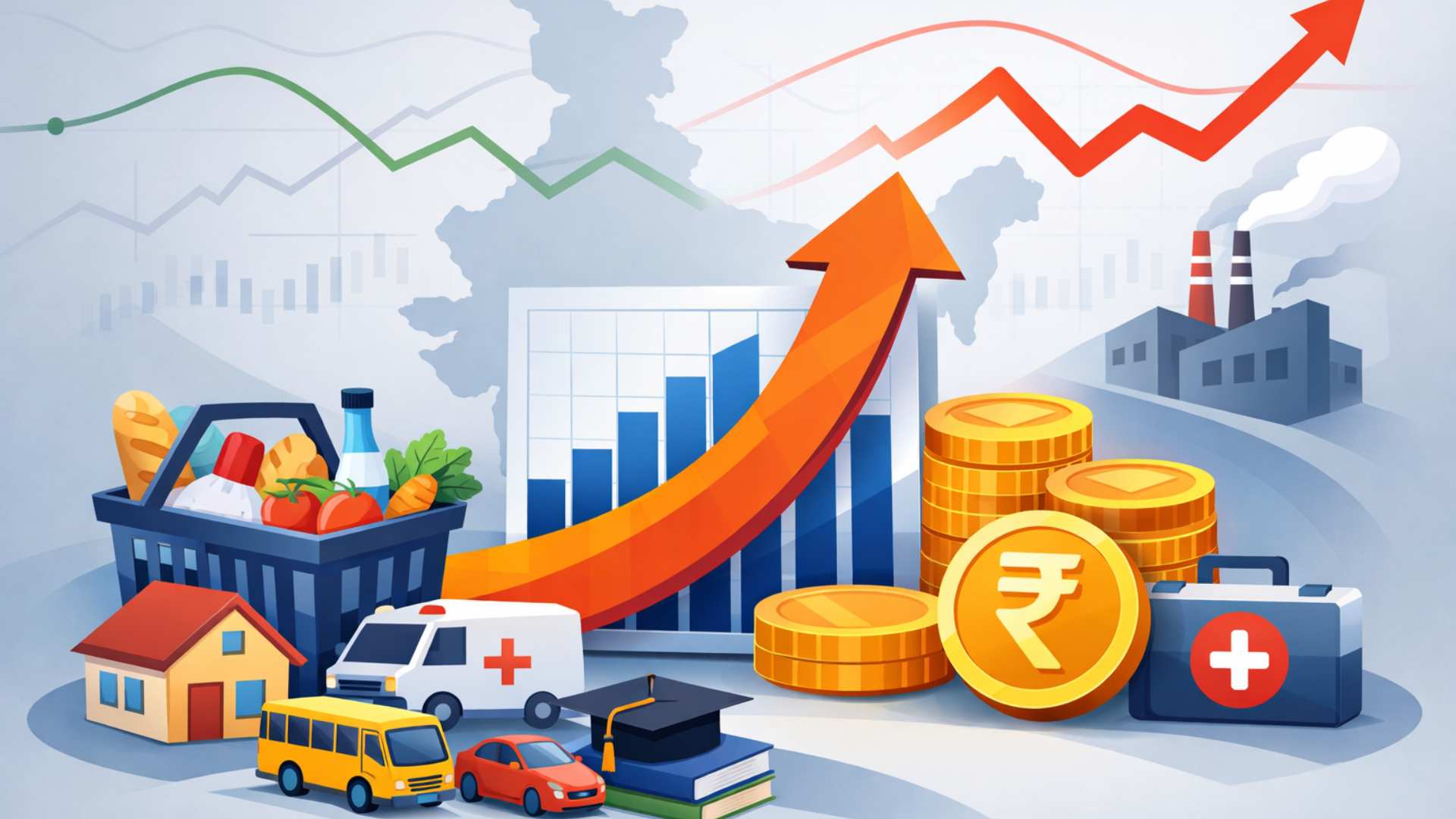
The Consumer Price Index (CPI) measures the change in prices of a fixed basket of goods and services consumed by households, including food, housing, transport, healthcare, education, and more. The year-on-year percentage change in this index is commonly referred to as retail inflation.

A rising CPI indicates that households must spend more to maintain the same standard of living, whereas a decline signals deflation, where the overall cost of the basket falls. CPI is calculated separately for rural and urban areas, and then aggregated to produce the all-India headline inflation rate, which serves as a key macroeconomic indicator for policymakers.

Monitoring CPI is essential for governance and economic policy as it directly affects monetary policy, social welfare programmes, and household purchasing power. Ignoring CPI trends can result in delayed policy responses and erosion of real incomes.


2. Headline Inflation and Alternative Measures

The headline CPI inflation reflects the year-on-year change in overall prices, providing a snapshot of broad price trends. However, India also tracks:

  • Wholesale Price Index (WPI): Measures prices at the wholesale level, capturing producer-side inflation.
  • CPI-IW: Tracks prices for industrial workers, used to calculate dearness allowance.
  • CPI-AL and CPI-RL: Track prices for agricultural and rural labourers, informing wage and welfare policies.

These indices supplement the CPI, allowing the government to tailor welfare programmes and wage adjustments across sectors and regions.

Using multiple inflation gauges ensures that policy interventions are responsive to sector-specific and demographic realities. Over-reliance on headline CPI alone can mask local or occupational disparities.

Comparative examples:

  • CPI-IW: Industrial workers’ cost of living
  • CPI-RL: Rural labour wage adjustments
  • CPI-AL: Agricultural labour welfare

3. Methodology of CPI Computation

CPI calculation is based on anchoring each basket item to a base year value of 100. Market-level prices are collected monthly across regions, then weighted according to household consumption patterns to produce a single CPI value.

The weightage of items reflects average expenditure shares, with the highest allocation typically given to food and beverages, followed by housing, fuel, light, transport, healthcare, education, and other services. CPI numbers can be revised marginally as more accurate data becomes available.

Accurate CPI computation is critical for economic planning, wage adjustments, and social policy. Miscalculations can distort inflation targeting, erode purchasing power, and affect credibility of economic statistics.

Key methodological points:

  • Base-year index set at 100
  • Monthly price collection across rural and urban markets
  • Weighted aggregation based on household spending patterns

4. Regional Variations in Inflation

CPI captures national average trends, but inflation experience varies across states and regions. For instance, in December 2025, all-India retail inflation was 1.33%, while Kerala recorded 9.49%, and Assam experienced -1.25%, reflecting deflation.

Such disparities arise due to regional differences in supply, demand, and consumption patterns, highlighting the importance of state-specific CPI data for policy design. This granularity informs targeted interventions in social welfare, subsidies, and regional economic planning.

Understanding regional CPI differences ensures equitable economic policy. Ignoring state-level variations can worsen inequalities and undermine the effectiveness of welfare and monetary measures.


5. Updates in CPI Base Year and Weightages

India’s all-India CPI has been revised twice, with the current index using 2012 as the base year. The CPI basket mirrors typical household spending patterns, assigning highest weight to food and beverages, with lower shares for services.

The CPI for January 2026 will adopt 2024 as the new base year, reflecting updated spending patterns over the past decade. The revision will increase weightages for services and reduce food’s share, aligning the index with contemporary consumption trends.

Updating the base year ensures CPI remains representative of current consumption habits. Failure to revise the base year can distort inflation measurement, affecting monetary policy, wages, and social transfers.

Key changes:

  • Base year updated to 2024
  • Services weight increased
  • Food and beverages weight reduced

6. Implications for Policy and Governance

CPI and its derivatives inform monetary policy, fiscal transfers, wage adjustments, and social protection schemes. Accurate, timely, and regionally disaggregated CPI data enables:

  • Targeted price stabilization policies
  • Efficient welfare allocation through schemes like PM-KISAN, PDS, and pensions
  • Adjustments in interest rates and dearness allowance
  • Monitoring inflationary pressures affecting the poor and vulnerable

Reliable CPI data underpins inclusive economic governance. Neglecting its accuracy or regional variations can lead to misaligned policies, eroded purchasing power, and inequitable resource distribution.


7. Conclusion

The CPI is a cornerstone of India’s economic statistics, translating complex market price changes into actionable policy insights. With the 2024 base year update, the index will better capture current household spending patterns, enhancing the effectiveness of inflation monitoring, welfare programmes, and macroeconomic management.

"Inflation is taxation without legislation." — Milton Friedman

Accurate CPI tracking is vital for monetary stability, social equity, and economic planning, reinforcing the role of data-driven governance in India.

Quick Q&A

Everything you need to know

Definition and purpose: The Consumer Price Index (CPI) is a key economic indicator that tracks the price changes of a fixed basket of goods and services consumed by households, including food, housing, transport, healthcare, and education. By comparing the current prices of these items with a base-year value, the CPI provides a measure of how the cost of living changes over time.

Importance: CPI is crucial for policy-making and economic analysis. It serves as the primary gauge for retail inflation, which reflects how much more or less households have to spend to maintain the same standard of living. For example, if CPI rises year-on-year, it signals that the average consumer needs to spend more to maintain their lifestyle, prompting potential adjustments in interest rates, subsidies, and social welfare programs.

Broader relevance: CPI also informs wage adjustments, pensions, and government welfare schemes, ensuring that purchasing power is protected. The CPI’s role extends beyond macroeconomic monitoring to influencing fiscal and monetary policy decisions, making it a critical tool in India’s economic management.

Differential consumption patterns: The all-India CPI represents an aggregated measure, but households in different states or regions spend their income on different goods and services in varying proportions. For example, food might dominate expenditure in rural areas, whereas urban households may spend more on housing and services. These differences can lead to divergent inflation experiences.

Regional price dynamics: Prices for goods and services are influenced by local supply-demand conditions, transportation costs, and policy interventions like subsidies or taxes. As a result, in December 2025, while India’s retail inflation was 1.33%, Kerala experienced a price rise of 9.49%, whereas Assam saw a deflation of 1.25%. This demonstrates that residents in different regions may perceive inflation very differently from the national headline figure.

Policy implications: Understanding regional variations is critical for state-specific interventions, such as targeted food subsidies or social welfare programs. It also highlights the importance of state-level CPI indices in accurately capturing the lived experience of households and informing both central and state government policy decisions.

Calculation methodology: The CPI is calculated by assigning each item in the consumption basket a weight based on household expenditure patterns. India’s statistical machinery collects price data for each product across urban and rural areas every month. These prices are then compiled using the weights to produce an index value for each month.

Base year anchoring: The CPI uses a base year to standardize comparisons, with the index set at 100 in that year. For instance, the current CPI was based on 2012 until recently. In February 2026, it will be updated to 2024 as the base year to reflect changes in consumption patterns over the last dozen years, including higher spending on services and relatively lower weight for food.

Updates and revisions: Periodic revisions ensure that CPI reflects current consumption trends, changes in market prices, and emerging services. While revisions generally have fractional effects, they are essential to maintain the accuracy and relevance of inflation measurement, ensuring policymakers and economists have reliable data for decisions on interest rates, subsidies, and social welfare schemes.

Reasons for base year update: Consumption patterns evolve over time due to changes in income, technology, lifestyle, and urbanisation. Using an outdated base year may misrepresent the actual inflation experienced by households. For example, services such as healthcare, education, and transport now account for a larger share of household spending compared to a decade ago. Updating the base year to 2024 aligns the CPI with contemporary consumption habits.

Implications for policy: A revised base year affects the weights assigned to various components, changing the headline inflation figure. Policymakers use these figures to adjust interest rates, subsidies, and welfare payments. For instance, a higher weight for services may increase the measured inflation if service costs rise faster than food prices.

Wider economic effects: Updating the base year ensures that wage negotiations, pension adjustments, and social programs like MGNREGA or food subsidies reflect the real cost of living. It improves the accuracy of economic planning and enhances the credibility of inflation targeting by the Reserve Bank of India.

Aggregate nature: The CPI provides a national average, which may not capture regional or demographic disparities. As noted, inflation in Kerala in December 2025 was 9.49%, whereas Assam saw a deflation of 1.25%. Such variations highlight that CPI may not fully reflect the lived experience of all households.

Weighting and coverage limitations: CPI assigns fixed weights to items based on surveys, but rapid changes in consumption patterns or the emergence of new goods and services may lag in inclusion. Additionally, CPI primarily reflects retail prices and may not capture wholesale or input price shocks that affect producers, indirectly influencing consumer prices later.

Policy implications: While CPI is essential for monetary and fiscal policy, its limitations require policymakers to supplement it with other indicators such as WPI, CPI-IW, and state-specific CPIs. This ensures balanced decisions on interest rates, subsidies, and social welfare schemes, mitigating the risk of policies that overlook regional or sectoral disparities.

Wholesale Price Index (WPI): Tracks prices at the wholesale level and captures inflation in goods before reaching retail markets. It is useful for analyzing producer-level inflation, supply-side shocks, and their potential transmission to consumers.

CPI-IW: Measures price changes faced by industrial workers and is used to calculate dearness allowances in organized industry. It ensures that wage adjustments keep pace with inflation for workers.

CPI-AL and CPI-RL: Track price trends for agricultural and rural labourers, respectively, informing rural wage adjustments and social welfare program planning. For example, these indices guide minimum wage calculations and public distribution system benefits.

Implications: These indices complement the headline CPI, allowing policymakers to target interventions for specific groups, sectors, and regions, thereby enhancing the effectiveness of inflation control and welfare measures.

Scenario description: Suppose the all-India CPI shows 2% inflation, but states like Kerala and Punjab experience 8–9% inflation due to local factors such as supply bottlenecks, higher service costs, or agricultural shocks. A national average would understate the pressure faced by households in these regions.

Policy response: Policymakers should complement the headline CPI with state-specific indices to target interventions. For instance, targeted subsidies on essential commodities, region-specific price support schemes, or adjustments in state-level minimum wages can help mitigate the impact of local inflation.

Broader lesson: This highlights the importance of granular data in economic decision-making. Reliance solely on the national CPI could lead to inadequate responses in high-inflation states, potentially eroding household purchasing power and regional equity. Using complementary indices ensures that both macroeconomic stability and social welfare objectives are met effectively.

Attribution

Original content sources and authors

Sign in to track your reading progress

Comments (0)

Please sign in to comment

No comments yet. Be the first to comment!