Introduction
Sand is the world's second most consumed natural resource after water, and India is among its largest consumers — driven by a construction boom requiring an estimated 700–800 million tonnes annually. Illegal sand mining has emerged as one of India's most organised environmental crimes, threatening river ecosystems, critically endangered species, and the lives of enforcement personnel. The National Chambal Gharial Sanctuary — spanning Rajasthan, Madhya Pradesh, and Uttar Pradesh — represents the sharpest convergence of ecological fragility, organised crime, and multi-state governance failure in India.
"The local sand-mining mafia are modern dacoits." — Supreme Court of India
| Parameter | Detail |
|---|---|
| Sanctuary jurisdiction | Rajasthan, Madhya Pradesh, Uttar Pradesh |
| Critically endangered species dependent on sand | Gharial, Red-crowned Roofed Turtle |
| Endangered species affected | Ganges River Dolphin |
| Period of documented violence | 2017–2024 |
| Legal prohibition | Supreme Court + NGT ban on mining in sanctuary |
| Weapons reportedly used by syndicates | Semi-automatic weapons (by 2023) |
Ecological Significance of the Chambal
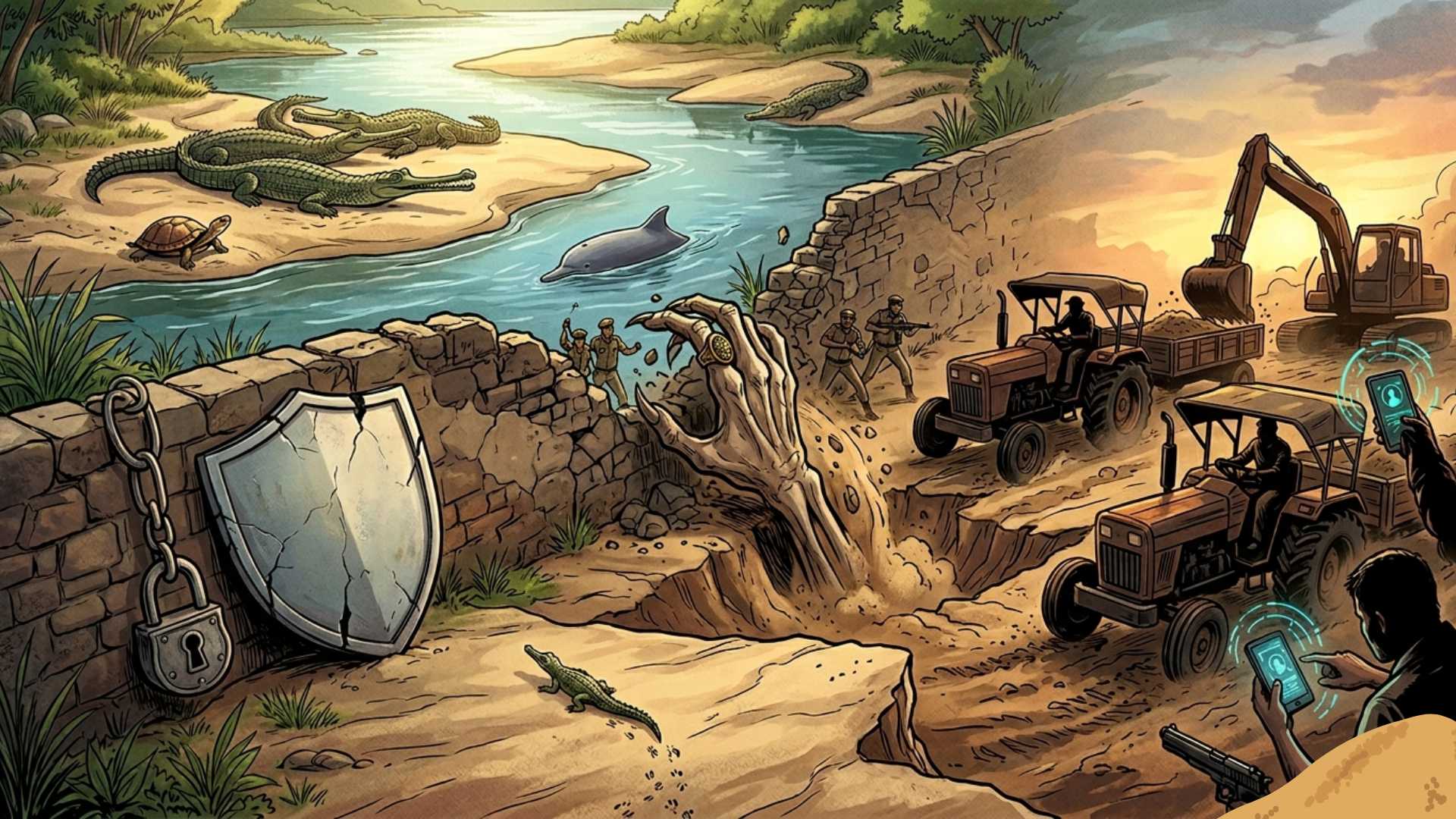
The Chambal river supports a rare lotic ecosystem (free-flowing river system) — one of India's least polluted major rivers. Three critically threatened species depend specifically on sandbars and sandbanks:
- Gharial (Gavialis gangeticus): Uses sandbars exclusively for nesting and basking — sand removal directly destroys reproductive habitat
- Red-crowned Roofed Turtle (Batagur kachuga): Critically endangered; nests on river sandbars
- Ganges River Dolphin (Platanista gangetica): Endangered; depends on undisturbed river flow and bed structure
Sand mining destroys nesting sites, destabilises river banks, increases turbidity, and alters river morphology — rendering these habitats functionally extinct even where legal protection exists on paper.
The Sand Mining Economy — Why It Persists
Demand side: North India's construction boom — driven by urbanisation, infrastructure projects, and real estate — created explosive demand for river sand, which is preferred over manufactured sand for construction quality.
Supply side: The Chambal ravines offer limited agricultural viability, leaving local youth economically vulnerable. Sand mining — even illegal — offers daily wages. The mafia recruits these young men as foot soldiers, converting local poverty into social cover for organised crime.
Jurisdictional arbitrage: The sanctuary straddles three states — Rajasthan, MP, and UP — each with separate enforcement agencies, legal frameworks, and political dynamics. Mining syndicates exploit these gaps deliberately, operating across boundaries to evade any single state's jurisdiction.
Organised Crime Dimension
By 2023, Chambal sand mining had evolved from opportunistic extraction to structured organised crime:
- Mining syndicates in the Gwalior-Chambal region equipped with semi-automatic weapons — regularly outgunning forest departments
- Tractor trolleys used as weapons — mowing down forest guards and police officers (2017–2024)
- Miners firing on police during enforcement raids
- Local villagers deployed to track patrol vehicles via mobile apps and GPS — sophisticated real-time counter-surveillance
- Syndicates providing political and social protection through recruitment of local youth
The Supreme Court's characterisation of these actors as "modern dacoits" reflects the severity of the law enforcement challenge — this is not poaching or petty extraction but armed insurgency against environmental governance.
State Complicity and Governance Failure
Rather than enforcing existing bans, both MP and Rajasthan attempted to legalise mining within the sanctuary — effectively rewarding organised crime with policy accommodation:
- Madhya Pradesh: Submitted proposals for limited mining in two districts inside the sanctuary — withdrawn after NGT resistance
- Rajasthan: Filed similar proposal in March 2025 — blocked by Supreme Court, which took suo motu cognisance
Justice Sandeep Mehta reminded Rajasthan of the National Security Act and the state-specific Goonda Act — tools available but unused against mining syndicate leaders.
This pattern reflects a broader failure: states passing jurisdictional responsibility between each other while mining continues unabated.
Judicial Intervention — Scope and Limits
The Supreme Court and NGT have repeatedly banned sand mining in the sanctuary. The Court's suo motu intervention signals frustration with executive inaction. However, a critical governance question arises:
Should the Court regulate, or discipline the regulator?
Given India's troubled history of judicial overreach into executive and regulatory functions — where courts have replaced rather than corrected institutions — there is merit in the Court holding states accountable for enforcement rather than micromanaging operations. Sustainable environmental governance requires credible state institutions, not perpetual judicial substitution.
The Livelihoods Trap
Sweeping crackdowns without livelihood alternatives will:
- Deepen local resentment among economically marginalised communities
- Entrench the social cover that sustains mining syndicates
- Convert forest officials into targets of 'public anger' — as is already documented
Force alone cannot quiet an economy feeding on grievance. The Chambal case illustrates that environmental crime with a livelihood base requires a dual response — strict enforcement against syndicate leadership combined with genuine economic alternatives for foot soldiers.
Way Forward
- Establish a Joint Chambal Enforcement Authority with representation from all three states and central agencies — resolving the jurisdictional gap exploited by syndicates
- Deploy NDRF/paramilitary support for forest departments facing armed syndicates — treating organised sand mining as an internal security threat
- Implement alternative livelihood programmes in Chambal ravine communities — eco-tourism, fisheries, MGNREGS-linked conservation work
- Mandate real-time satellite monitoring of river sandbars under NGT oversight to detect extraction
- Prosecute syndicate financiers and political enablers under existing NSA and Goonda Act provisions rather than targeting only foot soldiers
- Develop manufactured sand (M-sand) policy to reduce river sand demand — incentivising construction industry transition
Conclusion
The Chambal crisis is a microcosm of India's environmental governance paradox — strong laws, weak enforcement, and states that oscillate between inaction and legalising the very crime they are mandated to prevent. The gharial, river dolphin, and roofed turtle cannot wait for inter-state coordination to improve organically. But the lesson from Chambal's violent history is equally clear: ecological restoration without livelihood restoration is administratively unsustainable. Lasting change requires credible enforcement against syndicate leadership, genuine economic alternatives for vulnerable communities, and institutional architecture that eliminates the jurisdictional arbitrage on which organised environmental crime depends.