
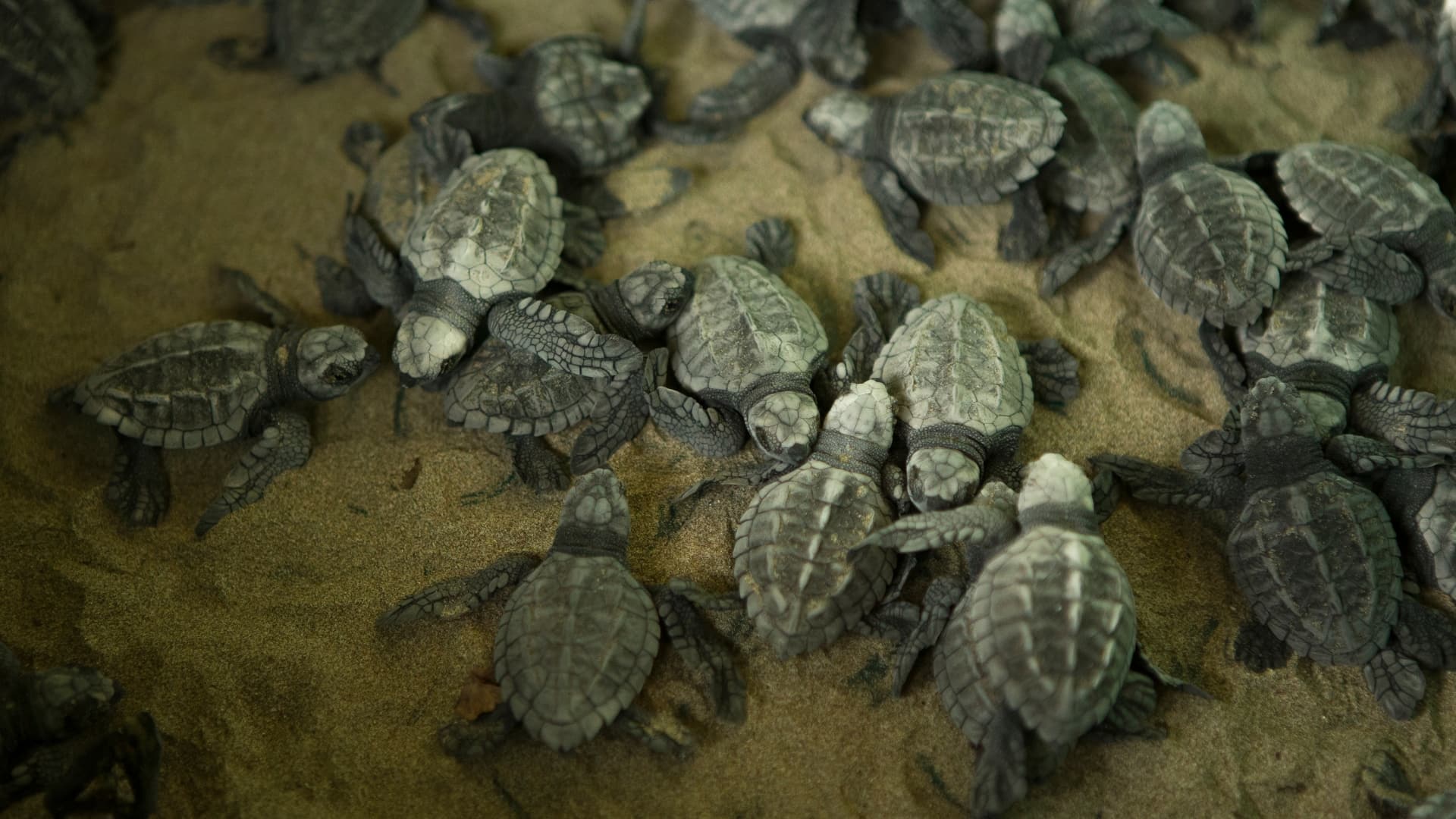
1. Context: Olive Ridley Turtles and India’s Eastern Coast
Olive ridley sea turtles (Lepidochelys olivacea) use India’s eastern coastline as a critical breeding and nesting corridor, with Andhra Pradesh forming an important link in this ecological continuum. Sandy beaches along river mouths and low-disturbance coastal stretches provide suitable conditions for nesting between December and April.
The species is classified as ‘Vulnerable’ by the IUCN, indicating a high risk of population decline if threats persist. This places a governance responsibility on coastal States to balance marine livelihoods with wildlife protection under national and international conservation commitments.
The current nesting season has gained attention due to the discovery of turtle carcasses along Visakhapatnam’s beaches, highlighting the fragility of marine biodiversity amid increasing anthropogenic pressures. Such incidents serve as early warning signals of regulatory and enforcement gaps in coastal management.
Ignoring these signals risks undermining decades of conservation efforts, weakening India’s credibility in marine biodiversity governance, and disrupting ecological services provided by marine species.
Governance logic: Coastal biodiversity is a shared ecological asset; neglecting early indicators like turtle mortality can escalate into irreversible population decline, reflecting failure of preventive environmental governance.
2. Issue: Turtle Mortality Due to Fishing Practices
The washing ashore of three large olive ridley turtle carcasses at Muthyalammapalem, Thantadi, and Rajanapalem beaches points towards accidental drowning caused by entanglement in fishing nets. Experts note that turtles must surface every 40–45 minutes to breathe, making prolonged net entrapment fatal.
This brings attention to the persistent challenge of by-catch in marine fisheries, especially during migration and nesting seasons when turtles traverse nearshore waters. Despite regulatory provisions, illegal or unregulated fishing within restricted coastal zones continues.
The Andhra Pradesh Marine Fishing Regulation Act prohibits fishing within 8 km of the coast to protect breeding marine life. Weak enforcement dilutes the Act’s preventive intent and shifts conservation costs onto wildlife.
Unchecked by-catch not only threatens turtle populations but also indicates unsustainable fishing practices that may eventually harm fish stocks and fisher livelihoods.
Causes:
- Use of non-selective fishing nets
- Illegal fishing within 8 km coastal regulation zone
- Lack of seasonal fishing discipline during turtle migration
Governance logic: Fisheries regulation is meant to internalise ecological costs; weak enforcement externalises these costs onto vulnerable species, leading to biodiversity loss and long-term economic stress.
3. Institutional Response and Conservation Measures
Following protocol, the Forest Department buried the carcasses, reflecting standard wildlife management practices. More importantly, authorities have announced plans to establish four nesting zones and operate four hatcheries in collaboration with civil society organisation The Tree Foundation.
This indicates a multi-stakeholder conservation approach, combining state capacity with non-governmental expertise. Hatcheries are designed to protect eggs from predation, flooding, and human disturbance, thereby improving hatchling survival rates.
Special precautions during large public events such as Visakha Utsav (January 23–31) have been planned to minimise disturbance, signalling sensitivity to seasonal ecological cycles in administrative planning.
However, reactive measures alone cannot substitute for preventive regulation in marine zones, especially where threats originate offshore.
Policy measures:
- Creation of 4 nesting zones
- Operation of 4 hatcheries along the coast
- Event-specific safeguards during Visakha Utsav
Governance logic: Collaborative conservation enhances implementation capacity, but without upstream regulation (fishing control), downstream measures like hatcheries face diminishing returns.
4. Challenge: Artificial Lighting and Coastal Urbanisation
Conservationists have highlighted artificial lighting as a growing threat to turtle nesting along the Visakhapatnam coastline, particularly near urbanised stretches like RK Beach. Observations show that most nests occur in darker zones between the Coastal Battery and the Novotel area.
Artificial lighting disorients nesting females and hatchlings, disrupting natural nesting cues influenced by lunar cycles and tides. This reflects the broader challenge of integrating biodiversity concerns into urban coastal development.
As coastal cities expand tourism and nightlife infrastructure, inadequate regulation of light pollution can silently erode critical habitats without visible conflict.
Failure to address such non-extractive threats results in “invisible” biodiversity loss, often overlooked in environmental impact assessments.
Impacts:
- Reduced nesting in illuminated beaches
- Disorientation of hatchlings
- Habitat avoidance by adult turtles
Governance logic: Environmental externalities like light pollution require anticipatory urban regulation; ignoring them leads to habitat degradation without direct accountability.
5. Ecological Behaviour and Conservation Timing
Olive ridley turtles follow specific nesting patterns influenced by lunar cycles and tides, typically coming ashore during high tide. Nesting activity often begins with small numbers, peaks, and then gradually declines, usually between November and March.
Such predictable biological rhythms allow administrations to design time-bound regulatory and protective interventions. However, erratic human activity during these sensitive windows can disrupt established ecological processes.
Understanding species behaviour is essential for evidence-based conservation rather than ad-hoc responses. Lack of ecological literacy in governance can render well-intended policies ineffective.
Key ecological facts:
- Nesting season: December–April
- Peak pattern: gradual rise, peak, and decline
- Nesting preference: high tide, low disturbance beaches
Governance logic: Aligning policy timing with ecological cycles improves conservation efficiency; ignoring behavioural science leads to misaligned and ineffective interventions.
Conclusion
The olive ridley nesting season along Andhra Pradesh’s coast underscores the intersection of marine biodiversity, fisheries regulation, urbanisation, and institutional coordination. Strengthening enforcement of fishing laws, managing non-traditional threats like light pollution, and integrating ecological knowledge into governance are essential for long-term conservation outcomes. Proactive, science-based coastal governance can ensure that development and biodiversity protection reinforce rather than undermine each other.
