
1. Context: Judicial Oversight and State Action on Vulture Conservation
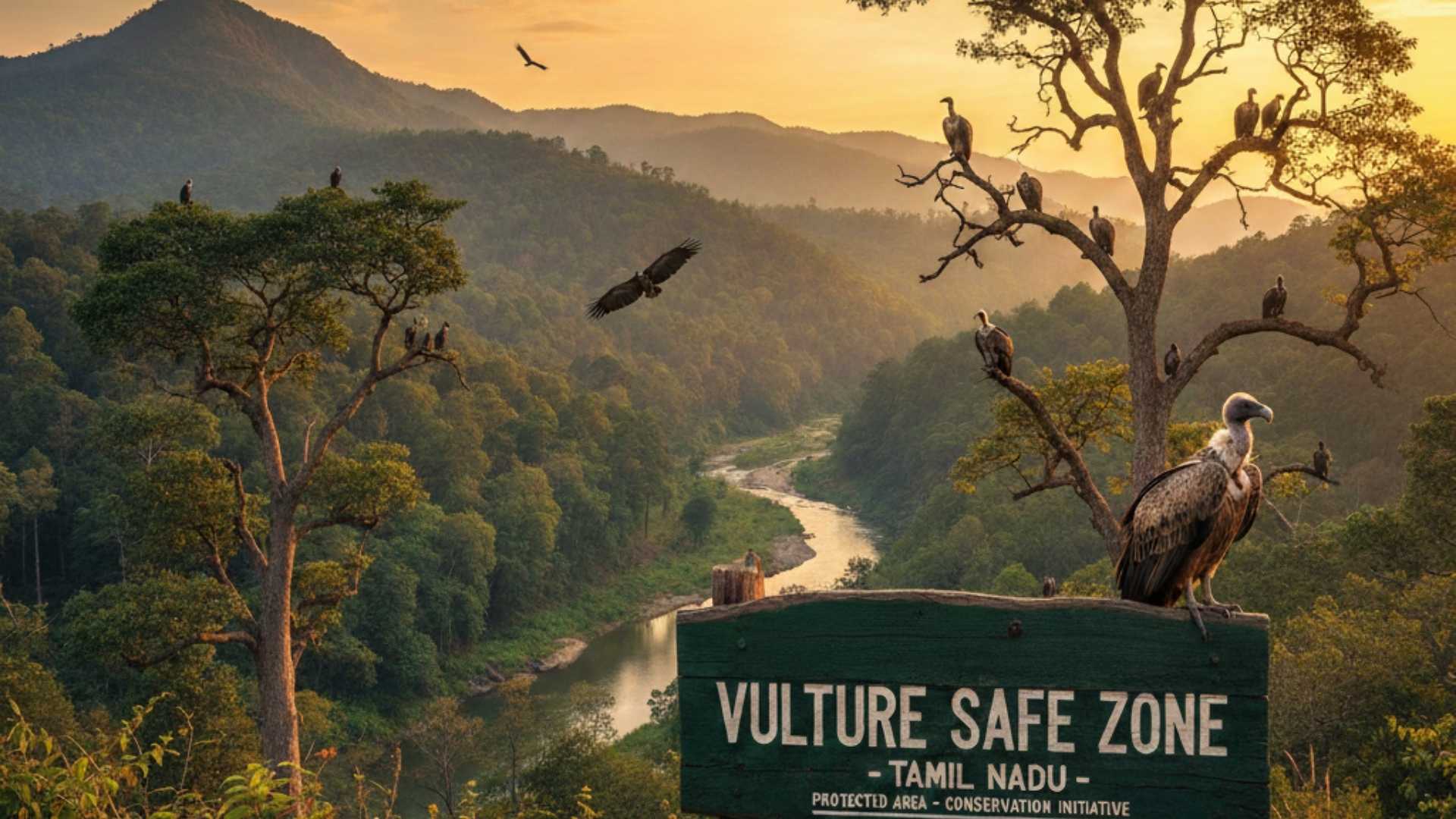
The Tamil Nadu Forest Department has informed the Madras High Court that it has initiated the process of establishing Vulture Safe Zones (VSZs) in the State. This action is aimed at creating a secure ecological environment for vultures, whose populations have witnessed sharp decline.
The initiative was placed before the High Court in response to a public interest litigation (PIL) highlighting mass vulture deaths and near-extinction risks. The case underscores the growing role of judicial oversight in enforcing wildlife conservation obligations.
The VSZ initiative is anchored in the Vision Document for Vulture Conservation (VDVC) in Tamil Nadu 2025–30, indicating a policy-backed, medium-term conservation roadmap rather than an ad-hoc intervention.
If such judicially monitored actions were absent, implementation gaps in wildlife conservation could persist, accelerating species decline and weakening environmental governance.
The governance logic reflects how courts act as catalysts when executive action lags. Without sustained oversight, conservation commitments risk remaining declaratory rather than operational.
2. Core Issue: NSAIDs and Vulture Mortality
The primary threat identified to vulture populations is the presence of toxic veterinary non-steroidal anti-inflammatory drugs (NSAIDs), especially diclofenac, in cattle carcasses consumed by vultures.
Despite regulatory bans, illegal or improper use of such NSAIDs by veterinarians continues to pose a lethal risk, causing kidney failure in vultures even at low residue levels.
The issue highlights a regulatory enforcement deficit where wildlife protection intersects with veterinary practices and pharmaceutical controls.
Failure to address this root cause would negate habitat-based conservation efforts and allow continued silent mortality of scavenger species.
The policy logic is that species conservation cannot succeed without addressing cross-sectoral regulatory leakages. Ignoring enforcement failures renders ecological interventions ineffective.
3. Identification of the First Vulture Safe Zone
The first VSZ in Tamil Nadu is proposed around the Moyar River Valley within the Nilgiris Biosphere Reserve, a region known for active vulture nesting and habitat usage.
This site selection reflects a science-based approach, prioritising areas with existing ecological significance rather than attempting artificial relocation or captive solutions.
By situating VSZs within a biosphere reserve, the State integrates species conservation with landscape-level ecological management.
If critical habitats are not prioritised early, conservation resources may be diluted with limited population recovery outcomes.
The conservation logic emphasises protecting ecological strongholds first. Neglecting such priority zones risks irreversible local extinctions.
4. Institutional Framework for Implementing VSZs
A field-level monitoring committee has been constituted to operationalise the VSZ framework. It is chaired by the Field Director of Mudumalai Tiger Reserve (MTR) and includes forest officers from multiple districts and tiger reserves.
The committee also includes a representative from the Advanced Institute for Wildlife Conservation (AIWC), Vandalur, indicating collaboration between government agencies and scientific institutions.
This multi-institutional structure reflects decentralised governance with technical input, improving monitoring credibility and coordination.
Without such institutional clarity, VSZs risk remaining notional designations without on-ground enforcement.
The governance logic rests on coordinated authority and expertise. Fragmented institutional roles would weaken accountability and implementation.
5. Monitoring, Surveillance, and Scientific Data Generation
The VSZ framework includes continuous monitoring of a 100-km radius around the Moyar vulture nesting population for a period of two years to generate scientific evidence.
Key operational measures include carcass sampling, laboratory analysis for banned NSAIDs, and inspection of veterinary drug retailers with support from the Drugs Controller.
- Statistics:
- 100-km radius monitoring zone
- 2-year monitoring period
- 800 carcasses to be sampled and tested
Such data-driven monitoring aims to move conservation from anecdotal reporting to evidence-based enforcement.
Ignoring systematic monitoring would limit learning, weaken legal action, and reduce policy adaptability.
The logic is that science-backed enforcement strengthens regulatory legitimacy. Without data, both prosecution and policy correction become weak.
6. Inter-State Coordination in Vulture Conservation
The status report indicates that similar conservation actions will be requested from Karnataka and Kerala, recognising that vulture habitats and feeding ranges transcend administrative boundaries.
This reflects an ecosystem-based approach rather than a State-centric one, essential for wide-ranging scavenger species.
Inter-State coordination is critical to prevent “safe islands” surrounded by high-risk zones that negate conservation gains.
The governance logic stresses cooperative federalism in environmental protection. Fragmented State action would undermine landscape-level conservation.
7. Role of Judiciary in Environmental Governance
After reviewing the status report and the VDVC 2025–30, the High Court granted time for further scrutiny and suggestions, keeping the matter under active consideration.
This reflects judicial insistence on participatory review and transparency in conservation planning.
Judicial engagement ensures continuity, timelines, and responsiveness from the executive.
The institutional logic is that judicial monitoring sustains momentum. Absence of follow-up often leads to policy inertia.
Conclusion
Tamil Nadu’s move to establish Vulture Safe Zones represents a science-based, institutionally coordinated, and judicially monitored conservation effort. Its success will depend on strict enforcement against banned NSAIDs, sustained inter-State coordination, and credible data generation. In the long term, such integrated approaches strengthen biodiversity governance and reinforce India’s commitment to ecosystem health and sustainable development.

