Introduction
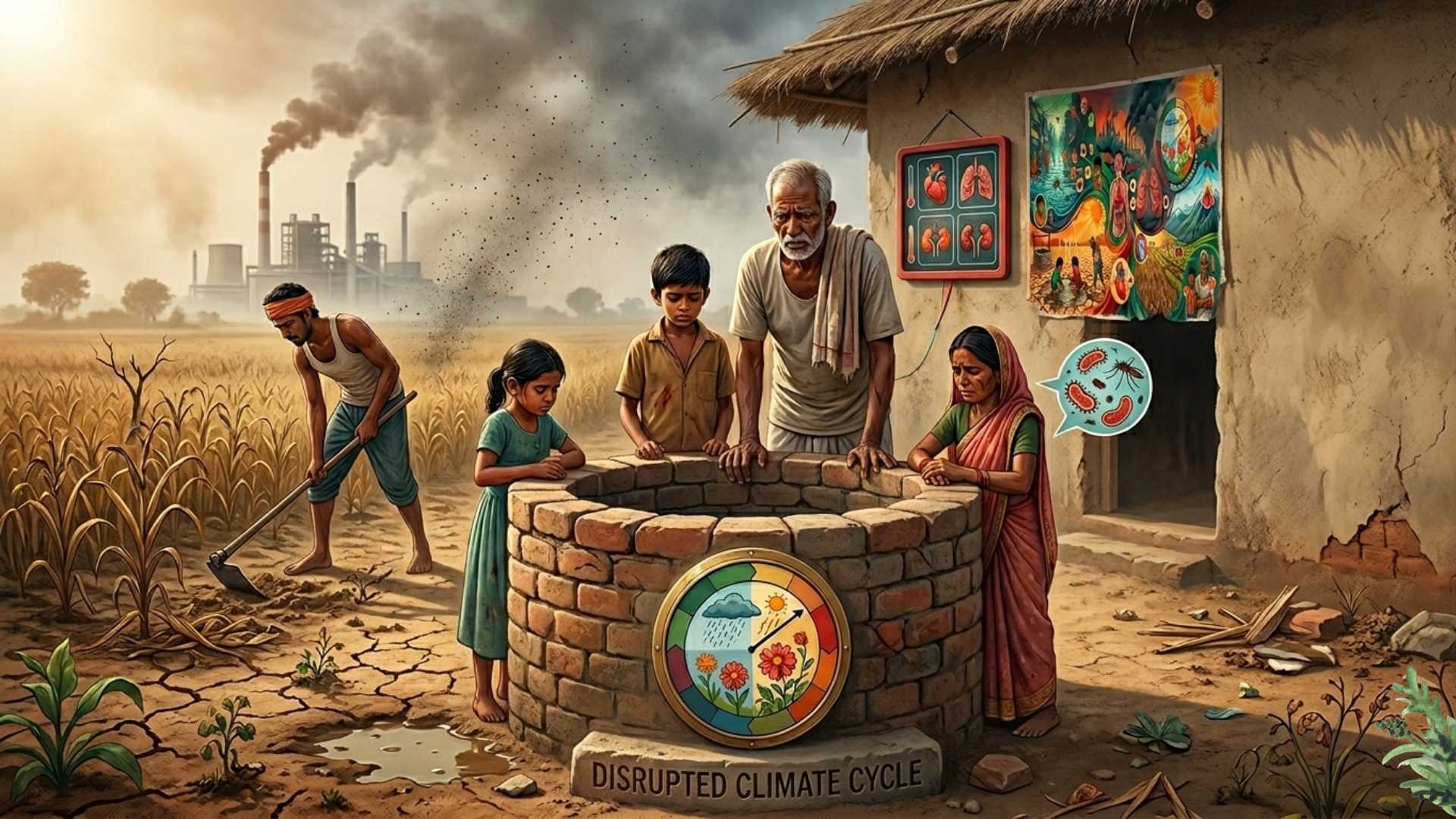
Climate change is no longer merely an environmental crisis — it is an accelerating public health emergency. The Lancet Countdown on Health and Climate Change (2023) warns that climate change is undermining decades of global health progress. In India, where 800 million people depend on climate-sensitive agriculture and where healthcare infrastructure remains strained, the health consequences are already measurable — from expanding dengue seasons in Delhi-NCR to malaria appearing in Himachal Pradesh for the first time. Treating climate change as a distant environmental issue dangerously underestimates its immediate human cost.
"Climate change intensifies every disease we already know and opens the door to those we have yet to face."
| Health Risk | Climate Driver | Indian Example |
|---|---|---|
| Waterborne diseases (cholera, typhoid, hepatitis A, leptospirosis) | Excess rainfall, urban waterlogging | Mumbai flooding |
| Diarrhoeal diseases, chronic dehydration | Drought, water scarcity | Drought-prone peninsular India |
| Vector-borne diseases (dengue, malaria) | Rising temperatures, extended rainfall | Delhi-NCR, Himachal Pradesh |
| Respiratory diseases (asthma, COPD) | PM2.5 pollution, heat-driven energy use | Delhi-NCR air quality crisis |
| Cardiovascular disease, stroke | Heat stress, PM2.5 arterial damage | Urban heat islands |
| Heat stroke deaths | Extreme heat events | Odisha, Telangana, Vidarbha |
| Preterm births, low birth weight | Heat exposure, air pollution | Urban centres |
| Malnutrition, micronutrient deficiency | Crop failure, reduced agricultural yield | Children, elderly populations |
Climate-Health Linkages: Key Mechanisms
1. Waterborne Disease Expansion Increasing frequency of urban waterlogging overwhelms sanitation infrastructure and contaminates drinking water supplies. Simultaneously, drought-prone regions force communities onto unsafe water sources — creating a dual waterborne disease burden across opposite ends of the rainfall spectrum.
2. Vector-Borne Disease Range Expansion Rising temperatures make previously inhospitable regions suitable for disease vectors. Two measurable Indian examples:
- Dengue in Delhi-NCR: Peak traditionally in September — now extends to November due to warmer, wetter conditions sustaining mosquito populations longer.
- Malaria in Himachal Pradesh: Historically minimal presence; now being reported in cooler hill areas as temperature thresholds shift.
Communities in newly affected areas lack prior immunity; local health systems are underprepared — a compounding vulnerability.
3. Air Pollution Feedback Loop Hotter summers → greater air conditioning use → higher energy consumption → elevated greenhouse gas and PM2.5 emissions → more heat trapped → further temperature rise. This feedback loop has multi-organ health consequences:
- Lungs: PM2.5 penetrates deep lung tissue causing inflammation, reduced function, aggravation of asthma and COPD
- Heart: Accelerates atherosclerosis, raises hypertension risk, increases heart attack and stroke incidence
- Kidneys: Chronic PM2.5 exposure impairs filtration efficiency and accelerates chronic kidney disease progression
4. Heat Stress and Cardiovascular Burden Extreme heat forces the cardiovascular system to work harder to regulate body temperature. Rising night-time temperatures in urban centres like Delhi-NCR and Mumbai eliminate the body's critical overnight recovery window. Manual labourers, outdoor workers, and slum dwellers without adequate shelter face disproportionate risk. Heat-stroke deaths are rising in Odisha, Telangana, and Vidarbha.
5. Food Security and Nutritional Health Extreme weather disrupts crop cycles and reduces agricultural productivity. Declining nutritional quality of food crops combined with price inflation creates a hidden burden of:
- Micronutrient deficiencies
- Chronic malnutrition — especially among children
- Reduced milk production due to heat stress in cattle — directly affecting infant nutrition
- Weakened immunity across vulnerable populations, amplifying disease susceptibility
Disproportionate Vulnerability
Climate-health impacts are not uniform — they concentrate among the most marginalised:
- Children: Higher risk of malnutrition, preterm birth, heat exposure, waterborne infections
- Elderly: Greater cardiovascular and respiratory vulnerability
- Agricultural and outdoor labourers: Direct heat stress exposure without occupational protection
- Urban poor: Heat island effect without cooling infrastructure; waterlogging without sanitation
- Tribal and forest communities: First exposed to emerging vector habitats; least served by healthcare
Policy and Governance Gaps
- Climate change remains largely absent from National Health Policy planning frameworks
- Disease surveillance systems are not calibrated to detect climate-driven geographic shifts in vector-borne diseases
- Urban planning does not adequately integrate flood resilience, sanitation redundancy, or heat mitigation
- Agricultural and health ministries operate in silos — nutritional consequences of crop failure are not tracked as health outcomes
- India lacks a national heat action plan with universal coverage — existing plans (Ahmedabad model) are city-specific
Way Forward
- Integrate climate risk into National Health Mission planning and district health action plans
- Expand Integrated Disease Surveillance Programme (IDSP) to track climate-sensitive disease patterns in real time
- Scale city-level Heat Action Plans (on Ahmedabad model) nationally, with focus on outdoor worker protection
- Invest in climate-resilient urban sanitation infrastructure to reduce waterborne disease vulnerability
- Link agriculture and nutrition policy to climate adaptation — crop diversification, fortification programmes
- Build community health worker capacity (ASHAs, ANMs) to recognise and respond to emerging climate-linked disease presentations
Conclusion
Climate change is not a future threat for India's public health system — it is a present emergency unfolding across disease wards, flood-hit slums, heat-stricken farms, and malnutrition-affected children. Its health consequences cut across waterborne, vector-borne, respiratory, cardiovascular, and nutritional domains simultaneously. India's policy response must evolve from treating climate change as an environmental portfolio issue to recognising it as a cross-cutting public health, governance, and social justice challenge. The urgency is not in the science — that has been settled for decades. The urgency is in translating that science into integrated, equity-focused action.