GS3 Environment & Bio-diversity
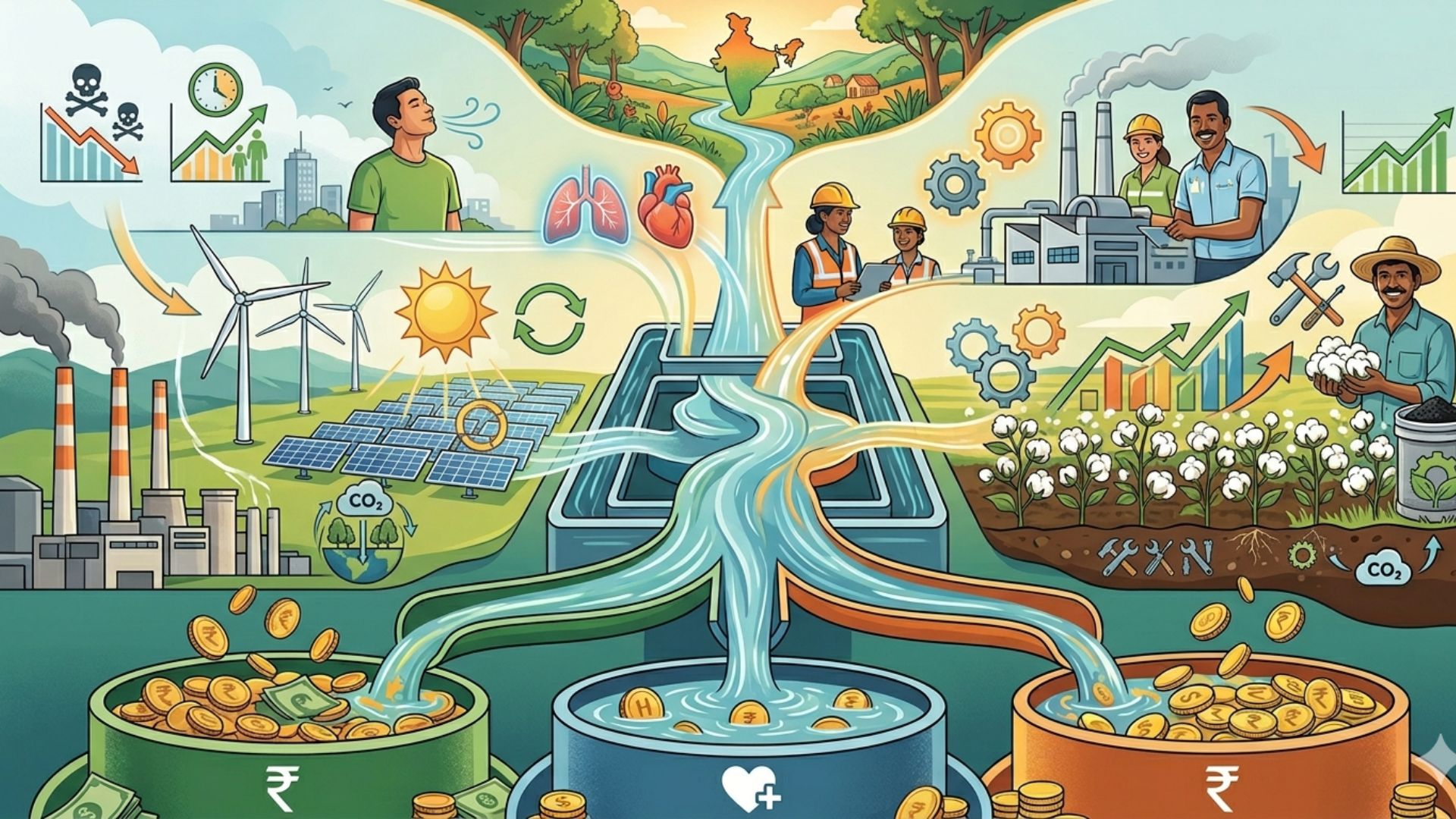
Climate Finance and Development Finance: Two Sides of the Same Coin

Asia possesses substantial pools of capital dedicated to climate action, health, poverty reduction, and sustainable development. However, these investments are often evaluated separately, despite the fact that a single intervention can simultaneously generate environmental, economic, and social benefits. Bridging this disconnect is critical for achieving both climate goals and the Sustainable Development Goals (SDGs).
The Scale of the Financing Challenge
Global and national estimates highlight the urgency of integrated financing.
| Indicator | Estimate |
|---|---|
| Global SDG Financing Gap | $4 trillion annually |
| Share linked to Energy Transition | ~50% |
| India's additional investment requirement for SDGs | ~6% of GDP annually |
Notably, sectors contributing most to the SDG financing gap—energy, infrastructure, and health—are also those requiring large-scale climate investments.
Climate Investment
        +
Development Investment
        ↓
Energy + Health + Livelihoods + Resilience
The challenge is therefore not merely a shortage of capital, but the absence of frameworks that recognise multiple returns from the same investment.
"The same investment can simultaneously deliver climate, health, productivity and poverty-reduction outcomes."
Why Current Investment Frameworks Fall Short
Many climate investments are assessed only through their carbon reduction benefits.
However, their actual impact extends much further.
Example: Clean Energy Transition
| Benefit Type | Outcome |
|---|---|
| Climate Return | Lower emissions |
| Health Return | Reduced air pollution |
| Productivity Return | Fewer workdays lost |
| Social Return | Better quality of life |
India faces significant costs from fossil fuel dependence:
- Nearly 0.95 million premature deaths annually from fossil fuel combustion.
- Extreme heat resulted in 247 billion lost working hours in 2024.
Thus, a renewable energy investment creates multiple gains, even though investors often account only for carbon reduction.
Renewable Energy as a Development Multiplier
India's renewable energy sector is projected to create approximately 3.4 million jobs by 2030.
These jobs generate:
- Employment opportunities
- Income security
- Poverty reduction
- Improved health outcomes
- Regional economic development
Renewable Energy Project
          ↓
Jobs Created
          ↓
Higher Income
          ↓
Better Health & Lower Poverty
This demonstrates that climate finance can also function as development finance.
Case Study: Kolhapur Foundry Cluster
The Kolhapur foundry cluster represents one of India's largest concentrations of small manufacturing units.
| Feature | Details |
|---|---|
| Share of India's Cast-Iron Exports | ~5% |
| Jobs Supported | ~27,700 |
Challenges faced:
- High electricity consumption
- Rising carbon compliance costs
- Impact of EU Carbon Border Adjustment Mechanism (CBAM)
- Export disruptions from global trade barriers
A shift to renewable power would simultaneously:
- Reduce emissions
- Improve export competitiveness
- Lower energy costs
- Protect employment
"The energy cost problem, trade competitiveness problem and climate problem are often the same problem."
Case Study: Biochar in Maharashtra's Cotton Belt
A proposed biochar initiative demonstrates how agriculture can generate both climate and development gains.
| Impact | Outcome |
|---|---|
| Farmers Covered | 10 lakh |
| Additional Annual Income | ₹85,000 per farmer |
| CO₂ Removal | 1.45 million tonnes annually |
Benefits include:
- Improved soil fertility
- Higher crop yields
- Reduced fertilizer dependence
- Lower pest pressure
- Carbon sequestration
Biochar Application
         ↓
Healthier Soil
         ↓
Higher Farm Income
         +
Carbon Removal
The farmer's income gain and carbon reduction are simply two different outcomes of the same intervention.
The Role of Philanthropy and Technical Assistance
Many promising projects fail to attract investment because they lack preparation and aggregation.
Important enabling functions include:
- Aggregating demand from multiple stakeholders
- Mapping energy requirements
- Assessing regulatory risks
- Designing payment security systems
- Developing investment-ready project pipelines
Commercial investors often avoid funding these early-stage activities but readily invest once projects become financially viable.
Unlocking Capital Through Integrated Frameworks
To mobilise greater investment, financing frameworks must recognise the complete spectrum of returns.
Key outcomes that should be measured include:
- Financial returns
- Carbon reduction
- Employment generation
- Health improvements
- Productivity gains
- Poverty reduction
- Economic resilience
When these benefits remain invisible, capital allocation is based on an incomplete understanding of value creation.
Way Forward
- Develop integrated climate-development financing frameworks.
- Create metrics that capture both financial and social returns.
- Expand blended finance mechanisms involving governments, philanthropy, and private capital.
- Strengthen project preparation facilities for climate-resilient investments.
- Promote carbon markets that also reward livelihood and ecosystem benefits.
- Encourage investments in renewable energy, sustainable agriculture, and resilient infrastructure.
- Improve disclosure standards for measuring developmental co-benefits.
Conclusion
The distinction between climate finance and development finance is increasingly artificial. Investments in clean energy, resilient agriculture, and sustainable infrastructure simultaneously generate environmental, economic, health, and social gains. By recognising and valuing these multiple returns, India and Asia can unlock larger pools of capital, accelerate SDG achievement, and build a more resilient and inclusive development pathway.
Attribution
Original content sources and authors


Syllabus classification
How this article maps to GS papers
Main syllabus
GS3Environment & Bio-diversityQuick Q&A
What is the concept of integrated climate-development financing and why is it gaining importance in contemporary policymaking?
Why is recognising multiple returns from climate investments essential for achieving sustainable development goals in India?
How can climate investments enhance economic competitiveness, employment generation and resilience in industrial sectors of India?
What practical examples demonstrate the synergy between climate action, agricultural sustainability and rural income enhancement in India?
Critically analyse the challenges involved in mobilising and deploying climate finance effectively in Asia and India.
What role can philanthropy and technical assistance play in unlocking climate finance and strengthening sustainable development initiatives?
Practice questions
1 question for mains preparation