
Introduction
"A powerful cyclone striking an uninhabited coastline is a natural event, not a disaster — disaster begins where hazard meets vulnerable people." — IPCC Sixth Assessment Report framework
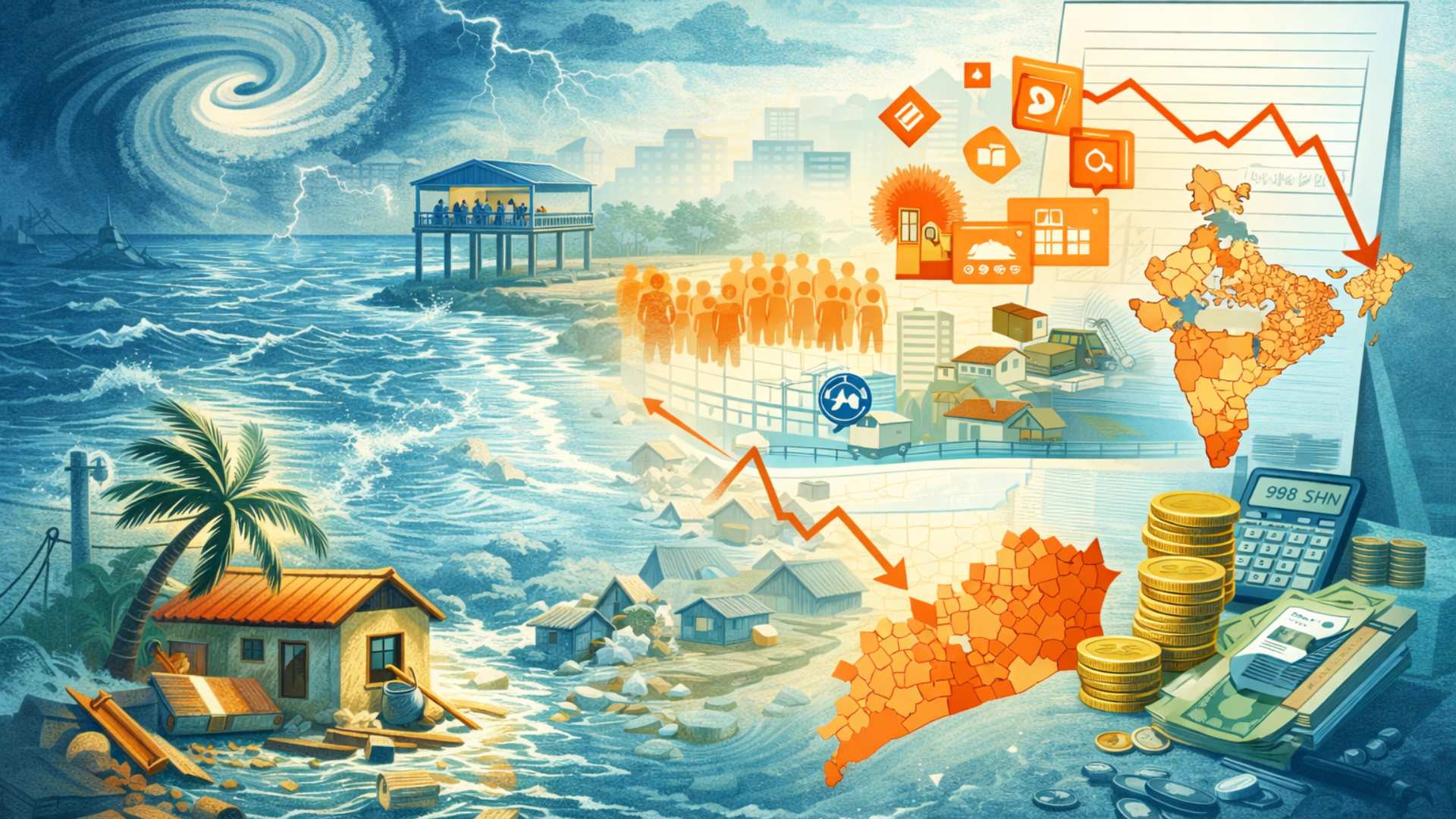
India's disaster finance architecture is only as strong as the formula that distributes it. The 16th Finance Commission has allocated ₹2,04,401 crore to State Disaster Response Funds (SDRF) — a 59.5% increase over its predecessor — yet Odisha, the State with the highest hazard score in the country, has received the single largest reduction in funding share (-1.57 percentage points). This paradox exposes a structural flaw: a formula that claims to measure risk but rewards demographic size over actual disaster exposure.
| State | Hazard Score | DRI Score | Funding Outcome |
|---|---|---|---|
| Odisha | 12 (highest) | 79.8 | -1.57 pp (largest cut) |
| Bihar | Lower | 224.2 | Gains |
| Uttar Pradesh | Lower | 413.2 | Gains |
| Kerala | Moderate | 34.5 | Underserved |
| Jharkhand | Moderate | High vulnerability | -0.78 pp |
Background and Context
Disaster finance in India flows through two channels: the State Disaster Response Fund (SDRF) — primarily funded by the Finance Commission — and the National Disaster Response Fund (NDRF), deployed for severe calamities. The Finance Commission determines each state's SDRF share through a Disaster Risk Index (DRI).
The 15th Finance Commission used an additive formula — treating hazard and vulnerability as separate, substitutable factors. The 16th Finance Commission shifted to a multiplicative formula: DRI = Hazard × Exposure × Vulnerability — theoretically sounder, as risk only materialises when all three factors intersect. The problem lies not in the logic but in the operationalisation of each variable.
The Formula's Two Structural Flaws
Flaw 1: Exposure = Total State Population
The Commission measures Exposure as total state population, scaled linearly from 1 (Sikkim) to 25 (Uttar Pradesh).
This is scientifically indefensible. Per the IPCC AR6, exposure means the presence of people in places that could be adversely affected — not simply everyone within a political boundary. A state with 10 crore people on a hazard-safe inland plateau has lower exposure than one with 3 crore people living entirely along a cyclone-prone coast.
Consequence: The multiplicative formula rewards demographic size. Odisha's hazard score of 12 (highest nationally) is neutralised by a population score of just 5, yielding a DRI of 79.8 — dwarfed by Bihar (224.2) and UP (413.2), both with lower hazard scores. The formula, in practice, is a headcount, not a risk index.
Flaw 2: Vulnerability = Per Capita NSDP (Inverted)
The Commission measures Vulnerability through inverted per capita Net State Domestic Product — poorer states score higher.
The intuition is reasonable: poorer states have less fiscal capacity to absorb shocks. But per capita income ≠ disaster vulnerability. True vulnerability encompasses housing quality, health infrastructure in hazard zones, early warning reach, share of population in structurally unsafe (kutcha) dwellings, and agricultural dependence.
Consequence: Kerala — which suffered ₹31,000 crore in damages in the 2018 floods (worst in a century) — receives a vulnerability score of just 1.073 because its per capita income is relatively high. Its DRI of 34.5 is lower than states with negligible disaster history.
Who Loses — and Why
20 states have lost relative funding share under the new formula. The common thread is not safety — it is being smaller, wealthier on average, or both.
| State | Why It Loses | What It Actually Faces |
|---|---|---|
| Odisha | Small population score offsets highest hazard | Cyclone-prone; 574.7 km coastline |
| Kerala | High per capita income → low vulnerability score | Floods, landslides; ₹31,000 cr damage (2018) |
| Jharkhand | Population too small to compensate in multiplicative model | Genuine poverty and tribal fragility |
| Andhra Pradesh | Similar structural disadvantage | High cyclone and flood exposure |
What Needs to Change
On Exposure: Replace total state population with hazard-zone population — the number of people living within defined flood plains, cyclone-prone coastal belts, and earthquake-susceptible zones. Data source: BMTPC Vulnerability Atlas cross-referenced with Census enumeration block data.
On Vulnerability: Replace per capita NSDP with a composite vulnerability index incorporating:
- Share of kutcha housing
- Agricultural labour dependence
- Health infrastructure density in high-hazard districts
- Crop insurance penetration (PMFBY database)
- Early warning system effectiveness (IMD records)
- NFHS-5 social indicators
Institutionalisation: The Finance Commission should mandate NDMA to publish an annual State Disaster Vulnerability Index as the authoritative input for each subsequent award period — ending contested metrics at every Commission cycle.
Conclusion
India cannot afford to get disaster finance wrong — and under the current formula, it is. Climate projections point to intensifying cyclone frequencies along both coastlines, expanding drought belts, and escalating extreme rainfall — with Odisha, Andhra Pradesh, Kerala, and Assam facing the sharpest increases. These are precisely the states the current formula underserves. A disaster risk index that measures total population rather than exposed population is not a scientific instrument — it is a demographic census dressed in risk language. The 16th Finance Commission's SDRF allocation, unless corrected, risks embedding a systematic anti-preparedness bias: states that invest most in disaster resilience, and face the greatest hazard, are penalised for not being populous enough.