Introduction
India loses approximately 29 lakh hectares of forest cover to land use change annually, with coastal and ecologically sensitive states bearing a disproportionate burden. Goa — a state where 83% of land is classified as eco-sensitive under its Regional Plan — is at the centre of a sharp conflict between real estate-driven development and ecological preservation. The Town and Country Planning (Amendment) Act, 2024, particularly Section 39A, has triggered one of Goa's largest grassroots resistance movements since the Goa Bachao Abhiyan of 2006, raising foundational questions about participatory planning, decentralisation, and the limits of legislative override of ecological protections.
Background & Context
Goa is a unique planning case: 320 inhabited villages across two districts, a single city (Panaji), and a colonial land tenure legacy under the Code of Communidades (1933) — Portuguese-era community-owned land law that ran parallel to Indian land law post-1961.
Timeline of Land-Use Legislation in Goa
| Year | Legislative Change |
|---|---|
| 1988 onwards | Zone changing begins; ~1.4 crore sqm settlement land added by 2006 |
| 2006 | New Regional Plan triggered Goa Bachao Abhiyan; plan denotified after protests |
| 2018 | Section 16B introduced — allowed Chief Town Planner to change regional plan zones |
| March 2023 | Section 17(2) introduced — private owners could "correct errors" in regional plan without public consultation |
| 2024 | Section 16B repealed; Section 39A introduced under TCP Amendment Act |
| April 2025 | Bombay HC (Goa Bench) read down Section 17(2) |
| Feb 2025 | 2,000+ protesters; hunger strikes; FIRs filed against 1,500+ people |
What is Section 39A?
Section 39A of the Town and Country Planning (Amendment) Act, 2024 allows ecologically sensitive zones — forests, hills, farmland, orchards — to be converted into settlement zones on application by individual landowners or companies, without mandatory Gram Sabha consent.
Key features (and concerns):
- Recognises only 7 eco-sensitive zone categories, versus 17–18 under the Regional Plan
- Orchard zones (ESZ-2 — restricted development) can be converted; ESZ-1 (no development) protections are weakened
- Applications are processed at the TCP Department level, bypassing local bodies
- Predominantly large real estate companies are applicants
- No requirement to approach Gram Sabha before conversion
"The problem with Section 39A is that it destroys the concept of planning. Every property owner is now a planner for their plot." — Norma Alvares, Environmental Lawyer, Parra
Scale of Impact — Key Data
- 68 lakh sqm of land across Goa has applications for conversion to settlement areas (Goa Gazette analysis by architect Tahir Noronha)
- 13.6% of applied land already unlocked/converted
- Pernem alone (near Manohar International Airport): 10.2 lakh sqm provisionally converted
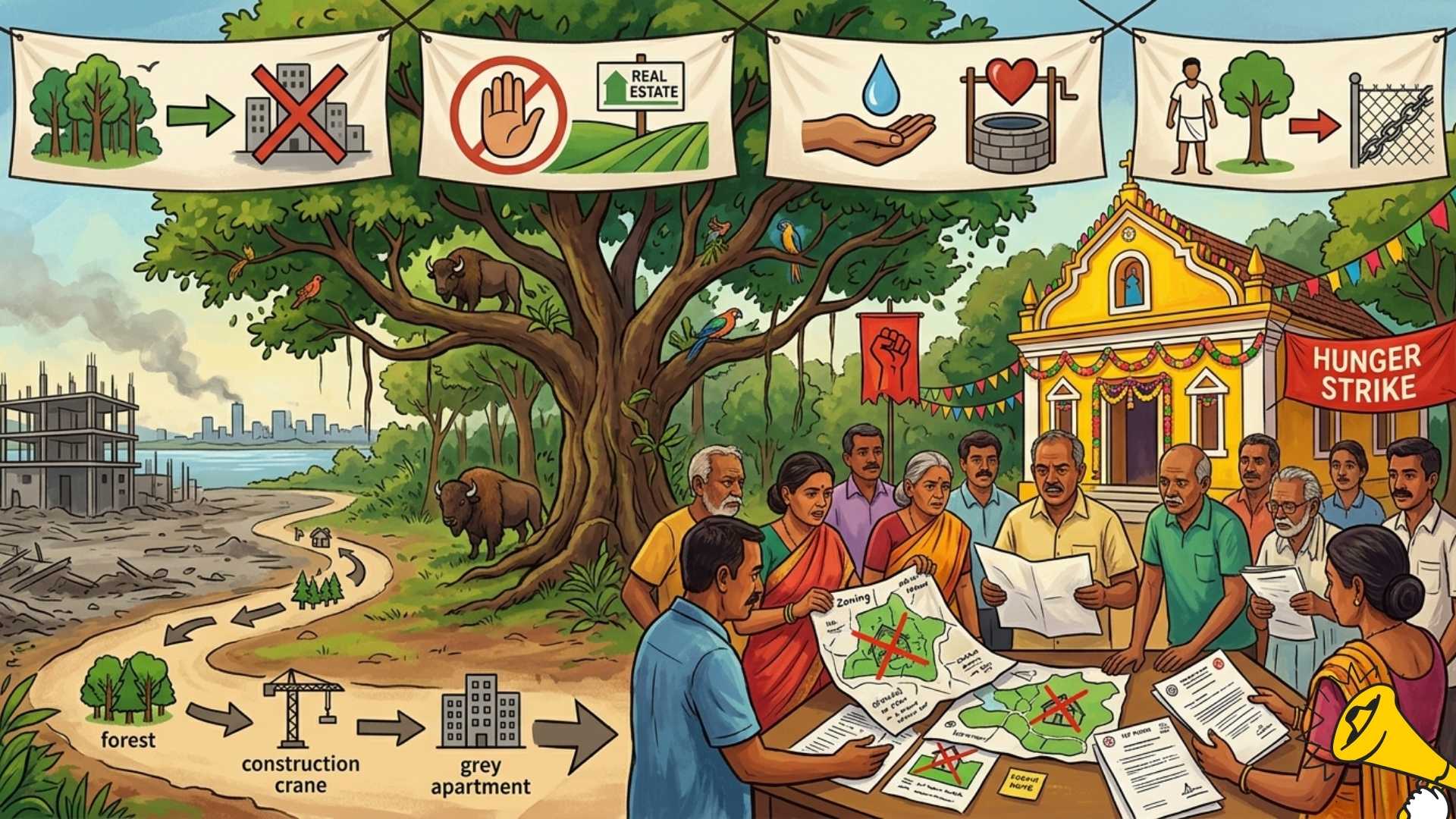
- Ella village (Old Goa): 2.6 lakh sqm proposed for conversion — including buffer zones of a 16th century heritage chapel and Carambolim Lake Wetland
- Palem village: 5,000 sqm already converted; 84,137 sqm applications pending
- North Goa is more severely affected than South Goa
Ecological & Governance Concerns
1. Bypassing Participatory Democracy Section 39A bypasses Gram Sabhas — the constitutionally mandated (Article 243A) forum for village-level decision-making. Villagers argue that development projects must come to the Gram Sabha rather than being decided at the ministerial level.
2. Heritage and Wetland Threat Conversions are occurring near UNESCO-recognised heritage zones (Old Goa churches), wetlands (Carambolim Lake), Fort Aguada heritage precinct, and disaster-prone hill slopes — raising questions of legal compliance with the Coastal Regulation Zone (CRZ) rules and the Environment Protection Act.
3. Carrying Capacity Ignored Infrastructure and ecological carrying capacity — water availability, drainage, biodiversity corridors — are not assessed before conversion approvals. The Chimbel case (proposed 17-storey building near a village lake) exemplifies this gap.
4. Colonial Land Law Confusion The Code of Communidades created community-owned land categories not recognised in standard Indian land law. Post-1961, Form I & XIV under the Goa Land Revenue Code records occupation, not ownership — creating title ambiguity that real estate interests exploit.
"Many present-day decisions ignore original Comunidade plans and treat such lands as if they have no established use." — Elsa Fernandes, Architect-Environmentalist
5. Biodiversity Loss Wildlife sightings (bison, leopards) near villages have increased — a signal of habitat encroachment pushing fauna toward human settlements. Deforestation on hill slopes increases flood and soil erosion risk in downstream areas.
The Grassroots Resistance
The protest movement against 39A is significant for its decentralised, village-level character — cutting across party lines and involving former sarpanches, MLAs, architects, lawyers, and young residents simultaneously.
Key demands of protesters:
- Repeal Section 39A entirely
- Introduce a Person of Goan Origin (POGO) Bill to prioritise local residents in land transactions
- Restrict sale of agricultural and forest land to outsiders
- Define scope of mega projects under the Goa Panchayat Raj Act with mandatory Gram Sabha approval
The CM's assurance to suspend conversions in St. Andre constituency and scrap FIRs has not been fully honoured — FIRs remain, and 1,500 unnamed protesters face potential legal and employment consequences.
Constitutional & Legal Dimensions
- Article 243A (Gram Sabha powers) and the 73rd Constitutional Amendment mandate community participation in local governance — Section 39A's bypass of Gram Sabhas is arguably in tension with this framework.
- Article 21 (Right to Life) has been interpreted by courts to include the right to a clean environment — a basis for challenging ecological degradation from unplanned conversion.
- Environment Protection Act, 1986 and Coastal Regulation Zone (CRZ) Notification impose restrictions on development near ecologically sensitive areas — compliance with these in 39A conversions is legally contestable.
- The Bombay HC reading down of Section 17(2) in April 2025 signals judicial receptivity to challenges against such amendments.
Comparison: Land Use Planning Models
| Dimension | Goa — Section 39A | Best Practice Model |
|---|---|---|
| Consent requirement | TCP department; no Gram Sabha | Mandatory Gram Sabha consent (as per 73rd Amendment spirit) |
| Eco-zone recognition | 7 categories | 17–18 (Goa Regional Plan); international models recognise more |
| Carrying capacity assessment | Absent | Mandatory EIA for zone changes |
| Heritage buffer compliance | Inconsistent | Strict enforcement (UNESCO/ASI norms) |
| Transparency | Gazette notification only | Public consultation + online disclosure |
Conclusion
Goa's Section 39A controversy is a microcosm of a broader national tension: between land as a commodity in a liberalised economy and land as an ecological and community commons. The state's unique ecology, colonial land tenure legacy, and strong tradition of village-level civic engagement make it a particularly stark case. The solution is not to freeze all development but to institutionalise participatory, ecologically informed planning — where Gram Sabhas have genuine veto power, carrying capacity assessments are mandatory, and heritage and wetland buffers are non-negotiable. India's commitment to LiFE (Lifestyle for Environment) and its biodiversity obligations under the Kunming-Montreal Global Biodiversity Framework (2022) demand nothing less. Legislative shortcuts that privatise ecological commons at the cost of local consent are not development — they are dispossession by another name.