1. India’s Long-Term Climate Strategy and Investment Needs
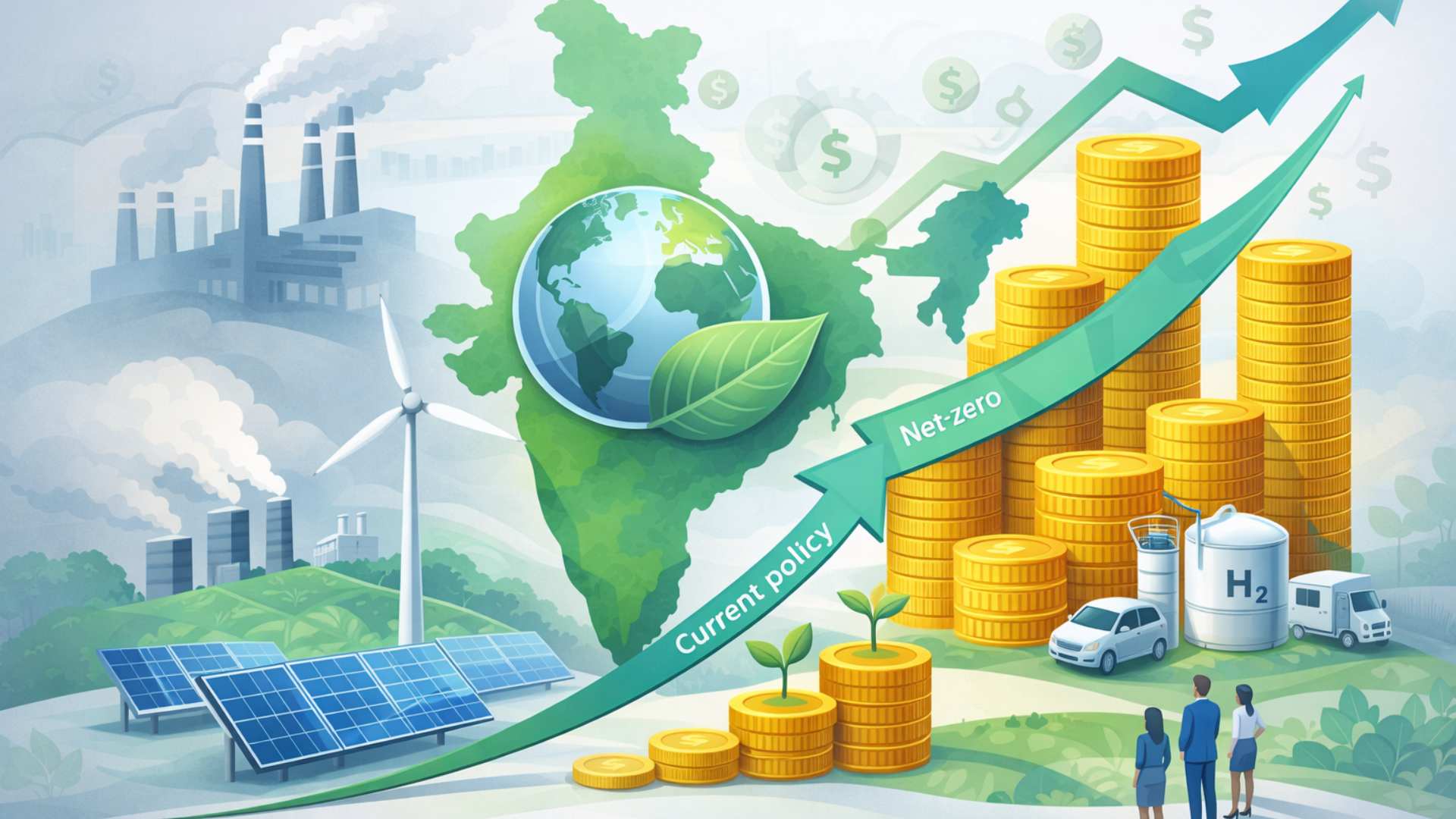
NITI Aayog’s recent study outlines India’s climate and development trajectory to achieve a “Viksit Bharat” by 2047 and net-zero emissions by 2070. The report estimates cumulative investment needs of 22.7 trillion under a net-zero scenario, implying an average annual investment of 135 billion annually, leaving a significant financing gap. Even with optimistic domestic capital mobilisation of 6.5 trillion gap remains, highlighting the need for international finance, concessional loans, and grants.
The magnitude of investment underlines the challenge of aligning developmental goals with climate commitments. Without bridging the financing gap, India risks slower transition, underprepared infrastructure, and unmet net-zero targets, which could undermine both economic and environmental resilience.
Long-term planning and credible financing are essential for sustainable growth. Ignoring the investment gap may delay energy transitions and compromise India’s global climate commitments.
Key statistics:
- Cumulative net-zero investment: $22.7 trillion
- Current annual investment: $135 billion
- Required average annual investment: $500 billion
- Financing gap by 2070: $6.5 trillion
2. Structural and Multilayered Challenges
The study identifies structural constraints affecting India’s climate transition:
- High cost of capital and limited long-term concessional finance undermine project viability, especially in energy storage, green hydrogen, and industrial decarbonisation.
- Global uncertainties, including protectionism, geopolitical tensions, and fragmented supply chains, exacerbate investment risk.
- Weak project pipelines and uneven sectoral readiness limit the execution of climate projects. While renewable energy deployment has scaled up, progress in grid expansion, storage, and clean industrial technologies remains slow.
- Rapid urbanisation, resource scarcity, and demand for skilled human capital require targeted investments in resilient infrastructure, green technologies, and workforce development.
Addressing structural and capacity-related bottlenecks is critical. Neglecting them could result in uneven climate action across states and sectors, reducing effectiveness of policies and public investments.
Challenges:
- Sectoral readiness varies; grid and storage lag renewable deployment
- High capital costs restrict private investment
- Limited long-term concessional finance for hard-to-abate sectors
- Human capital and infrastructure constraints in urbanising regions
3. Climate Finance Landscape and Gaps
The Economic Survey 2025-26 highlights an imbalance in climate finance allocation:
- Heavy concentration on mature mitigation sectors such as solar and wind.
- Adaptation, urban infrastructure, MSME finance, and hard-to-abate industries remain underfunded.
- Climate finance remains predominantly domestic, with ~83% of mitigation finance and ~98% of adaptation finance sourced locally.
This skew limits the ability to fund comprehensive climate action, including resilience-building and industrial decarbonisation. Reliance on domestic finance also constrains access to lower-cost capital, raising the overall cost of the transition.
Balanced climate finance across mitigation, adaptation, and emerging sectors is essential for inclusive and sustainable development. Ignoring underfunded areas can exacerbate climate vulnerability and regional disparities.
4. Policy Measures and Demand-Side Interventions
The report emphasizes demand-side interventions to enhance cost-effective climate action:
- Energy efficiency and behavioural change to reduce emissions.
- Material circularity and sustainable consumption under initiatives like Mission LiFE.
These measures provide relatively low-cost pathways to emission reduction while supporting broader environmental goals. Promoting efficiency and lifestyle-oriented measures complements infrastructure-heavy investments.
Demand-side interventions reduce overall mitigation costs and enhance public engagement. Neglecting them could increase dependence on capital-intensive solutions, slowing the transition.
5. Financing and Institutional Reforms
To mobilise the required resources, NITI Aayog recommends institutional and financial innovations:
- Creation of a National Green Finance Institution to aggregate capital, reduce risk, and lower borrowing costs.
- Expansion of blended finance facilities combining public, private, and concessional capital.
- Adoption of unified climate-finance taxonomies for transparency and comparability.
- Development of corporate and green bond markets to deepen private-sector participation.
These reforms aim to bridge the $6.5 trillion financing gap, attract international capital, and ensure sustainable, predictable flows for long-term climate projects.
Robust institutional and financial architecture is crucial for effective net-zero transition. Ignoring reforms can perpetuate funding gaps and project delays.
Key reforms:
- National Green Finance Institution
- Blended finance expansion
- Unified climate-finance taxonomies
- Deepened green bond markets
6. Strategic Implications for Governance and Development
India’s net-zero ambition intersects with economic planning, industrial policy, urban governance, and skill development. Achieving climate targets requires:
- Long-term investment planning aligned with sectoral readiness.
- Integrated infrastructure and urban resilience strategies.
- Capacity building for workforce and project execution.
- Coordinated domestic and international financing frameworks.
Effective implementation strengthens India’s global credibility, fosters green industrial growth, and ensures sustainable urbanisation, aligning with SDGs and national development priorities.
Comprehensive planning across sectors and finance ensures climate and development goals are mutually reinforcing. Ignoring sectoral gaps and institutional reforms risks delayed action and suboptimal outcomes.
7. Conclusion
NITI Aayog’s study underscores that India’s net-zero by 2070 and Viksit Bharat by 2047 goals require credible financing, institutional reform, and long-term planning. Bridging investment gaps through domestic and international finance, promoting demand-side interventions, and strengthening institutional frameworks will be crucial to achieving sustainable, inclusive, and resilient climate and development outcomes.
"Climate action is not just an environmental imperative but a development imperative for India." — NITI Aayog, 2026