
1. Institutional and Policy Context: CAQM and Supreme Court Direction
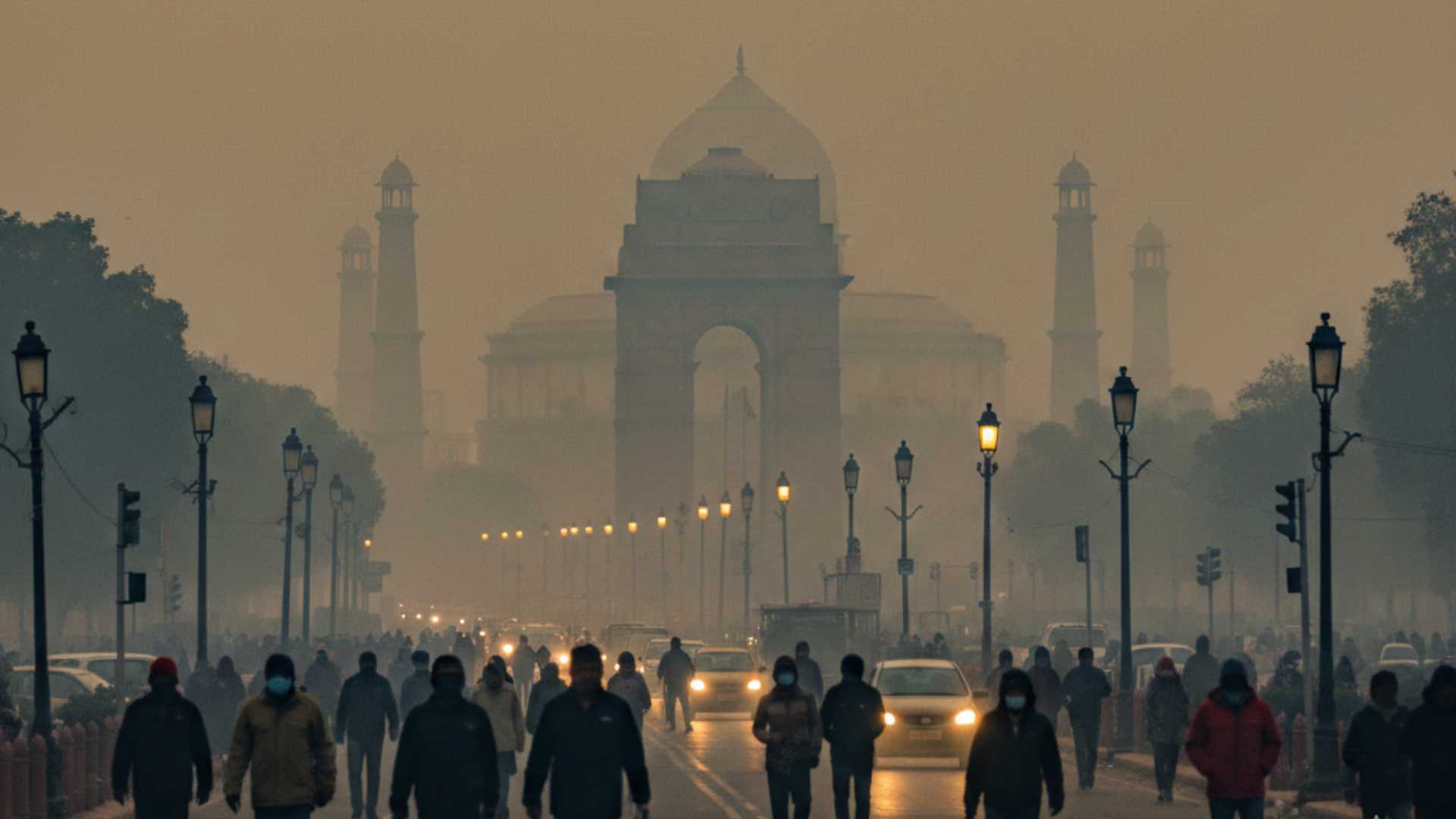
Air pollution in Delhi–NCR has evolved from a seasonal environmental issue into a chronic governance and public health challenge, directly affecting urban productivity, health outcomes, and quality of life. Persistent winter smog episodes have underscored limitations in fragmented policy responses and conflicting datasets on pollution sources.
Against this backdrop, the Supreme Court intervened on January 6, 2026, directing the Commission for Air Quality Management (CAQM) to place on record the major causes of worsening AQI in the region. This judicial push reflects the growing role of courts in environmental governance when executive coordination is weak.
The CAQM responded by synthesising existing source apportionment studies rather than commissioning fresh fieldwork, aiming to establish a common evidence base for policymaking. The stated objective was to reduce ambiguity in source attribution that had earlier weakened regulatory action.
If such institutional clarity is not achieved, policy measures risk remaining reactive, sectorally skewed, and legally vulnerable, thereby undermining long-term air quality management in the National Capital Region.
This section highlights how judicial oversight and statutory regulators interact in environmental governance; ignoring evidence consolidation perpetuates policy paralysis and weakens accountability.
2. Source Apportionment Findings: Relative Contribution to Winter Pollution
The meta-analysis identifies secondary particulate matter as the single largest contributor to winter air pollution in Delhi–NCR, accounting for 27% of PM2.5. This shifts attention from only visible sources to atmospheric chemical processes.
Transport emissions emerge as the second-largest contributor at 23%, reflecting high vehicular density, fossil-fuel dependence, and congestion patterns in the region. This reinforces the link between urban mobility planning and air quality outcomes.
Biomass burning contributes 20%, including both municipal solid waste burning and crop-residue burning, indicating that peri-urban and rural practices significantly affect urban air quality. Dust (15%) and industry (9%) form the remaining major contributors.
Importantly, the report does not identify new pollution sources but reconciles divergent methodologies used in earlier studies, thereby offering a unified evidentiary baseline for governance.
Key contributors to winter PM2.5:
- Secondary particulate matter: 27%
- Transport: 23%
- Biomass burning: 20%
- Dust: 15%
- Industry: 9%
The logic is that without consensus on source contribution, regulatory focus becomes misaligned; ignoring relative shares leads to inefficient allocation of regulatory and fiscal resources.
3. Secondary Particulate Matter and the Role of Ammonia
Secondary particulate matter forms through atmospheric reactions involving primary pollutants such as sulphur dioxide (SO₂), nitrogen oxides (NOₓ), and ammonia (NH₃). Unlike primary emissions, these particles are not directly emitted but are chemically generated, making them harder to regulate.
The CAQM report explains that SO₂ from coal combustion and brick kilns forms sulphuric acid, while NOₓ undergoes oxidation to form nitric acid. Both acids react with ammonia to generate ammonium sulphate and ammonium nitrate aerosols.
Independent scientific evidence cited in the article shows that nearly 80% of ammonia emissions in India originate from fertiliser use and livestock excreta. A November 2024 study in the Journal of Hazardous Materials estimated total NH₃ emissions at 10.54 Tg (2022), with 4.9 Tg/year from synthetic fertilisers and 3.2 Tg/year from livestock excreta.
As a result, 25%–60% of PM2.5 consists of sulphates and nitrates, which are particularly harmful due to their ability to penetrate deep into the lungs.
Health impacts associated with PM2.5:
- Asthma and chronic obstructive pulmonary disease
- Lung cancer
- Hypertensive disorders
- Acute respiratory infections
- Ophthalmic diseases
This underscores that air pollution control cannot be urban-only or tailpipe-centric; ignoring secondary pollutants weakens health protection despite visible emission controls.
4. Limitations of Existing Decision-Support Tools
The CAQM report acknowledges methodological inconsistencies across earlier studies, which reduced their policy utility. This directly affected the credibility of technology-driven governance tools.
In late 2024, CAQM suspended the use of the Decision Support System (DSS) developed by IITM Pune for policy purposes, citing its inability to accurately forecast sudden AQI deterioration and attribute immediate sources.
Such limitations reveal the gap between scientific modelling and regulatory decision-making, especially during episodic pollution spikes when timely interventions are critical.
Without reliable real-time attribution, authorities are forced into blanket measures such as construction bans or vehicular restrictions, which carry high economic and social costs.
The governance lesson is that weak predictive capacity leads to blunt policy instruments; ignoring system credibility erodes both compliance and public trust.
5. Forthcoming Emissions Inventory and Integrated Forecasting
To address data and credibility gaps, a new emissions inventory and source apportionment study is proposed with 2026 as the base year. Key institutions involved include ARAI Pune, IIT Delhi, TERI, and IITM Pune, indicating a multi-institutional approach.
These studies are intended to strengthen the Air Quality Early Warning System and improve near real-time source contribution analysis. Accurate baseline inventories are essential for aligning national, State, and municipal interventions.
If implemented effectively, this could mark a shift from episodic crisis management to anticipatory, evidence-based air quality governance.
However, delays or poor inter-agency coordination would risk repeating past cycles of data generation without policy translation.
This reflects the development logic that credible data infrastructure is a public good; ignoring it locks governance into reactive and high-cost responses.
6. Broader Governance and Development Implications
The findings link air pollution directly to agricultural practices, energy choices, urban planning, and public health, cutting across GS1, GS2, and GS3 dimensions. Managing ammonia emissions, for instance, requires coordination between agriculture, environment, and urban authorities.
The health burden of PM2.5 translates into productivity losses, increased healthcare expenditure, and inequality, as vulnerable populations face higher exposure and lower adaptive capacity.
Failure to integrate these insights into policy risks normalising chronic air pollution as an urban inevitability, undermining India’s commitments to sustainable development and human capital formation.
This demonstrates that air quality is not an environmental externality but a core development variable; ignoring cross-sectoral linkages weakens long-term growth outcomes.
Conclusion
The CAQM synthesis provides a unified, evidence-based understanding of Delhi–NCR’s winter air pollution, highlighting the dominant role of secondary particulate matter and systemic emission sources. Its value lies not in novelty but in policy clarity. Translating this clarity into coordinated, multi-sectoral action will determine whether air quality governance shifts from reactive control to sustainable management.

