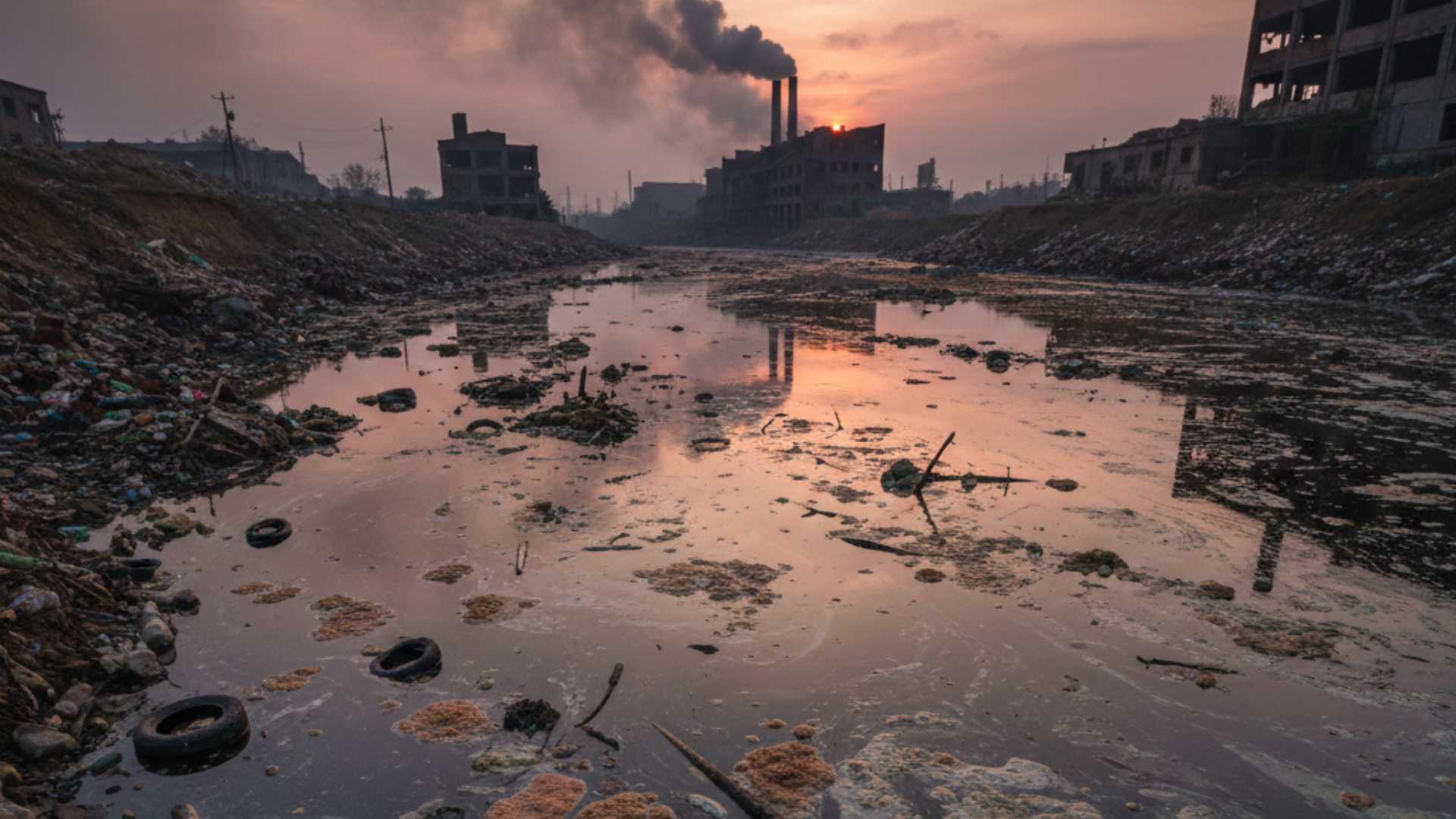
1. Judicial Intervention in River Pollution: Background and Constitutional Basis
The Supreme Court in February 2026 closed a suo motu case initiated in January 2021 concerning remediation of polluted rivers, directing the National Green Tribunal (NGT) to reopen and continue monitoring the matter. The case was originally triggered due to concerns over widespread contamination of rivers by untreated sewage and municipal lapses.
In January 2021, the Court had taken suo motu cognisance of river pollution, recognising that open surface water resources are central to human survival and economic activity. The intervention reflected the judiciary’s continuing role in environmental governance, especially where executive compliance has been weak.
The earlier Bench emphasised the constitutional dimension of environmental protection, linking clean water directly to Article 21 (Right to Life). It observed that deterioration in freshwater quality has a direct correlation with public health outcomes, thereby elevating river pollution from a regulatory issue to a fundamental rights concern.
“Deterioration of the quality of fresh water has a direct co-relation with the quality of public health... The right to a clean environment, and further, pollution-free water, has been protected under the broad rubric of the right to life.” — Supreme Court (2021)
The constitutionalisation of environmental protection ensures enforceability through judicial review. If such linkage weakens, environmental governance risks being reduced to administrative discretion rather than rights-based accountability.
2. Institutional Capacity and Limits of Judicial Oversight
While closing the case, the Chief Justice of India questioned the feasibility of the Supreme Court directly examining pollution levels in all rivers across the country. The Court noted the difficulty of handling multiple similar issues simultaneously, raising concerns about multiplicity of proceedings and institutional overreach.
The decision to transfer continued monitoring to the NGT reflects recognition of institutional specialization. The NGT, established under the National Green Tribunal Act, 2010, is designed to handle environmental disputes through technical expertise and sustained supervision mechanisms.
The move suggests a recalibration of judicial priorities, balancing constitutional oversight with practical constraints of docket management and functional competence.
When the apex court assumes continuous monitoring of complex environmental issues, it risks administrative overextension. Delegating to specialised tribunals enhances efficiency, but weak monitoring may dilute accountability.
3. Persistent River Pollution: Governance Gaps and Federal Dimensions
The 2021 proceedings were prompted by a petition from the Delhi Jal Board seeking immediate stoppage of pollutant discharge into the Yamuna by Haryana. This highlights the inter-State dimension of river pollution and the complexities of federal environmental governance.
River pollution in India is largely attributed to untreated sewage discharged by municipalities, reflecting systemic failures in urban infrastructure, sewage treatment capacity, and enforcement. Despite periodic judicial interventions, long-term compliance has remained inconsistent.
Indicators of Concern:
- CPCB data indicate only a slight reduction in polluted river sites
- Parliamentary Panel reported 23 Yamuna sites failing water quality tests
These data points underscore that while incremental improvements may occur, structural issues remain unresolved.
Inter-State disputes over river pollution reveal coordination deficits in cooperative federalism. Without clear accountability mechanisms, pollution becomes a recurring governance failure rather than a solvable regulatory problem.
4. Role of the National Green Tribunal (NGT)
The Supreme Court’s direction to the NGT to reopen and monitor the case reaffirms the Tribunal’s central role in environmental adjudication. The NGT is empowered to provide effective and expeditious disposal of environmental cases, applying principles such as:
- Polluter Pays Principle
- Precautionary Principle
- Sustainable Development
By shifting oversight to the NGT, the Court aims to ensure continuous monitoring without overburdening constitutional courts. This reflects an institutional preference for specialised forums over broad-based judicial activism in environmental matters.
However, the effectiveness of such delegation depends on:
- Enforcement capacity
- Compliance by State authorities
- Timely reporting and monitoring
Specialised tribunals can ensure focused oversight, but their success hinges on executive cooperation. Without administrative follow-through, even strong judicial directives risk becoming symbolic.
5. Environmental Governance and Public Health Linkages
River pollution directly affects drinking water quality, agriculture, fisheries, and ecosystem services. The Supreme Court’s earlier observation linking freshwater deterioration with public health situates the issue within the broader framework of sustainable development (GS3).
Poor water quality leads to:
- Increased disease burden
- Higher public health expenditure
- Economic productivity losses
- Environmental degradation
This also intersects with:
- GS2: Judicial activism, federal relations, environmental institutions
- GS3: Pollution control, sustainable development, water resource management
- Essay: Rights-based development, environmental justice
Failure to address river pollution undermines SDG commitments, especially SDG 6 (Clean Water and Sanitation).
Environmental degradation imposes invisible long-term costs on public health and economic growth. If river pollution persists, it compromises both developmental gains and intergenerational equity.
6. Way Forward: Strengthening Institutional and Policy Response
India’s river pollution challenge requires structural reforms rather than episodic judicial monitoring.
Policy Measures:
- Strengthening municipal sewage treatment infrastructure
- Enhancing CPCB and SPCB monitoring capacity
- Time-bound compliance frameworks with financial penalties
- Greater Centre–State coordination in inter-State river basins
- Data transparency and public reporting mechanisms
Judicial oversight should complement, not substitute, executive accountability.
Conclusion
The Supreme Court’s closure of the 2021 suo motu case marks a shift from direct constitutional monitoring to specialised institutional oversight through the NGT. While this reflects judicial pragmatism, the persistence of polluted river stretches indicates that structural governance reforms remain incomplete.
Sustainable river rejuvenation requires coordinated federal action, regulatory enforcement, and infrastructure investment. Long-term environmental security depends not merely on judicial intervention, but on effective administrative implementation and institutional accountability.