
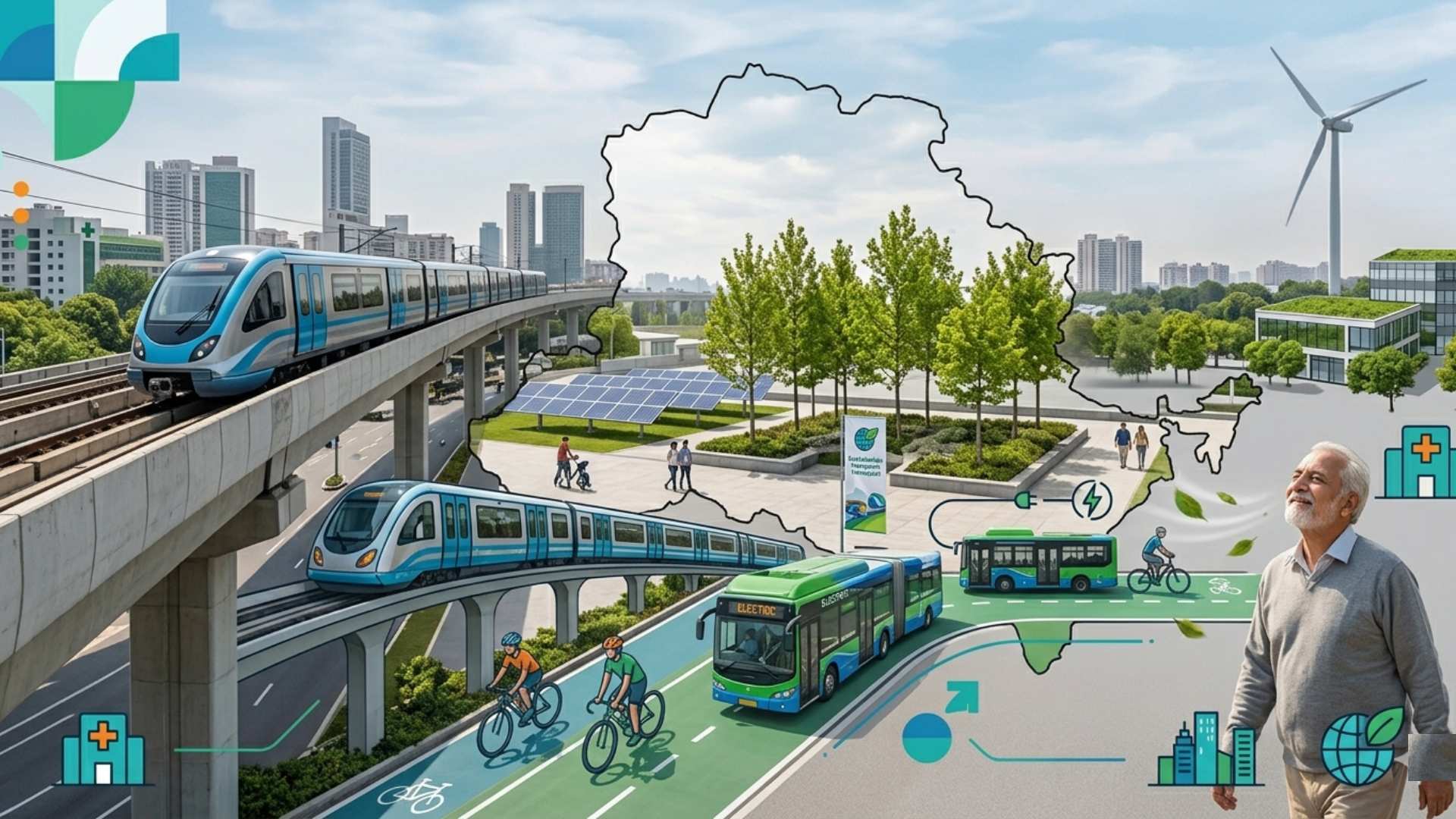
Transport: The Key to India's Air Quality Strategy

Addressing the transport sector's role is crucial for enduring solutions to tackle air pollution in India.
GopiGopi
4 mins read
Transport Reforms Key to Solving Urban Air Pollution

Introduction

Air pollution is among the leading environmental health risks globally, responsible for nearly 7 million premature deaths annually (WHO). In India, cities like Delhi consistently record PM2.5 levels far above WHO limits, with transport contributing 20–40% annually and over 50% during peak pollution months. Notably, 30–35% of PM2.5-related deaths in Delhi (~13,000 annually) are linked to transport emissions, underscoring the urgent need to reorient air quality policy around structural transport reforms.


Background and Context: Air Pollution–Transport Nexus

Urban air pollution in India is driven by multiple sources, but transport stands out due to its direct exposure and high toxicity.

  • Transport emissions include tailpipe pollutants (PM2.5, NOx, CO) from fossil fuel combustion
  • Seasonal measures (e.g., odd-even scheme, construction bans) have limited long-term impact
  • Transport-related exposure is continuous and localized, affecting commuters and roadside workers disproportionately

Key Insight: Unlike other sources, transport emissions are highly measurable, policy-sensitive, and structurally addressable.


Key Concepts: Demand-Side vs Supply-Side Policies

AspectDemand-Side PoliciesSupply-Side Regulations (SSRs)
ApproachIncentivize adoption (e.g., EV subsidies)Mandate outcomes (e.g., emission norms)
NatureVoluntaryMandatory
Fiscal ImpactHigh subsidy burdenLower long-term fiscal cost
CertaintyUncertain adoption ratesPredictable outcomes
ExamplesFAME scheme (India)Fuel standards, ZEV mandates

Conclusion from Evidence: SSRs provide greater certainty, durability, and scalability in emissions reduction.


Magnitude of Transport Contribution to Air Pollution

  • 20–40% of Delhi’s annual PM2.5 from transport

  • >50% contribution during peak pollution periods

  • 30–35% of pollution-related deaths attributed to transport

  • Exposure levels:

    • +40% while walking
    • +30% on two-wheelers/auto-rickshaws
    • +20–30% in buses and at bus stops

Implication: Ambient air quality data underestimates real human exposure, especially for vulnerable groups.


Challenges in Transport-Centric Air Quality Reform

  • Political resistance to road space reallocation and congestion control
  • Weak enforcement of vehicle emission standards
  • Fragmented governance across transport, urban development, and environment sectors
  • Over-reliance on short-term emergency measures
  • Inequitable transition due to cost barriers in EV adoption

Structural Solutions: Supply-Side Regulatory Framework

1. Phasing Out Internal Combustion Engine Vehicles (ICEVs)

  • Establish time-bound roadmap for ICEV phase-out
  • Introduce intermediate targets by vehicle segment
  • Provides predictable demand for Zero Emission Vehicles (ZEVs)

Global Example: EU plans to phase out ICE vehicles by 2035


2. Strengthening Fuel Efficiency Standards

  • Tighten Corporate Average Fuel Efficiency (CAFE) norms
  • Extend regulations to freight and heavy-duty vehicles
  • Align with India’s climate commitments (NDCs)

Benefit: Improves fleet-wide efficiency and reduces emissions incrementally but steadily


3. Zero-Emission Vehicle (ZEV) Sales Mandates

  • Mandate minimum ZEV sales targets for manufacturers
  • Gradually increase targets to achieve 100% ZEV sales
  • Ensures industry accountability and investment certainty

ICCT Finding: Combining fuel standards with ZEV mandates delivers maximum impact at low fiscal cost


Implications of Transport-Centric Air Quality Policy

Public Health Benefits

  • Reduction in respiratory and cardiovascular diseases
  • Lower premature mortality burden
  • Improved occupational health for high-exposure groups

Economic and Industrial Gains

  • Boost to EV manufacturing and supply chains
  • Reduced oil import dependence
  • Job creation in clean mobility sector

Urban Governance Improvements

  • Reduced congestion and improved mobility efficiency
  • Promotion of sustainable urban planning
  • Integration of transport and environmental policy

Case Study: Delhi’s Policy Experience

  • Heavy reliance on episodic measures (GRAP, odd-even scheme)
  • Limited long-term improvement in air quality
  • Absence of strong regulatory push in transport sector
  • Highlights need for systemic rather than reactive governance

Expert Insight

“Air pollution control requires systemic transformation, not episodic responses.” – World Health Organization

ICCT studies highlight that binding regulations outperform subsidies in achieving long-term emissions reduction.


Way Forward

  • Shift policy focus from short-term mitigation to structural reform
  • Integrate transport planning with air quality management
  • Strengthen institutional coordination across sectors
  • Combine public transport expansion with regulatory measures
  • Ensure just transition to avoid socio-economic exclusion

Conclusion

India’s air pollution crisis cannot be resolved through fragmented and temporary measures. Placing transport at the centre of air quality strategy, backed by robust supply-side regulations, offers a pathway to sustained emissions reduction, improved public health, and economic transformation. A shift from incentives to enforceable mandates is essential to ensure that clean air goals translate into tangible outcomes.


UPSC Mains Question (250 words)

“Transport sector reforms are central to tackling urban air pollution in India.” Discuss the role of supply-side regulations in achieving sustainable air quality improvements.


Quick Q&A

Everything you need to know

Role of Transport in Urban Air Pollution: The transport sector is a dominant and persistent contributor to urban air pollution, especially in megacities like Delhi. Studies indicate that transport contributes around 20%–40% of annual PM2.5 levels, which can rise to over 50% during peak pollution months when local sources are isolated. This makes it one of the most significant sources of fine particulate matter, which is directly linked to severe health outcomes such as respiratory illnesses and cardiovascular diseases.

Public Health Implications: Transport-related emissions are responsible for approximately 30%–35% of PM2.5-related deaths in Delhi, translating to nearly 13,000 premature deaths annually. Unlike other pollution sources, transport emissions occur at ground level, increasing human exposure. For instance, commuters, traffic police, and street vendors experience significantly higher pollution levels than citywide averages.

Exposure Disparity: Research shows that PM2.5 exposure is about 40% higher for pedestrians, 30% higher for two-wheeler users, and 20%–30% higher for bus commuters. This highlights that transport pollution is not just a systemic issue but also a localized and continuous exposure problem, disproportionately affecting vulnerable populations.

Political and Structural Challenges: Despite clear evidence of its impact, transport remains at the margins of air quality policy primarily due to the political difficulty of implementing structural reforms. Measures such as congestion pricing, road space reallocation, and stricter emission enforcement often face public resistance and require strong political will.

Institutional and Governance Constraints: Effective transport reform demands institutional coordination across multiple agencies, including urban planning, transport authorities, and environmental regulators. This complexity often leads policymakers to favor short-term, visible actions like vehicle bans or odd-even schemes, rather than long-term structural changes.

Preference for Short-term Solutions: Seasonal interventions are easier to implement and politically safer, even though they yield limited results. For example, emergency measures during winter smog episodes in Delhi often fail to produce sustained improvements, highlighting the inadequacy of such approaches. Thus, transport policy remains under-prioritized despite its central role.

Concept of Supply-Side Regulations: Supply-side regulations (SSRs) focus on mandating outcomes rather than incentivizing voluntary behavior. Unlike subsidies, SSRs directly influence what manufacturers produce and supply, ensuring that cleaner technologies become the norm rather than the exception.

Key Mechanisms: SSRs include measures such as fuel efficiency standards, zero-emission vehicle (ZEV) mandates, and phasing out internal combustion engine vehicles (ICEVs). These policies create predictable market signals, enabling manufacturers and infrastructure providers to make long-term investments. For instance, a phased ICEV ban can stimulate demand for electric vehicles and charging infrastructure.

Impact and Benefits: Evidence from international experiences shows that SSRs lead to deeper, more predictable, and sustained emissions reductions. They also align industrial growth with environmental goals, ensuring that cleaner technologies scale effectively. In the Indian context, SSRs can complement existing policies and deliver economic, environmental, and public health benefits at relatively low fiscal cost.

Role of Demand-Side Subsidies: Demand-side subsidies, such as incentives for electric vehicle (EV) purchases, have played an important role in initial market creation. They help reduce upfront costs and encourage early adoption among consumers.

Limitations and Challenges: However, these subsidies have several limitations. First, they can become a fiscal burden on governments if sustained over long periods. Second, they often lead to uneven adoption, benefiting higher-income groups more than lower-income populations. Third, subsidies do not provide long-term certainty to manufacturers and investors regarding market demand.

Comparative Perspective: Unlike SSRs, subsidies rely on voluntary uptake and can be withdrawn or diluted, leading to policy instability. For example, fluctuations in EV subsidy schemes in various countries have created uncertainty in the automotive sector. Therefore, while subsidies are useful in the early stages, they must be complemented with robust regulatory frameworks to ensure sustained and equitable transition.

Multiple Co-benefits of Transport Reform: Transport reforms aimed at reducing emissions often generate wide-ranging co-benefits. For instance, promoting public transport and non-motorized mobility reduces congestion, leading to shorter travel times and improved productivity.

Case Study – Delhi and Global Examples: In Delhi, the expansion of the metro network has not only reduced vehicular emissions but also improved urban mobility and accessibility. Similarly, cities like Copenhagen and Amsterdam have prioritized cycling infrastructure, resulting in lower pollution levels, healthier populations, and reduced traffic congestion.

Broader Impacts: Cleaner transport systems also enhance road safety and reduce noise pollution. Additionally, the transition to electric mobility can stimulate industrial growth and job creation in sectors such as battery manufacturing and charging infrastructure. Thus, transport reform is a multi-dimensional strategy with significant socio-economic and environmental benefits.

Integrated Policy Approach: A comprehensive strategy would require a multi-pronged and long-term approach focusing on both regulatory and infrastructural measures. First, I would introduce a time-bound phase-out of ICE vehicles with clear interim targets, ensuring a gradual but irreversible transition to zero-emission vehicles.

Strengthening Regulations and Infrastructure: Second, I would implement stringent fuel efficiency standards and ZEV sales mandates to ensure that manufacturers align with environmental goals. Simultaneously, significant investment would be made in public transport systems, including buses and metro networks, along with last-mile connectivity solutions.

Addressing Exposure and Equity: Third, targeted interventions would focus on high-exposure groups such as traffic police and street vendors by creating low-emission zones and improving urban design. Finally, public awareness campaigns and behavioral nudges would complement structural reforms. This integrated strategy would ensure sustained reductions in pollution while promoting equitable and inclusive urban mobility.

Attribution

Original content sources and authors

Sign in to track your reading progress

Comments (0)

Please sign in to comment

No comments yet. Be the first to comment!