GS3 Environment & Bio-diversity
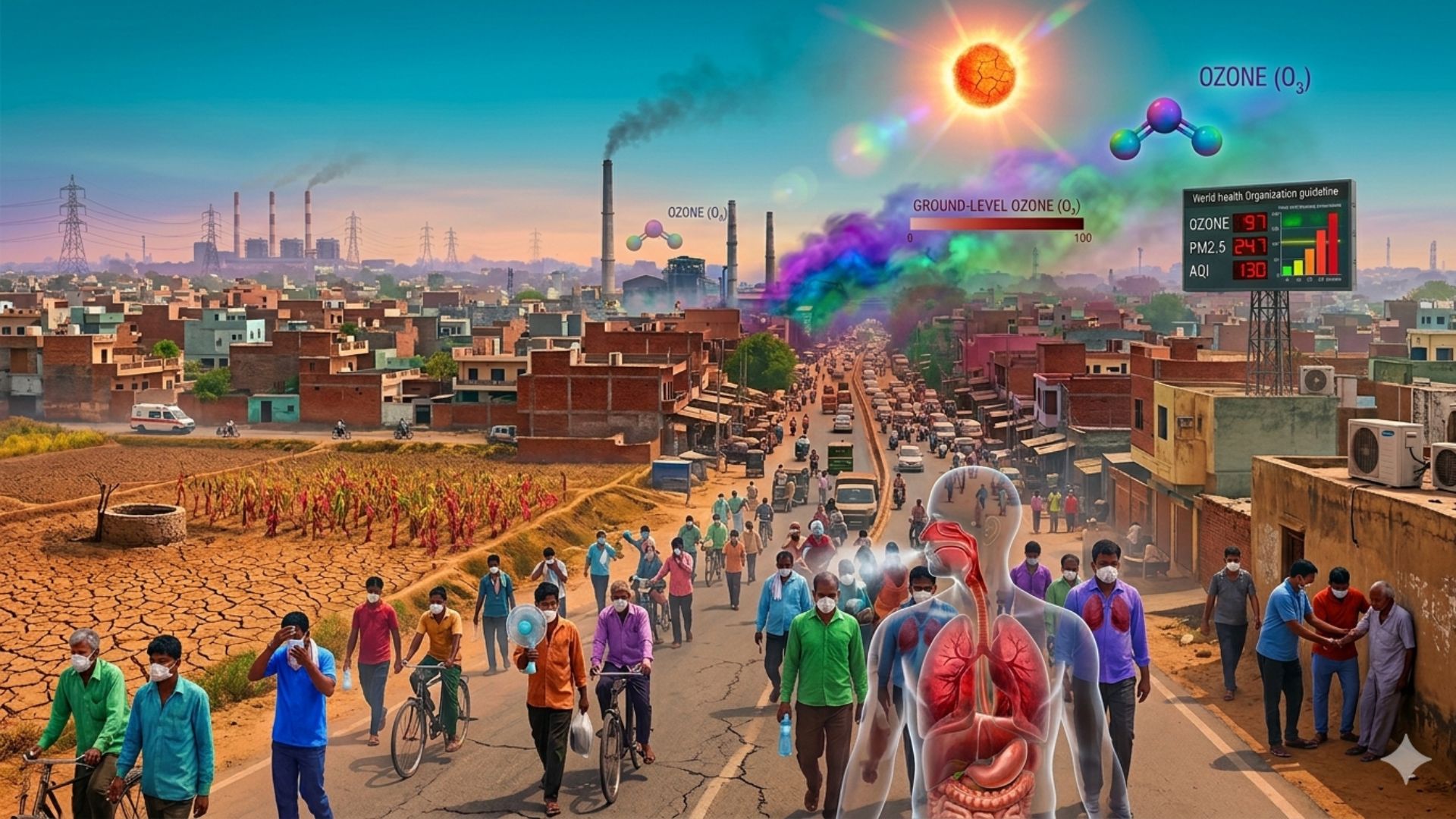
Heatwaves, Surface Ozone and India's Emerging Climate–Air Pollution Nexus

Why in News?
A recent study published in npj Clean Air (Nature Portfolio, June 2026) finds that heatwaves significantly elevate surface ozone levels across India, worsening air pollution and increasing mortality from cardiovascular and respiratory diseases. The study highlights the growing interaction between climate change, atmospheric processes, urbanization, and public health.
“Coupled heat–ozone extremes are intensifying, requiring urgent integrated climate–air quality policy action.”
Understanding Surface Ozone
Surface (ground-level) ozone is a secondary pollutant that is not directly emitted into the atmosphere. It forms when sunlight triggers photochemical reactions among pollutants such as:
- Nitrogen Oxides (NOx)
- Formaldehyde (HCHO)
- Volatile Organic Compounds (VOCs)
Unlike stratospheric ozone, which protects Earth from harmful ultraviolet radiation, surface ozone is harmful to human health and ecosystems.
“Ozone is very harmful, while NO₂ and HCHO directly damage the respiratory system.”
Major Factors Promoting Ozone Formation
| Factor | Impact |
|---|---|
| High temperature | Accelerates photochemical reactions |
| Strong solar radiation | Enhances ozone production |
| Heatwaves | Intensify ozone formation |
| Urban emissions | Supply precursor gases |
| Atmospheric stagnation | Traps pollutants near the surface |
Geographical Basis of the Heatwave–Ozone Nexus
The spatial distribution of ozone across India is shaped by the interaction of climate, atmospheric circulation, topography, seasonality, and urbanization.
1. Temperature–Chemistry Relationship
Heatwaves create ideal conditions for ozone formation.
Higher Temperature
        +
Intense Solar Radiation
        ↓
Faster Photochemical Reactions
        ↓
Greater Surface Ozone Formation
Thus, heatwaves act as natural amplifiers of air pollution.
2. Atmospheric Stability and Pollution Build-Up
Heatwaves are often associated with:
- Weak winds
- Subsiding air masses
- Reduced vertical mixing
These conditions prevent pollutants from dispersing.
Stable Atmosphere
        ↓
Reduced Dispersion
        ↓
Pollutant Accumulation
        ↓
Higher Ozone Levels
3. Why Pre-Monsoon Months Matter
The study notes that ozone levels already exceed safe limits across much of India during the hot pre-monsoon season.
This occurs because:
- Temperatures are highest.
- Solar radiation is strongest.
- Rainfall has not yet begun to cleanse the atmosphere.
With the onset of the monsoon:
- Cloud cover reduces sunlight.
- Rain removes pollutants.
- Ozone concentrations decline.
4. Urban Geography and Heat Islands
Urban centres experience:
- Dense built-up surfaces
- Limited vegetation
- Heavy vehicular emissions
- Industrial activity
These factors create Urban Heat Islands (UHIs) that increase local temperatures and ozone formation.
Urban Heat Island
        ↓
Higher Local Temperature
        ↓
Enhanced Ozone Formation
        ↓
Greater Human Exposure
5. Why the Western Himalayas Are Emerging as a Hotspot
The study reports that the Western Himalayas recorded the steepest long-term increase in ozone levels.
Possible geographical explanations include:
- Long-range transport of pollutants from the Indo-Gangetic Plain.
- Valley-induced trapping of pollutants.
- Rapid warming of mountain ecosystems.
- Increasing atmospheric stagnation during heatwaves.
This demonstrates that even ecologically sensitive mountain regions are becoming vulnerable to anthropogenic pollution and climate-induced atmospheric changes.
6. Influence of El Niño and Global Climate Systems
The most severe heatwave years identified in the study were:
- 2010
- 2016
- 2019
- 2024
These years followed strong El Niño episodes.
El Niño often leads to:
- Above-normal temperatures
- More frequent heatwaves
- Enhanced ozone formation
Thus, global climatic processes increasingly influence local air quality outcomes.
Climate Change and Compound Environmental Extremes
The researchers identified 188 heatwave events between 2004 and 2024 using temperature records from the India Meteorological Department (IMD).
The study illustrates how climate change is producing compound environmental extremes, where one hazard amplifies another.
Climate Change
        ↓
More Frequent Heatwaves
        ↓
Higher Surface Ozone Formation
        ↓
Poor Air Quality
        ↓
Cardio-Respiratory Stress
        ↓
Increased Mortality
The challenge therefore extends beyond rising temperatures to interconnected climate and pollution risks.
Key Findings: Ozone Levels Across India
Surface ozone already exceeds safe limits during much of the pre-monsoon season, but heatwaves further aggravate the problem.
| Indicator | Observation |
|---|---|
| Ozone during heatwaves in North India | 85–110 μg/m³ |
| WHO guideline value | 70 μg/m³ |
| National trend | WHO limit exceeded in all regions |
| Recovery period | 3–4 days after heatwave ends |
Regional Concern
The Western Himalayas exceeded WHO guideline levels by 115% in 2024, recording the steepest long-term rise among all regions.
Urban Environment and Air Pollution
Urban centres are particularly vulnerable because they combine:
- High emissions
- Urban Heat Island effects
- Dense population exposure
Urbanization
      ↓
More Vehicles & Energy Consumption
      ↓
Higher NOx and VOC Emissions
      ↓
Heatwave Conditions
      ↓
Enhanced Surface Ozone
      ↓
Air Quality Crisis
This highlights the close relationship between urban development patterns and environmental health.
Public Health Implications
The study focused on:
- Ischaemic Heart Disease (IHD)
- Chronic Obstructive Pulmonary Disease (COPD)
Mortality Estimates During 2024 Heatwaves
| Category | Estimated Deaths |
|---|---|
| Deaths linked to ozone exposure during heatwave days | ~26,500 |
| Additional deaths due specifically to heatwave-induced ozone increase | ~832 |
| └ Heart disease | ~490 |
| └ COPD | ~342 |
Understanding the Estimates
The figures are modelled estimates rather than directly observed deaths.
Researchers applied:
- Exposure-response relationships,
- Disease prevalence data,
- Population statistics,
to estimate mortality impacts.
The authors acknowledge that continuous ground-level ozone measurements were unavailable for many affected cities during specific heatwave periods, necessitating the use of modelling approaches.
Environmental and Ecological Consequences
Elevated ozone affects not only human health but also ecosystems.
Potential Impacts
- Reduced agricultural productivity
- Damage to vegetation
- Lower photosynthetic efficiency
- Stress on forest ecosystems
- Reduced carbon sequestration potential
Thus, ozone pollution has implications for food security, biodiversity, and climate mitigation efforts.
Methodology and Significance of the Study
The researchers combined:
- Two decades of IMD temperature records,
- Satellite observations,
- Global meteorological datasets,
to assess ozone behaviour during heatwaves.
Significance
The study is described as the:
- First comprehensive,
- First long-term,
- First nationwide
assessment of surface ozone during heatwaves in India.
Previous studies were largely restricted to individual cities or regions.
Governance and Disaster Management Dimension
The study gains significance in light of the 16th Finance Commission's recommendation (November 2025) to include:
- Heatwaves
- Lightning
within India's list of nationally notified disasters.
This would enable states to access the State Disaster Response Fund (SDRF) for relief and mitigation.
The findings strengthen the argument that heatwaves should be viewed as multi-dimensional environmental disasters with health, economic, and ecological consequences.
Way Forward
- Integrate climate and air-quality governance frameworks.
- Expand continuous ozone-monitoring networks across India.
- Strengthen heatwave and air-quality early-warning systems.
- Reduce NOx and VOC emissions from transport and industry.
- Promote climate-resilient urban planning and green infrastructure.
- Enhance public-health surveillance for pollution-related illnesses.
- Mainstream compound climate risks into disaster-management planning.
- Protect vulnerable regions such as the Himalayas through region-specific adaptation strategies.
Conclusion
The study demonstrates that heatwaves and air pollution are no longer separate environmental challenges. Rising temperatures are intensifying surface ozone formation, creating a dangerous climate–air pollution nexus with significant implications for public health, ecosystems, urban sustainability, and disaster management. As climate change accelerates, India will require integrated policies that combine climate adaptation, pollution control, sustainable urban development, and resilient governance to address these emerging compound risks.
Attribution
Original content sources and authors


Syllabus classification
How this article maps to GS papers
Main syllabus
GS3Environment & Bio-diversityAlso covers
Quick Q&A
What is surface ozone pollution and why has it emerged as a significant environmental and public health concern in India?
Why are heatwave-induced ozone episodes becoming increasingly important for policy makers and UPSC aspirants to understand?
How do heatwaves contribute to higher surface ozone concentrations and what mechanisms explain this relationship?
What are the major reasons behind the intensification of coupled heatwave and ozone extremes in India over the last two decades?
What are the key findings and limitations of the recent study on ozone-related mortality during heatwaves in India?
What policy measures and case studies illustrate the need for integrated climate and air-quality management in India?
Practice questions
1 question for mains preparation