GS3 Environment & Bio-diversity
Revisiting Invasive Species: A Shift in Environmental Perspective

Introduction
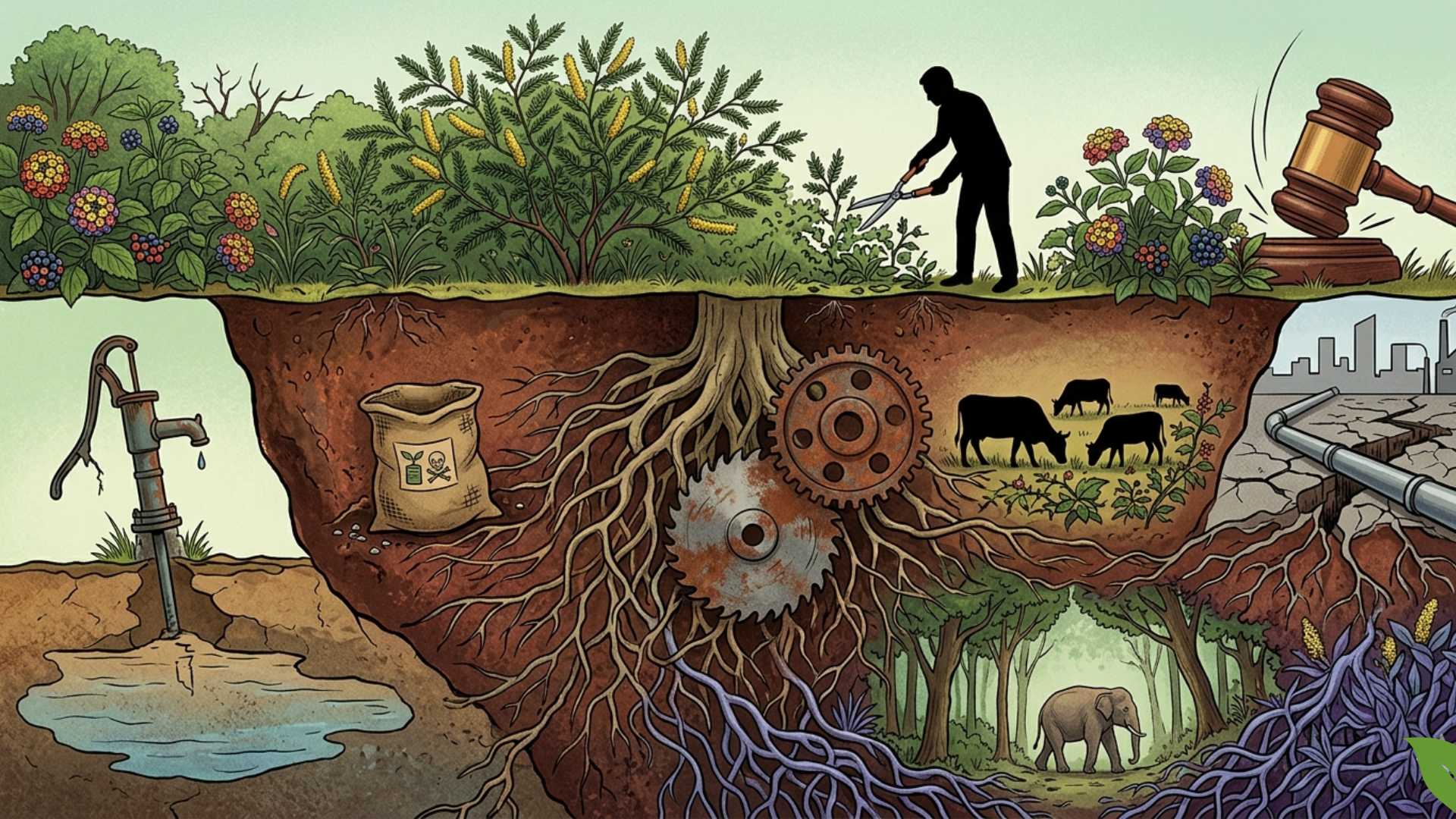
India is witnessing a surge in administrative and judicial action against Invasive Alien Species (IAS) — from Tamil Nadu court orders targeting Prosopis juliflora across 517 villages in 32 districts, to State-wide eradication drives against Lantana camara and Senna spectabilis. Yet the prevailing assumption — remove the invasive species and ecological recovery will follow — fundamentally misreads the problem. These species are symptoms of deeper landscape transformation, not its cause.
"India risks spending much of its conservation energy removing plants that are symptoms of a wider civilisational transformation it has yet to confront."
| Species | Region | Driver of Spread |
|---|---|---|
| Prosopis juliflora | Tamil Nadu, arid zones | Irrigation seepage, altered hydrology, introduced 1877 |
| Lantana camara | Wayanad, Western Ghats | Forest edge degradation, heavy livestock grazing |
| Senna spectabilis | Multiple States | Nitrogen deposition, atmospheric carbon rise |
Background: Physical Disruption Came First
Native ecosystems across India were already compromised before IAS became dominant. Colonial forestry, plantation expansion (tea, coffee, rubber, teak, eucalyptus), logging, mining, roads, and chemical agriculture fragmented habitats and altered soil biology, shade regimes, and water cycles — long before invasive plants filled the vacuum.
P. juliflora was introduced in 1877 and remained present for decades without dominance. What changed was the landscape around it — Green Revolution-era canal expansion, borewell proliferation, and fertiliser surge created waterlogging and altered soil moisture regimes that this deep-rooted phreatophyte is physiologically suited to exploit.
Key Ecological Drivers Sustaining IAS
Livestock Pressure: India supports ~500 million cattle and livestock — one of the world's largest populations — exerting continuous grazing pressure on forests and commons. Palatable native species are suppressed; thorny, chemically defended, disturbance-tolerant species like L. camara persist and expand.
Nutrient Loading: India uses 35–40 million tonnes of urea per year. Atmospheric nitrogen deposition adds 10–30 kg per hectare annually across many regions. Nitrogen-fixing woody IAS like S. spectabilis and P. juliflora thrive under these altered chemical conditions.
Urbanisation: India's urban governance footprint has roughly doubled over three decades, creating fragmented high-disturbance landscapes extending deep into peri-urban and rural ecologies — ideal conditions for IAS colonisation.
Climate and Carbon: Rising atmospheric CO₂ is associated with increasing woody cover across open landscapes globally. IAS with woody, disturbance-tolerant physiology benefit disproportionately.
The Misdiagnosis Problem
Conservation efforts targeting only visible plants risk measuring the wrong thing — it is easier to count acres cleared than to measure shifts in soil chemistry or moisture regimes. Three structural problems with removal-only approaches:
- Ecological vacuum: Without restored ecological relationships, clearing creates new vacancies that the same or another IAS rapidly fills
- Succession uncertainty: Even natural ecological succession after removal does not guarantee return to prior ecological states — new assemblages emerge suited to current conditions
- Compensatory roles ignored: Some IAS accumulate heavy metals, fix nitrogen, bind soil, provide wildlife cover in disturbed landscapes, and serve as pioneer species enabling later native re-establishment
Way Forward: Restoration Over Removal
- Read the land comprehensively — understand hydrological, chemical, and ecological history before intervening
- Phased, community-led removal — communities embedded in habitats are best placed for careful, ecologically sensitive clearing
- Least-harm principle — large-scale mechanical removal serves biomass economy interests more than ecological recovery
- Address underlying drivers — livestock policy, fertiliser regulation, hydrological restoration, and land-use planning must accompany any species removal
- Intergenerational time horizon — restoration is local, patient, and continuous; success can only be judged over years, not acres cleared
Conclusion
-
The campaign against IAS in India reflects a broader pattern in environmental governance: treating visible symptoms while leaving structural causes untouched. P. juliflora, L. camara, and S. spectabilis did not create India's ecological crisis — they colonised the spaces that industrial agriculture, colonial forestry, and urbanisation left behind.
-
Genuine restoration demands confronting this civilisational transformation honestly — through integrated land-use policy, reduced chemical inputs, livestock management, and community-centred ecological care — rather than animating an earthmover economy in the name of conservation.
Attribution
Original content sources and authors


Syllabus classification
How this article maps to GS papers
Main syllabus
GS3Environment & Bio-diversityQuick Q&A
What are invasive alien species (IAS), and why have they become a major ecological governance issue in India?
The issue has gained administrative and judicial attention because IAS are increasingly linked to ecological degradation, human-wildlife conflict, and declining ecosystem productivity. For example, courts and State governments have initiated removal drives against P. juliflora in Tamil Nadu and L. camara in parts of the Western Ghats. The prevailing assumption is that removing these species will automatically restore ecological health.
However, the article argues that invasive species are often symptoms rather than root causes of ecological decline. Many landscapes had already undergone severe transformation before IAS became dominant. Colonial forestry, plantation expansion, road construction, mining, intensive agriculture, and urbanisation fragmented ecosystems and weakened native biodiversity. Such disturbed landscapes create ecological vacancies that invasive species can exploit more effectively than native plants.
For instance, P. juliflora was introduced in India in the 19th century but became highly invasive only after irrigation expansion, groundwater alteration, and agricultural intensification changed soil and moisture conditions. Thus, the spread of IAS is closely linked to broader ecological disruptions such as climate change, nutrient loading, grazing pressure, and hydrological imbalance.
The issue therefore goes beyond simple species removal. It raises larger questions about ecological restoration, development models, land-use policies, and sustainability. Effective governance requires understanding how economic systems, infrastructure expansion, and environmental degradation interact to create conditions favourable to invasive species.
Why is the assumption that removing invasive species will automatically restore ecosystems considered problematic?
The article highlights that ecological degradation often predates the arrival or spread of invasive species. For example, forest edges in Wayanad had already suffered biodiversity loss and habitat fragmentation before Lantana camara spread extensively. Similarly, P. juliflora expanded in Tamil Nadu after irrigation-related changes altered soil moisture and hydrological conditions. Therefore, invasive species are often beneficiaries of ecological disruption rather than its sole cause.
Removing invasive species without addressing underlying environmental conditions can produce unintended consequences. Once invasive plants are cleared, vacant ecological space may emerge, creating opportunities for the same species or another invasive species to recolonise the area. In degraded landscapes where native biodiversity has weakened, natural ecological recovery may not occur automatically.
Large-scale mechanical removal also creates economic and ecological complications. Excessive clearing can disturb soils, increase erosion, damage surviving native vegetation, and encourage commercial interests linked to biomass extraction or land conversion. In some regions, invasive plants may also perform limited ecological functions such as soil stabilisation, carbon storage, or providing cover for wildlife in disturbed habitats.
This does not mean invasive species should never be removed. Rather, restoration must adopt a holistic approach involving soil recovery, hydrological restoration, biodiversity conservation, grazing management, and long-term monitoring. Ecological restoration is a gradual process requiring local participation and scientific understanding.
Thus, the article argues that conservation efforts should move beyond simplistic narratives of ‘good native species versus bad invasive species’ and instead focus on restoring resilient ecological relationships.
How have historical land-use changes and modern development practices contributed to the spread of invasive alien species in India?
During the colonial period, large areas of forests were cleared for commercial plantations such as tea, coffee, rubber, teak, and eucalyptus. Diverse ecosystems were replaced with simplified monocultures that altered soil composition, water cycles, and biodiversity patterns. Roads, railways, mining, and settlement expansion fragmented habitats further, weakening the resilience of native ecological communities.
Post-independence development intensified these transformations. The Green Revolution increased fertiliser use, groundwater extraction, irrigation canal expansion, and chemical agriculture. Such interventions altered hydrological and nutrient regimes across landscapes. Deep-rooted species like P. juliflora adapted effectively to these changed conditions, especially in waterlogged or degraded soils.
Rapid urbanisation has also played a major role. India’s expanding urban footprint has produced fragmented and high-disturbance peri-urban landscapes. Construction activities, waste generation, pollution, and transport networks create disturbed environments where hardy invasive species thrive more easily than native plants.
Livestock pressure is another significant factor. India supports nearly 500 million cattle and livestock, resulting in heavy grazing pressure on forests and commons. Palatable native species are repeatedly consumed while thorny, chemically defended plants such as Lantana camara survive and expand.
Climate change and atmospheric nitrogen deposition further strengthen invasive species by altering rainfall patterns, temperature, and nutrient availability. Woody nitrogen-fixing species like Senna spectabilis benefit from such conditions.
Therefore, IAS spread is not simply a biological accident but a consequence of broader socio-economic and developmental processes. Addressing the problem requires sustainable land-use planning, ecological restoration, climate-sensitive policies, and reduced dependence on ecologically destructive production systems.
Critically analyse whether invasive alien species should always be viewed only as ecological threats.
From a conservation perspective, invasive plants can intensify human-wildlife conflict, reduce agricultural productivity, and increase management costs. Dense thickets may hinder movement of wildlife and local communities alike. Their spread is often associated with biodiversity loss and ecological homogenisation.
However, the article argues that viewing IAS solely as ecological villains oversimplifies a much more complex reality. Many invasive species thrive because ecosystems have already been deeply altered by human activities. In disturbed landscapes, certain IAS may perform temporary compensatory ecological functions.
For example, some invasive plants can:
- Stabilise degraded soils and prevent erosion
- Accumulate heavy metals and pollutants
- Provide biomass, shade, or windbreaks
- Create ecological conditions that later allow other species to establish
- Offer shelter to smaller wildlife in fragmented habitats
Pioneer species often dominate during ecological succession after disturbance. Over time, native species may gradually return if conditions improve. Therefore, some IAS may function as ecological first responders in heavily degraded landscapes.
This does not imply that invasive species are harmless or desirable. Their ecological role must be evaluated contextually rather than ideologically. Blanket eradication campaigns without ecological assessment may sometimes cause more damage than benefit.
The key challenge is balancing conservation goals with ecological realities. Policymakers must distinguish between situations where removal is necessary and situations where gradual restoration and adaptive management may be more effective. Ecological systems are dynamic, and restoration cannot always recreate historical conditions exactly.
Thus, invasive species should be understood not merely as isolated biological threats but as indicators of deeper environmental and developmental transformations.
Suppose a State government plans a massive mechanical removal campaign against Prosopis juliflora. As a policy advisor, what ecological and governance concerns would you raise?
First, ecological assessment is essential. Policymakers must identify why the species became dominant in the first place. In many cases, degraded soils, altered hydrology, overgrazing, and biodiversity loss create conditions favourable to P. juliflora. If these underlying drivers remain unchanged, cleared landscapes may simply be reinvaded.
Second, large-scale mechanical clearing can damage ecosystems further. Heavy machinery may compact soils, disturb microbial networks, increase erosion, and destroy surviving native vegetation. Sudden clearing can also expose landscapes to extreme heat and moisture loss.
Third, socio-economic dimensions must be considered. In some regions, local communities use P. juliflora for fuelwood, charcoal production, fencing, and livelihood support. Abrupt eradication without alternatives may negatively affect vulnerable populations.
A phased and locally adapted strategy would therefore be preferable. Such an approach may include:
- Selective removal in ecologically sensitive areas
- Restoration of native grasses and shrubs
- Improved grazing management
- Hydrological restoration and soil conservation
- Long-term ecological monitoring
- Community participation in restoration efforts
The government should also distinguish between areas where removal is ecologically beneficial and areas where the species has become integrated into highly altered landscapes.
Finally, restoration must be viewed as a long-term process rather than a short-term administrative target. Success cannot be measured merely by the number of acres cleared but by whether biodiversity, soil health, water balance, and ecosystem resilience improve over time.
What are the broader environmental and civilisational lessons that the invasive species debate offers for India’s development model?
India’s economic development model has prioritised large-scale production, infrastructure expansion, monoculture plantations, and chemical-intensive agriculture. While these policies increased food production and economic growth, they also altered ecosystems fundamentally through deforestation, groundwater depletion, pollution, habitat fragmentation, and biodiversity loss.
The spread of invasive species demonstrates how ecological systems respond to these disruptions. Species such as P. juliflora and Lantana camara thrive because landscapes have become disturbed, nutrient-rich, fragmented, and climatically altered. Their expansion reflects changing hydrological and atmospheric conditions rather than merely biological invasion.
The debate also exposes limitations of technocratic conservation approaches. Policymakers often prefer visible and measurable interventions such as mechanical removal campaigns because they generate immediate administrative outcomes. However, ecological restoration requires patience, local knowledge, and long-term engagement with complex environmental processes.
Another important lesson concerns sustainability and justice. Rural communities, indigenous groups, and local practitioners often possess deep ecological understanding but remain marginalised in top-down conservation programmes. Restoration efforts that ignore local livelihoods may create social conflict and fail ecologically.
The article therefore calls for a more holistic environmental ethic. India must move toward development models that balance economic growth with ecological resilience. This includes sustainable agriculture, biodiversity-sensitive land use, reduced chemical dependence, climate adaptation, and participatory conservation governance.
Ultimately, the invasive species issue is not only about plants invading ecosystems; it is also about human economic systems reshaping the conditions of life itself. Addressing the challenge requires confronting the deeper ecological consequences of modern development.
Practice questions
2 questions for mains preparation