GS3 Environment & Bio-diversity
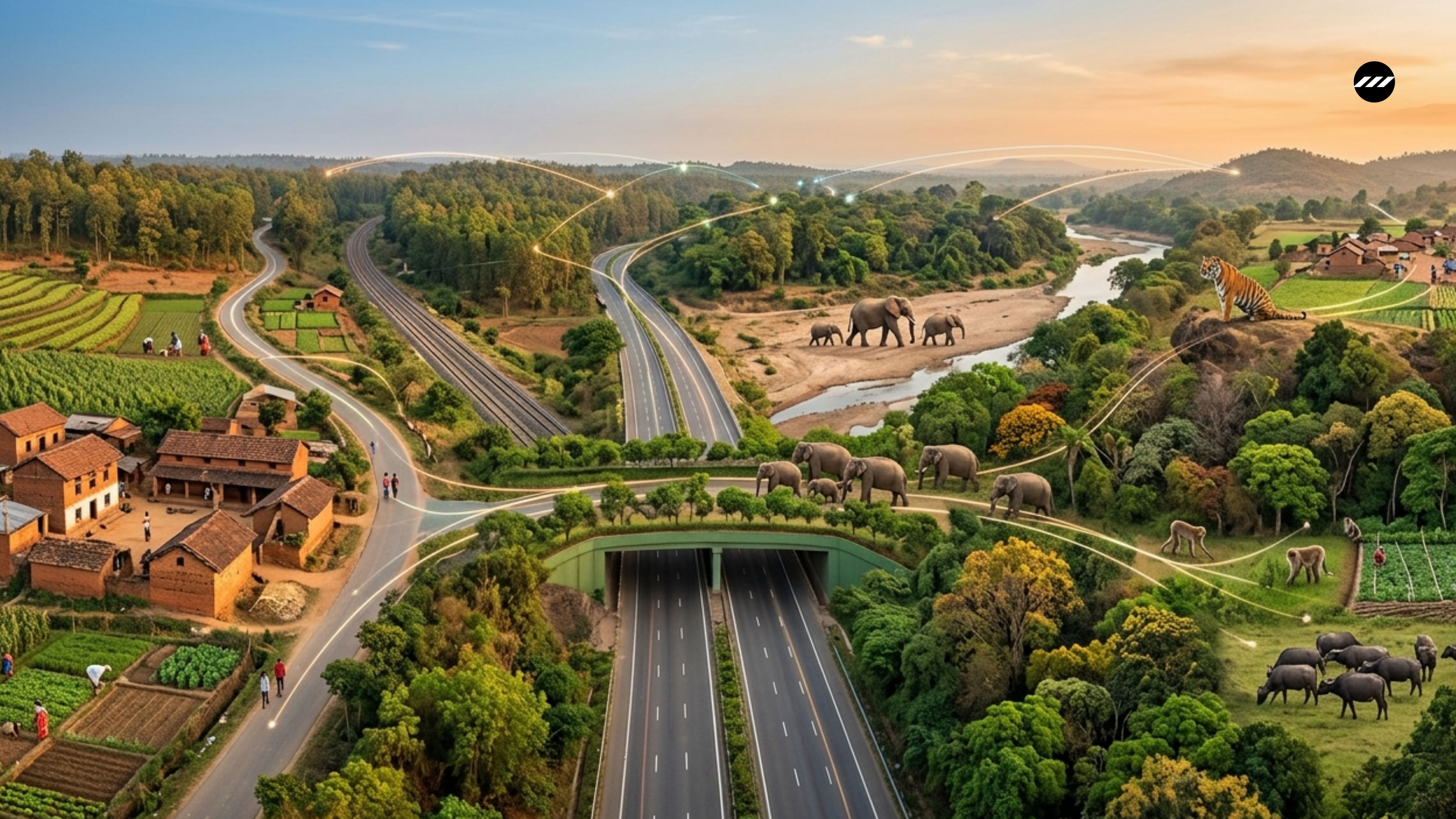
Managing Coexistence in Human-Wildlife Conflict Zones

Human-wildlife conflict (HWC) is routinely framed as a conservation problem — animals straying into human territory. The reality is far more complex. It is a socio-ecological challenge shaped by land use, livelihoods, and ecological change, where human activity is the primary driver of increasing frequency and intensity of such encounters.
The Scale of the Problem
The numbers are stark. In India, hundreds of people die annually in elephant encounters, while large numbers of livestock are lost to predators. Similar patterns recur across Africa, Southeast Asia, and Latin America. The most conflict-prone geographies are:
- South and Southeast Asia — elephants, big cats
- Sub-Saharan Africa — large mammals across vast ranges
- Latin America — Brazil in particular, involving predator-prey disruption
Countries like India, Indonesia, Kenya, Tanzania, and Brazil face recurring challenges because these are precisely the regions where biodiversity overlaps with dense human settlement.
Why It Happens: Ecological Logic, Not Animal Aggression
A critical insight that often gets lost in public discourse — animal behaviour in conflict situations is rarely aggressive in intent. It is adaptive.
Crop raiding by elephants or livestock predation by carnivores are adaptive responses to ecological constraints, not aberrant behaviour.
Forest cleared → Natural corridor disrupted
       ↓
Wildlife moves into agricultural/peri-urban areas
       ↓
Crop raiding, livestock predation, human casualties
       ↓
Retaliatory killing, habitat destruction — cycle deepens
Monkeys and wild boars exploit food near forest edges. Predators turn to livestock when natural prey declines. These are predictable ecological responses to habitat fragmentation, agricultural expansion, and changing land use — not random acts of wildlife aggression.
Global Models: What Coexistence Looks Like
Successful global responses share three features: strong local participation, reliable economic support, and ecological data-driven planning. They treat HWC as a shared management issue, not a law-and-order problem.
- Botswana and Namibia — Community-based natural resource management; local communities share tourism revenues and gain rights over wildlife use, aligning conservation with economic incentives
- Costa Rica — Ecological corridors integrated into national land-use planning to maintain habitat connectivity
- Finland — Real-time wildlife monitoring combined with rapid compensation systems, reducing both risk and resentment
- Bhutan and Nepal — Community-managed forests, coordinated grazing, and predator-proof livestock enclosures backed by stable conservation funding
India's Challenges: Well-Intentioned but Incomplete
India has compensation schemes, technological interventions like solar fencing and early-warning systems, and a robust legal framework for wildlife protection. However, significant gaps remain:
- Compensation mechanisms lack timeliness, coverage, and accessibility — particularly for marginalised communities
- Solar fencing and early-warning systems show context-specific success but lack coordinated ecological planning
- Legal frameworks need realignment with evolving human-wildlife interface realities
One recurring suggestion in public debate — fertility control in wild elephants — has been flagged by experts as having limited applicability. In the Indian context, where elephants range across vast fragmented landscapes, the core problem is habitat loss, food and water competition, and expanding human-wildlife interface. Isolated technical fixes cannot substitute for systemic solutions.
The Way Forward
Climate change will intensify HWC further by altering resource availability and forcing adaptation in both humans and wildlife — adding urgency to structural reform.
The path to coexistence requires:
- Habitat restoration and ecological connectivity as the primary intervention
- Securing wildlife corridors within land-use planning frameworks
- Strengthening and expediting compensation systems
- Community participation as active partners, not passive beneficiaries
- Education and awareness to rebuild social tolerance toward wildlife
Conclusion
HWC is not an anomaly — it is a predictable outcome of how societies use land and resources. The goal cannot be to eliminate conflict entirely; that is ecologically unrealistic. The goal is to manage it in ways that are scientifically informed, socially just, and ecologically sustainable. Coexistence between people and wildlife is not an idealistic aspiration — it is an ecological and civilisational necessity.
Attribution
Original content sources and authors


Syllabus classification
How this article maps to GS papers
Main syllabus
GS3Environment & Bio-diversityQuick Q&A
What is human-wildlife conflict (HWC), and why should it be understood as a socio-ecological issue rather than merely a conservation problem?
HWC emerges when human activities alter ecosystems through deforestation, mining, infrastructure projects, and agricultural expansion. This disrupts wildlife habitats and migratory corridors, compelling animals to move into farms and villages. For example, elephants entering agricultural fields in India or Kenya are not simply 'encroaching' but responding to shrinking habitats and fragmented landscapes.
Its broader significance lies in the interaction between ecology and society:
- Livelihoods of rural communities are directly affected through crop losses and livestock attacks.
- Conservation efforts are weakened when local communities perceive wildlife as threats.
- It reflects unsustainable development patterns and weak land-use planning.
Why is human-wildlife conflict increasing globally, and what structural factors are driving this trend?
Another major factor is declining prey and resource availability. Predators often attack livestock when natural prey populations shrink due to ecological stress. Similarly, herbivores raid crops because cultivated fields offer abundant food. Climate change worsens this by altering water and food distribution, forcing species to move unpredictably.
Structural reasons include:
- Rapid conversion of forests into agricultural and urban landscapes.
- Linear infrastructure such as roads and railways cutting migration corridors.
- Population growth in biodiversity-rich regions.
- Weak ecological integration in development planning.
How have different countries addressed human-wildlife conflict, and what lessons can India draw from global best practices?
Costa Rica integrates ecological corridors into national planning, ensuring habitat continuity for species movement. Finland employs GPS tracking, real-time alerts and rapid compensation mechanisms, reducing both conflict and resentment. These systems recognise HWC as a management issue requiring institutional coordination.
India can draw three key lessons:
- Empower local communities as stakeholders rather than passive recipients.
- Ensure timely and transparent compensation systems.
- Incorporate wildlife movement data into land-use planning.
Critically analyse the limitations of India’s current approach to managing human-wildlife conflict.
A major limitation is the delay in compensation disbursal, which undermines trust among affected communities. Marginalised groups often face procedural barriers in claiming losses. Technological interventions are unevenly deployed and frequently fail where ecological planning is weak. Legal frameworks remain conservation-centric and do not adequately integrate land-use change or local governance realities.
Critical concerns include:
- Overreliance on compensation rather than prevention.
- Weak habitat restoration and corridor protection.
- Limited interdepartmental coordination between forest, agriculture and rural development agencies.
- Insufficient community participation in policy design.
How does climate change intensify human-wildlife conflict, and what implications does it hold for future conservation policy?
For instance, drought conditions may drive elephants toward agricultural fields and settlements in search of water, while predators may approach villages when prey species decline. Seasonal changes also disrupt migration patterns, creating unexpected wildlife movement. This makes traditional conflict prediction models less reliable.
Policy implications are significant:
- Conservation planning must incorporate climate adaptation strategies.
- Water sources and corridors must be restored proactively.
- Land-use policies should account for future ecological shifts.
- Disaster management frameworks should integrate wildlife responses.
Using India as a case study, explain how coexistence between humans and wildlife can be achieved in practice.
Practical coexistence requires multi-dimensional interventions. Securing wildlife corridors ensures safe animal movement. Community-based conservation involving local forest users creates shared responsibility. Improved compensation and insurance systems reduce economic losses. Awareness programmes can change public perceptions from hostility to coexistence.
Practical strategies include:
- Restoring forest connectivity between protected areas.
- Community-managed grazing systems.
- Predator-proof livestock shelters.
- Participatory land-use planning involving panchayats.
Practice questions
1 question for mains preparation