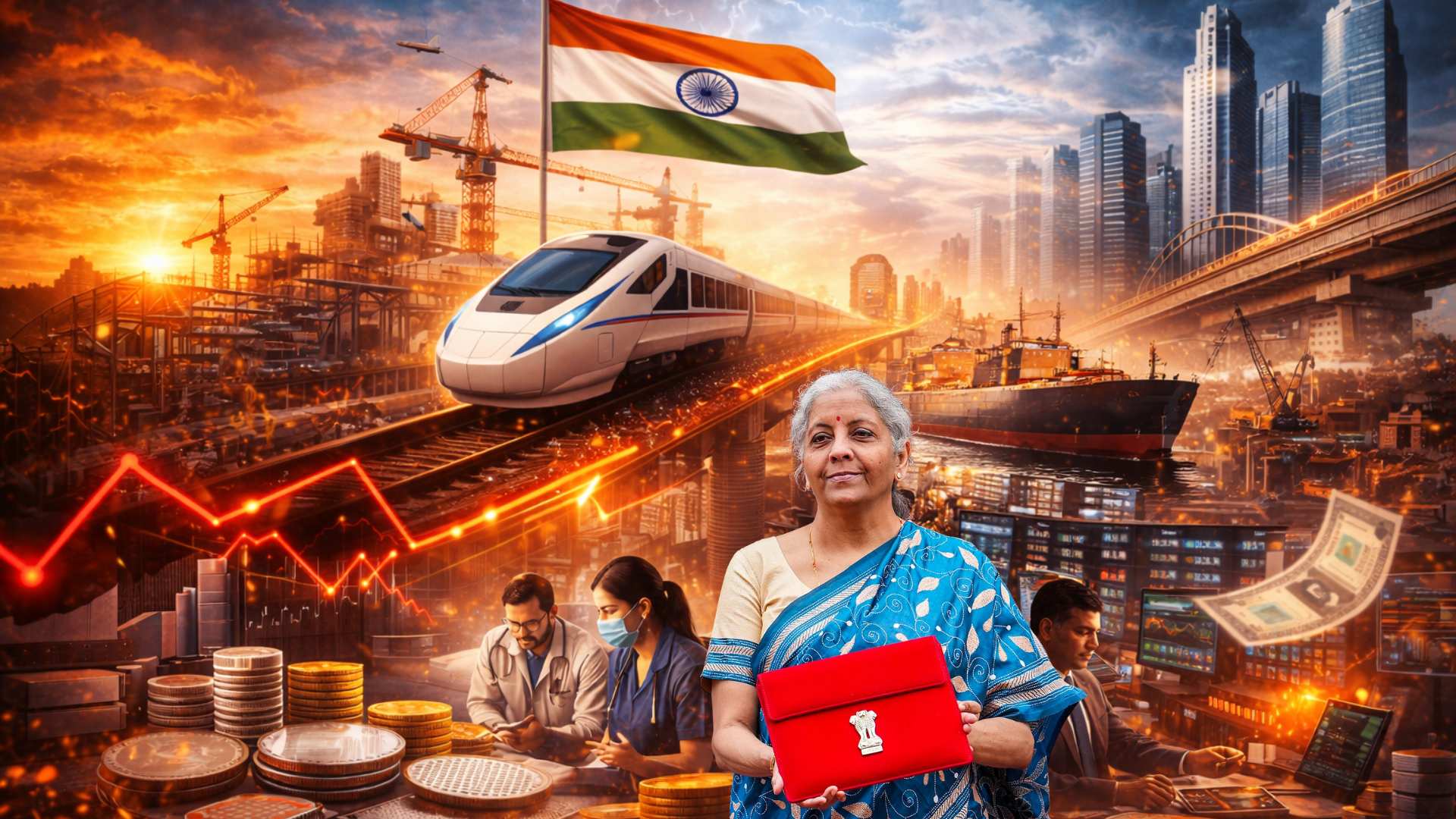
A Budget for Uncertain Times: Growth through Services

The Union Budget 2026-27 emphasizes fiscal consolidation and enhances services for sustainable economic growth.
S
Surya
5 mins read
Union Budget 2026-27: Driving growth through infrastructure, services, and fiscal prudence amid global uncertainties
Not Started

1. Macroeconomic Context and Budgetary Setting

The Union Budget 2026–27 has been presented against the backdrop of heightened global geoeconomic uncertainty, marked by trade tensions, financial market volatility, and slowing global demand. Despite this, India’s economy recorded a robust 7.4% real GDP growth, underscoring relative macroeconomic resilience.

This context matters for governance because external shocks can quickly transmit through trade, capital flows, and commodity prices. A growth-supportive Budget becomes critical to prevent cyclical slowdown from turning structural.

The Budget therefore seeks to balance growth stimulation with prudence. Failure to manage this balance could risk either demand compression (if consolidation is too sharp) or macro-instability (if borrowing rises excessively).


2. Public Capital Expenditure as the Primary Growth Lever

The government has continued its strategy of using public capital expenditure to crowd in growth. Infrastructure spending is budgeted to rise to ₹12.2 trillion in 2026–27, reflecting a sustained emphasis on asset creation rather than consumption-led stimulus.

The new infrastructure vision focuses on connectivity and logistics efficiency: high-speed rail corridors (especially in South India), east–west dedicated freight corridors, coastal cargo systems, and 20 new national waterways to move minerals from interiors to ports. These projects aim to reduce transaction costs and improve long-term productivity.

A notable institutional feature is that a significant portion of additional capex is routed through interest-free loans to States, strengthening cooperative federalism and decentralised investment capacity. Ignoring state-level capacity could otherwise weaken national growth impulses.


3. Manufacturing Push and the Limits of “Make in India”

Despite high public investment, private investment in factories and projects has remained muted, and job creation has been limited. This highlights the limits of relying on public capex alone to revive manufacturing dynamism.

There have been targeted successes. The Budget announced a second iteration of the India Semiconductor Mission and increased the outlay for the Electronics Components Manufacturing Scheme to ₹40,000 crore (from ₹23,000 crore). These aim to build strategic manufacturing capabilities.

However, structural headwinds persist: global trade tensions, uncertain market access, and tariff and non-tariff barriers for Indian goods. Rising capital intensity of modern manufacturing also weakens its employment potential. If these constraints remain unresolved, manufacturing-led mass employment may remain elusive.


4. Strategic Shift Towards Services-Led Employment

The Budget signals a strategic recalibration towards the services sector. A high-powered committee has been proposed to examine employment and output across services, spanning “education to employment and enterprise”.

Specific services verticals—IT-enabled services, tourism, health and veterinary care, social care, and the creative sector—received targeted support through centres of excellence, subsidies, and institutional funding. Services are less exposed to tariff barriers and global supply-chain disruptions.

This shift reflects concerns about limited private manufacturing investment and rising automation. However, services growth is skill-intensive, and the success of this strategy hinges on closing workforce skill gaps. Ignoring this could widen inequality and constrain absorptive capacity.


5. Technology, Artificial Intelligence, and Employment Uncertainty

While services are being prioritised, the Budget implicitly confronts a new uncertainty: the disruptive impact of artificial intelligence. Many services—IT, creative work, and even parts of healthcare—are increasingly susceptible to automation.

This raises questions about the sustainability of job creation precisely in sectors now being promoted. Governance must therefore anticipate not just sectoral expansion but also task-level disruption.

If the AI challenge is underestimated, policies may generate output growth without commensurate employment, aggravating concerns of “jobless growth”.


6. Fiscal Consolidation, Debt Targeting, and Market Implications

A significant institutional shift in this Budget is the move from fiscal deficit targeting to debt-to-GDP ratio as the “operational instrument for debt targeting”. The debt ratio is projected to decline marginally from 56.1% to 55.6% of GDP in 2026–27.

The fiscal deficit is budgeted to fall only slightly from 4.4% to 4.3% of GDP, reflecting slower consolidation. This approach assumes 10% nominal GDP growth, partly driven by higher inflation expectations.

However, debt dynamics remain challenging. While net borrowing rises modestly, gross market borrowing increases sharply to ₹17.2 trillion (from ₹14.6 trillion), likely exerting upward pressure on bond yields. If markets lose confidence, borrowing costs could rise structurally.


7. Ease of Living, Market Regulation, and Governance Reforms

For households, small businesses, and investors, the Budget emphasises governance reforms and transaction cost reduction. Measures include expanding TReDS for MSMEs, decriminalising several tax offences, granting immunity for certain compliance oversights, and shifting Customs towards a trust-based approach.

Personal consumption facilitation is reflected in revised duty-free allowances for travel. At the same time, securities transaction tax on futures and options has been tightened to curb excessive retail speculation.

These steps align with the long-term “ease of living” framework. Ignoring regulatory excesses or speculative risks could undermine financial stability and public trust.


Conclusion

The Union Budget 2026–27 reflects a calibrated response to global uncertainty, combining sustained public investment, cautious fiscal consolidation, and a strategic pivot towards services-led growth. Its success will depend on execution capacity, skill development, and managing debt-market dynamics. Over the long term, aligning infrastructure, human capital, and fiscal credibility will be central to sustaining inclusive and resilient growth.

Quick Q&A

Everything you need to know

Key priorities:
The Union Budget 2026-27 focuses on sustaining growth through capital expenditure, fiscal prudence, and a targeted shift toward services. Infrastructure spending is set to rise to ₹12.2 trillion, including new high-speed rail links, dedicated freight corridors, 20 national waterways, and coastal cargo initiatives. A significant portion of this capital expenditure is provided as interest-free loans to states to catalyse local investment.

Growth strategy:
While private manufacturing investment remains muted, the Budget leverages public investment to create growth momentum. The second iteration of the India Semiconductor Mission and increased allocation to Electronics Components Manufacturing Scheme demonstrate targeted support for critical manufacturing sectors. Additionally, a high-powered committee on services and sectoral schemes—from IT-enabled services to health, veterinary care, and creative industries—indicates a focus on employment generation and skill development in sectors less affected by trade barriers.

Implications:
By combining capital-intensive infrastructure, fiscal restraint, and a pivot to the services sector, the Budget seeks to sustain India’s robust growth of 7.4% amid geopolitical uncertainty. It reflects a nuanced approach that balances immediate economic needs with medium- to long-term structural priorities.

Limited response from manufacturing:
Private investment in manufacturing has lagged despite government initiatives like Make in India. Factors include high capital intensity of factories, ongoing trade tensions, and global market access issues, which restrict returns on new industrial projects.

Advantages of services:
The services sector, including IT, health, tourism, creative industries, and social care, faces none of these external constraints. It offers a relatively easier avenue for job creation and economic diversification. By enhancing skills through targeted schemes and centres of excellence, the government aims to close workforce gaps and leverage sectors with high growth potential.

Strategic importance:
This focus also aligns with global trends, where knowledge-intensive services are becoming major drivers of GDP. It allows India to maintain employment generation and productivity growth while structural constraints in manufacturing are addressed. This shift demonstrates adaptability in economic planning, balancing traditional industrial ambitions with realistic growth levers.

Shift from fiscal deficit to debt-to-GDP ratio:
The government has transitioned its formal fiscal target from fiscal deficit to debt-to-GDP ratio, aiming to reduce it marginally from 56.1% to 55.6%. Fiscal deficit is projected to decline slightly from 4.4% to 4.3%, indicating a modest approach to consolidation given global economic pressures.

Capital expenditure-led growth:
Despite constrained fiscal space, capital expenditure is prioritized at ₹12.2 trillion, covering infrastructure projects, freight corridors, and high-speed rail. Interest-free loans to states further amplify growth potential without adding immediate debt burden.

Revenue management:
The Budget continues efforts to rationalize subsidies, tighten non-essential spending, and enhance efficiency in tax collection. Measures such as decriminalization of minor tax offences, expanding TReDS for MSMEs, and customs reforms support private enterprise and business confidence without compromising fiscal discipline. This combination ensures that consolidation does not stifle growth initiatives.

Market liquidity vs retail speculation:
The increase in STT on derivatives aims to curb excessive retail speculation, which had been encouraged by gamification and short-term trading strategies. While it may slightly reduce trading volumes and liquidity, it is intended to make markets more stable and less prone to volatility induced by speculative flows.

Encouraging responsible investment:
By moderating the pace of high-risk trading, the government encourages investors to focus on long-term, stock-specific, or corporate earnings-driven investment rather than derivatives-driven speculation. This aligns with broader financial market stability objectives and protects retail investors from complex market risks.

Policy coherence:
This measure complements other Budget initiatives that aim to simplify taxation, improve transparency, and encourage productive investment in infrastructure, manufacturing, and services. By reducing speculative excess, resources are more likely to flow into real economy activities, supporting long-term economic growth.

Dependence on government expenditure:
Public investment can stimulate growth, but it is constrained by fiscal space and interest obligations. Rising gross market borrowing (₹17.2 trillion) may pressure bond markets and raise yields, limiting the government’s ability to expand further without crowding out private investment.

Private investment gap:
Despite increased public spending, private manufacturing investment has remained muted. Structural issues such as capital intensity, trade barriers, and global uncertainty hinder the private sector from complementing public initiatives. Over-reliance on state-driven growth can therefore limit multiplier effects and long-term productivity gains.

Sectoral and regional constraints:
While infrastructure and capital-intensive projects are necessary, their benefits may take years to materialize, and regional disparities in implementation can create uneven economic outcomes. Hence, public investment alone cannot substitute for comprehensive policy reforms, private-sector participation, and ease of doing business improvements.

High-speed rail links:
The Budget proposes new high-speed rail links connecting South Indian growth hubs. These links reduce travel time, improve logistics, and enhance regional connectivity, stimulating investment and tourism.

Dedicated freight corridors and coastal cargo:
East-west freight corridors and coastal shipping routes aim to decongest railways and highways, lowering transportation costs for minerals, industrial goods, and agricultural produce. This improves supply chain efficiency and competitiveness.

National waterways:
Twenty new national waterways facilitate inland shipping, easing pressure on roads and railways while supporting regional economic development. Such projects have multiplier effects on local employment, industrial growth, and export competitiveness, especially for interior regions far from ports.

Support for MSMEs:
The expansion of TReDS (Trade Receivables Discounting System) enables smaller companies to access working capital more efficiently. Decriminalization of minor tax offences and granting immunity for certain oversights reduce compliance burden and legal risk.

Customs and duty-free measures:
A new trust-based approach to Customs and revision of duty-free allowances for personal travel simplify interactions with government systems, encouraging entrepreneurship and international trade participation.

Implications for citizens:
These measures reduce bureaucratic friction, improve cash flow for small businesses, and enhance ease of doing business, which indirectly benefits consumers through better service delivery, employment opportunities, and economic inclusivity. It reflects a sustained government focus on improving quality of life alongside macroeconomic management.

Attribution

Original content sources and authors

Sign in to track your reading progress

Comments (0)

Please sign in to comment

No comments yet. Be the first to comment!