Introduction
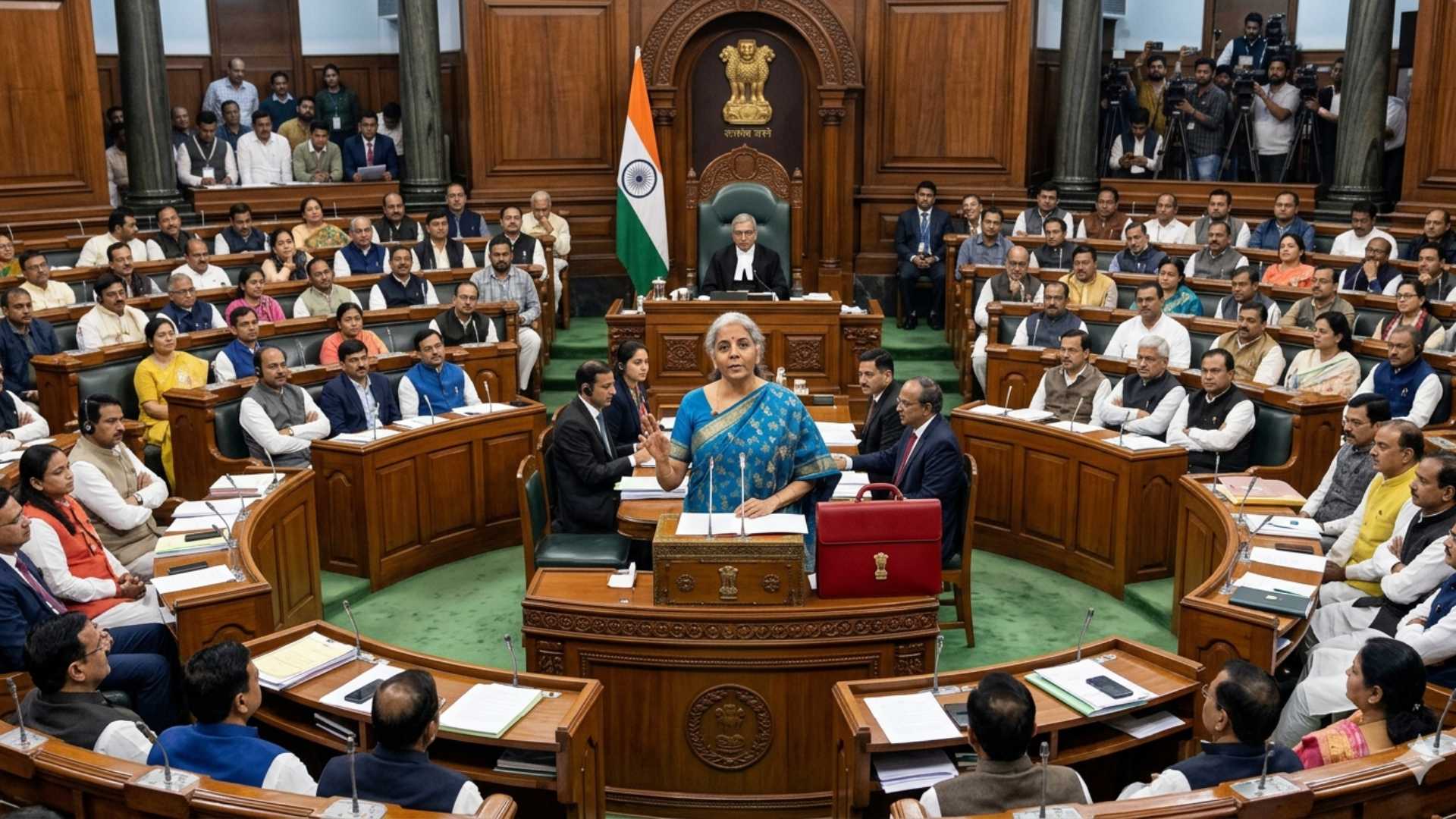
The Union Budget, presented under Article 112 of the Constitution, is the cornerstone of India's fiscal policy — translating government priorities on growth, equity, and macroeconomic stability into numbers. In BE 2026-27, total expenditure stands at ₹53,47,315 crore (up from ₹46,52,867 crore in FY 2024-25 actuals), against a nominal GDP of ₹3,93,00,393 crore — a 10% expansion — as India tightens its fiscal consolidation path toward a 4.3% fiscal deficit target.
Understanding the Three Budget Columns
| Term | Full Form | What It Means |
|---|---|---|
| FY 2024-25 Actuals | Actual figures | Real money actually collected and spent. Audited final numbers — the ground truth of what happened. |
| FY 2025-26 RE | Revised Estimates | Mid-year corrections presented during the Winter Session of Parliament. Reflects actual tax trends, emergency spending, and ground realities. |
| FY 2026-27 BE | Budget Estimates | Forward-looking projections for the upcoming year presented on February 1. Intentions, not guarantees — subject to revision via RE later. |
The Lifecycle: Budget Estimates (BE) → Revised Estimates (RE) → Actuals
UPSC Note: Deviation between BE and RE, or RE and Actuals, is called fiscal slippage — closely watched by rating agencies like Moody's and S&P to assess India's sovereign creditworthiness.
Theme 1 — Fiscal Policy & Deficit Management
Key Concepts
| Term | Definition |
|---|---|
| Fiscal Deficit (FD) | Total Expenditure minus Total Receipts (excluding Debt Capital Receipts). Reflects government's total borrowing requirement. |
| Revenue Deficit (RD) | Excess of Revenue Expenditure over Revenue Receipts. |
| Effective Revenue Deficit (ERD) | Revenue Deficit minus Grants-in-Aid for creation of Capital Assets. |
| Primary Deficit (PD) | Fiscal Deficit minus Interest Payments. Reflects current borrowing needs, excluding legacy debt burden. |
| Effective Capital Expenditure | Capital Expenditure + Grants-in-Aid for creation of Capital Assets. |
Deficit Indicators — Three Year Trend
| Indicator | FY 2024-25 Actuals | FY 2025-26 RE | FY 2026-27 BE |
|---|---|---|---|
| Fiscal Deficit | ₹15,74,431 cr (4.8%) | ₹15,58,492 cr (4.4%) | ₹16,95,768 cr (4.3%) |
| Revenue Deficit | ₹5,64,296 cr (1.7%) | ₹5,26,764 cr (1.5%) | ₹5,92,344 cr (1.5%) |
| Effective Revenue Deficit | ₹2,91,640 cr (0.9%) | ₹2,18,613 cr (0.6%) | ₹99,642 cr (0.3%) |
| Primary Deficit | ₹4,58,856 cr (1.4%) | ₹2,84,154 cr (0.8%) | ₹2,91,796 cr (0.7%) |
Analysis
The fiscal deficit has declined from 4.8% to 4.3% of GDP over three years, reflecting adherence to the FRBM Act, 2003 glide path. However, absolute borrowings have risen from ₹15,74,431 crore to ₹16,95,768 crore — illustrating that fiscal consolidation in percentage terms is enabled by GDP growth, not necessarily by reduced borrowing. The Primary Deficit's fall from 1.4% to 0.7% signals genuine improvement in current fiscal stance, stripped of legacy interest obligations.
Key Insight: Absolute deficit numbers can rise while % of GDP falls. This is how fiscal consolidation coexists with economic growth — a frequently misunderstood dynamic in budget analysis.
Theme 2 — Capital Expenditure & Economic Growth
Key Numbers
| Indicator | FY 2024-25 Actuals | FY 2025-26 RE | FY 2026-27 BE |
|---|---|---|---|
| Capital Expenditure | ₹10,51,953 cr | ₹10,95,755 cr | ₹12,21,821 cr |
| Grants-in-Aid for Capital Assets | ₹2,72,656 cr | ₹3,08,151 cr | ₹4,92,702 cr |
| Effective Capital Expenditure | ₹13,24,609 cr | ₹14,03,906 cr | ₹17,14,523 cr |
Analysis
Effective Capex has risen nearly 30% from FY 2024-25 actuals to BE 2026-27 — the single most significant growth signal in the budget. High capex has a multiplier effect on GDP, crowds in private investment, and creates productive assets without fuelling demand-side inflation. However, Grants-in-Aid for Capital Assets — included in Effective Capex but routed through the revenue account — blurs the true capital-revenue distinction, a structural classification issue in Indian public finance.
The revenue-to-capital expenditure ratio remains at approximately 77:23 — meaning for every ₹100 spent, only ₹23 creates long-term assets. Improving this ratio requires reducing committed revenue expenditure (salaries, pensions, interest) through structural reform.
Theme 3 — Taxation & Revenue Mobilisation
Where Does the Rupee Come From? — Three Year Trend
| Source | FY 2024-25 Actuals | FY 2025-26 BE | FY 2026-27 BE |
|---|---|---|---|
| Borrowings & Other Liabilities | 24 paise | 24 paise | 24 paise |
| Income Tax (incl. STT) | 22 paise | 22 paise | 21 paise |
| GST & Other Taxes | 18 paise | 18 paise | 15 paise |
| Corporation Tax | 17 paise | 17 paise | 18 paise |
| Non-Tax Revenue | 9 paise | 9 paise | 10 paise |
| Union Excise Duties | 5 paise | 5 paise | 6 paise |
| Customs | 4 paise | 4 paise | 4 paise |
| Non-Debt Capital Receipts | 1 paise | 1 paise | 2 paise |
Analysis
Three structural concerns emerge from the receipts side. First, borrowings remain frozen at 24 paise across all three years — India consistently spends far beyond its earnings. Second, the GST share has dropped sharply from 18 to 15 paise — a significant indirect tax buoyancy concern given GST's role as the backbone of post-2017 indirect taxation. Third, Non-Debt Capital Receipts (disinvestment and asset monetisation) contribute a negligible 2 paise — indicating that India's disinvestment strategy remains conservative and underutilised as a fiscal tool.
On the positive side, Corporation Tax is rising (17 → 18 paise), suggesting improving corporate profitability and formalisation. India's overall tax-to-GDP ratio, however, remains structurally low compared to peer emerging economies, pointing to the need for base broadening reforms.
Theme 4 — Subsidies & Expenditure Rationalisation
Where Does the Rupee Go? — Three Year Trend
| Expenditure Head | FY 2024-25 Actuals | FY 2025-26 BE | FY 2026-27 BE |
|---|---|---|---|
| States' Share of Taxes | 22 paise | 22 paise | 22 paise |
| Interest Payments | 20 paise | 20 paise | 20 paise |
| Central Sector Schemes | 16 paise | 16 paise | 17 paise |
| Centrally Sponsored Schemes | 8 paise | 8 paise | 8 paise |
| Defence | 8 paise | 10 paise | 11 paise |
| Finance Commission & Other Transfers | 8 paise | 8 paise | 7 paise |
| Other Expenditures | 8 paise | 8 paise | 7 paise |
| Major Subsidies | 6 paise | 6 paise | 6 paise |
| Civil Pension | 2 paise | 2 paise | 2 paise |
Analysis
Major subsidies have remained at 6 paise across all three years — a surface-level stability that masks the lack of structural rationalisation. Food, fertiliser, and fuel subsidies continue to dominate the subsidy basket. While targeted delivery through DBT has improved leakage reduction, the overall subsidy philosophy has not shifted from entitlement to enablement. The trade-off between welfare spending and capital investment remains unresolved — every rupee locked in subsidies is a rupee unavailable for productive asset creation.
Theme 5 — Public Debt & Interest Payments
Key Numbers
| Indicator | FY 2024-25 Actuals | FY 2025-26 RE | FY 2026-27 BE |
|---|---|---|---|
| Interest Payments | ₹11,15,575 cr | ₹12,74,338 cr | ₹14,03,972 cr |
| As % of Total Expenditure | ~24% | ~25% | ~26% |
| Share per Rupee Spent | 20 paise | 20 paise | 20 paise |
Analysis
Interest payments at ₹14,03,972 crore represent the single largest line item after state devolution — and critically, this share has not declined despite three years of fiscal consolidation. This is the paradox of India's fiscal position: Primary Deficit is falling (1.4% → 0.7%) yet interest burden is not easing in absolute or proportional terms, because the legacy debt stock continues to compound.
Primary Deficit — Fiscal Deficit minus Interest Payments — is a superior indicator of the government's current fiscal stance precisely because it strips out this inherited debt service obligation. A government can show a declining Primary Deficit while its Fiscal Deficit rises, purely due to accumulated interest — making Primary Deficit the more honest diagnostic tool for policymakers and analysts.
Theme 6 — Federalism & State Finances
Key Numbers
| Indicator | FY 2024-25 Actuals | FY 2026-27 BE | Change |
|---|---|---|---|
| Total Resources to States | ₹21,65,506 cr | ₹25,43,769 cr | +₹3,78,263 cr |
| States' Share of Taxes (per rupee) | 22 paise | 22 paise | Unchanged |
| CSS Allocation (per rupee) | 8 paise | 8 paise | Unchanged |
Analysis
India's fiscal federalism rests on three pillars — Finance Commission devolution (formula-based, untied), Grants (Finance Commission and discretionary), and Centrally Sponsored Schemes (tied, co-funded). The 15th Finance Commission's devolution formula awards states 41% of the divisible pool, reflected in the stable 22 paise share.
However, a critical distinction must be drawn: Central Sector Schemes are 100% centrally funded and implemented directly by the Centre, while Centrally Sponsored Schemes (CSS) are jointly funded, with states required to contribute a matching share. CSS tied grants impose conditionalities that restrict state spending priorities — undermining fiscal autonomy even as headline devolution numbers appear generous.
The ₹3,78,263 crore increase in total state transfers is a positive signal for cooperative federalism, but genuine fiscal autonomy requires shifting the balance from tied CSS grants toward untied Finance Commission devolution — allowing states to contextualise national programmes to local needs.
Theme 7 — Defence & National Security Spending
Three Year Trend
| Year | Defence Share (per rupee) |
|---|---|
| FY 2024-25 Actuals | 8 paise |
| FY 2025-26 BE | 10 paise |
| FY 2026-27 BE | 11 paise |
Analysis
Defence allocation has risen consistently — from 8 to 11 paise per rupee over three years — the steepest increase of any expenditure head in the budget. This reflects India's strategic response to evolving security challenges on the northern and western borders, the push for defence indigenisation under Atmanirbhar Bharat, and the modernisation of the armed forces. The fiscal implication is significant: every additional paise allocated to defence compresses space for social sector and developmental spending, making the quality of defence expenditure — capital vs. revenue — a critical policy variable.
Theme 8 — Macroeconomic Management
Key Macroeconomic Parameters
| Parameter | Figure |
|---|---|
| Nominal GDP (FY 2026-27 BE) | ₹3,93,00,393 crore |
| GDP Growth (over FY 2025-26 AE) | 10% |
| Fiscal Deficit Target | 4.3% of GDP |
| Total Borrowings | ₹16,95,768 crore |
| Revenue Receipts | ₹35,33,150 crore |
Analysis
The budget's macroeconomic framework rests on a 10% nominal GDP growth assumption — comprising real growth plus inflation. Any downside deviation — from global headwinds, monsoon failure, or commodity price shocks — will compress tax revenues against fixed expenditure commitments, widening actual fiscal deficit beyond the BE target. This is precisely why RE and Actuals often diverge from BE, and why fiscal slippage remains a perennial concern.
Fiscal policy and monetary policy must work in tandem. A high fiscal deficit sustains demand-side inflationary pressure, complicating the RBI's inflation targeting mandate under the Flexible Inflation Targeting framework (target: 4% CPI ± 2%). Coordination between North Block and Mint Road is therefore not optional — it is structurally necessary for macroeconomic stability.
Theme 9 — Budget Process & Constitutional Framework
Key Constitutional & Statutory Provisions
| Provision | Significance |
|---|---|
| Article 112 | Annual Financial Statement (Union Budget) |
| Article 110 | Money Bill definition — Budget is a Money Bill |
| Article 266 | Consolidated Fund of India — all revenues and borrowings |
| Article 267 | Contingency Fund of India |
| FRBM Act, 2003 | Statutory fiscal consolidation targets and glide path |
| Article 280 | Finance Commission — tax devolution to states |
Budget Calendar
| Stage | Timing |
|---|---|
| Budget Presentation | February 1 (since 2017, advanced from February 28) |
| Vote on Account (if needed) | Before April 1 |
| Revised Estimates | November/December (Winter Session) |
| Actuals Published | After financial year end (audited by CAG) |
Theme 10 — Broader Governance & Reform
The Expenditure Quality Challenge
| Expenditure Type | Share of Total | Nature |
|---|---|---|
| Revenue Expenditure | ~77% | Largely committed — salaries, pensions, interest, subsidies |
| Capital Expenditure | ~23% | Productive asset creation |
Analysis
The Union Budget 2026-27 reflects a calibrated balance between fiscal consolidation and investment-led growth. The declining deficit trajectory, rising capex, and increased state devolution are positive signals toward Viksit Bharat 2047 — India's vision of becoming a developed nation. However, structural rigidity in expenditure — with interest payments, state devolution, and defence alone consuming over 53 paise per rupee — severely limits policy agility.
Genuine fiscal reform requires movement on four fronts simultaneously: broadening the tax base to reduce borrowing dependence; rationalising subsidies from entitlement to enablement; accelerating disinvestment and asset monetisation beyond 2 paise; and improving expenditure quality by shifting the revenue-capital ratio progressively in favour of capital.
"The quality of fiscal adjustment matters as much as its quantity." — Economic Survey of India