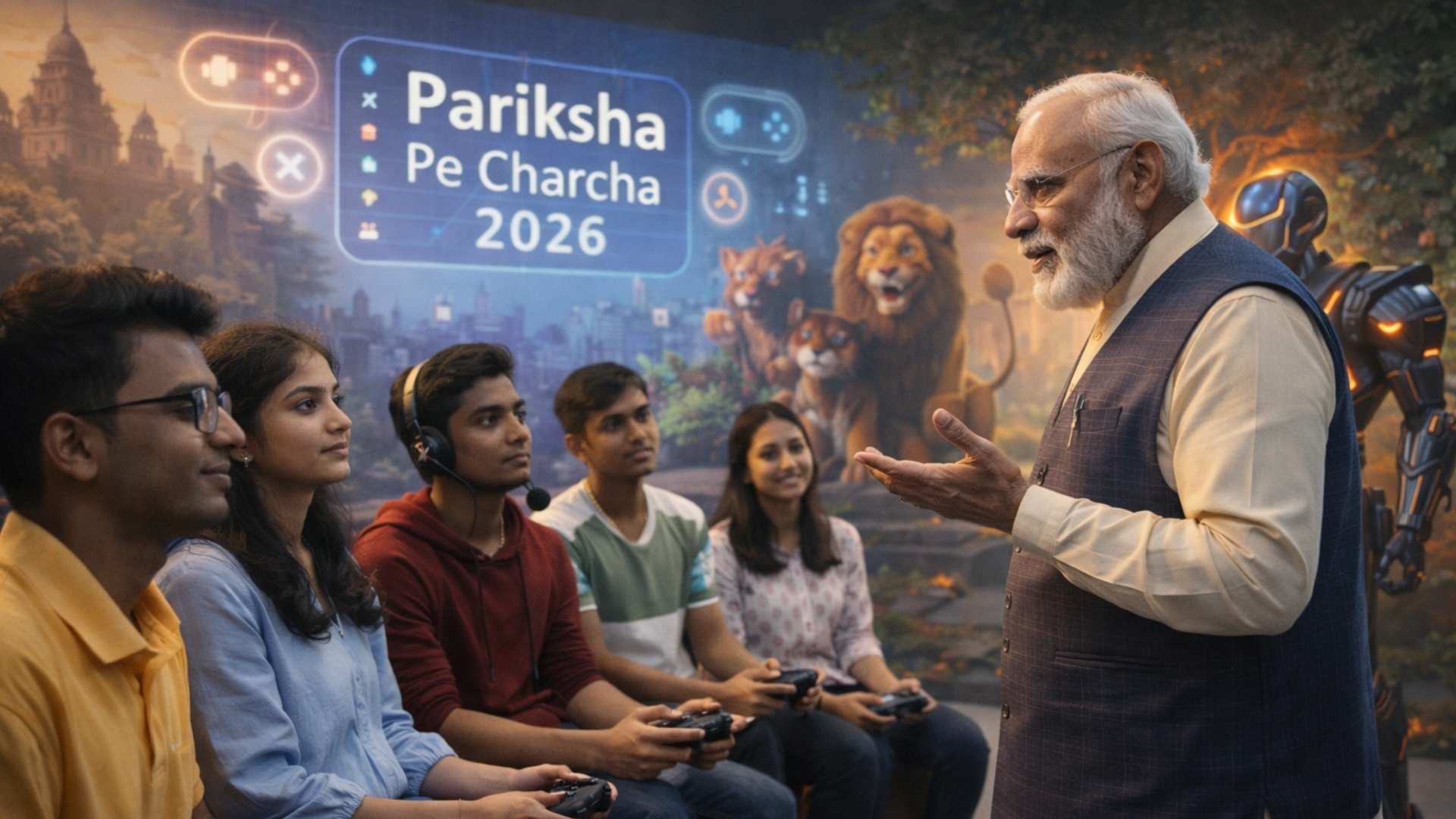
1. Political Endorsement of Gaming as Skill
At Pariksha Pe Charcha 2026, the Prime Minister framed gaming not as distraction but as discipline, emphasising quality engagement, skill development and even indigenous game creation rooted in Indian narratives like the Panchatantra. The messaging distinguished between productive gaming and wasteful or betting-linked usage.
This framing reflects a broader shift in how digital activities are viewed in India — from mere entertainment to potential economic and cognitive assets. It signals political recognition of gaming as part of the digital and creative economy.
However, endorsement was accompanied by caution against betting and irresponsible time or financial expenditure, acknowledging that cheap digital access can amplify misuse. Thus, gaming was positioned as opportunity conditioned on maturity and safeguards.
The governance logic lies in balancing economic opportunity with behavioural risk. Political endorsement without institutional safeguards may accelerate adoption without preparedness, while excessive restriction may stifle innovation and skill development.
2. Scale and Economic Significance of Gaming in India
India’s gaming ecosystem is large and expanding rapidly, primarily through smartphones. The sector has emerged as a significant digital economy segment with youth concentration.
- 488 million gamers in India; projected 517 million next year
- Nearly 40% aged 15–24 years
- Around 90% access via smartphones
- Market size: 16.7 billion (2034)
Globally, gaming generates $184–187 billion annually (Newzoo, PwC). In South Korea, gaming contributes roughly 1% of GDP, supported by a structured ecosystem.
India’s growth has been faster, more mobile-driven and largely private-sector-led. However, institutional systems — regulation, behavioural safeguards, and public health mechanisms — are still consolidating.
The scale implies macroeconomic relevance (GS3) and demographic impact (GS1). Without systemic maturity, rapid expansion can create governance gaps in youth welfare, taxation, and digital regulation.
3. Gaming Disorder and Behavioural Health Concerns
The deaths of three minor sisters in Ghaziabad reignited debate around gaming and adolescent vulnerability. Although no direct causal link to a specific game was officially established, the incident intensified public anxiety about screen exposure in a mobile-first ecosystem.
In 2019, the World Health Organisation recognised Gaming Disorder as a disease, defined by impaired control, prioritisation over other activities and continuation despite harm for at least 12 months, while cautioning against over-diagnosis. It applies to a minority of users.
India lacks national prevalence data; evidence largely comes from hospital-based reporting.
"Digital addiction cannot be treated with a categorical approach." — Yatan Pal Singh Balhara, AIIMS Delhi
Clinicians report increased cases since the pandemic, with progression often beginning with academic decline and social withdrawal.
-
Challenges:
- No population-level prevalence data
- Clinical intervention begins late
- Low integration of digital literacy in schools
- Parental awareness uneven
Behavioural risks are cumulative and subtle. If not addressed through early literacy and institutional systems, extreme outcomes may surface after prolonged unnoticed decline.
4. Regulatory Framework: National and State Dimensions
Online gaming in India is governed primarily through amendments to the Information Technology Act, 2000 and related rules, rather than a consolidated gaming statute.
In April 2023, the Ministry of Electronics and IT:
- Brought online gaming intermediaries under due-diligence norms
- Defined “online real money games”
- Mandated user verification and grievance redressal
- Enabled recognition of self-regulatory bodies
- Allowed blocking of impermissible wagering games under Section 69A
The GST Council (2023) imposed 28% tax on the full face value of online gaming, casinos and horse racing, significantly impacting real-money formats.
States retain constitutional powers over betting and gambling, leading to regulatory fragmentation:
- Tamil Nadu: Enacted law with time safeguards and age-linked provisions
- Karnataka: Attempted ban struck down by High Court
- Telangana: Removed “game of skill” exemption
Courts continue to rely on the distinction between games of skill and games of chance.
The layered terrain — national classification, state permissibility, executive enforcement — creates uncertainty. Regulatory unpredictability can affect investment flows, compliance costs and market stability.
5. Industry Adaptation and Compliance Challenges
Krafton’s experience illustrates regulatory sensitivity. After PUBG Mobile was banned in September 2020 over national security concerns linked to Tencent, the company launched BGMI (2021) with localisation and compliance measures. It was temporarily removed in 2022 and reinstated in 2023.
The company has invested over $250 million since 2021 and committed ₹6,000 crore via an India-focused fund.
Industry demands:
- Transparent classification mechanisms
- Consistency across states
- Clear jurisdictional boundaries
Safeguards in structured formats include:
- Playtime reminders
- Parental OTP verification
- Spending caps
- Mandatory parental consent for under-18 tournaments
- Integrity systems like device/session monitoring
However, structured esports account for only a fraction of users; most engagement remains informal.
Investment and innovation require regulatory predictability. However, compliance within flagship titles does not automatically translate into ecosystem-wide behavioural safeguards.
6. Esports Institutionalisation vs Mass Informal Engagement
Political comfort with gaming partly rests on esports, where competition resembles organised sport. Companies such as NODWIN Gaming and global associations like the National Association of Collegiate Esports (USA) and the Korea e-Sports Association institutionalise competitive gaming.
In such systems:
- Tournaments are structured
- Eligibility rules apply
- Age safeguards exist
- Competitive integrity is monitored
In India, similar pathways exist but remain limited in reach relative to the total gaming population.
Most users engage through continuity rather than competition. Industry discourse is shifting from time spent to metrics such as session quality and retention.
- Average Revenue Per User (ARPU): $6–8 annually
- Only a minority pay
Structured esports demonstrates the potential of gaming as skill. However, policy cannot assume that discipline within elite circuits will automatically shape behaviour across hundreds of millions of casual users.
7. Public Health and Institutional Gaps
Unlike South Korea, where addiction clinics and public discourse evolved alongside commercial growth, India’s behavioural response remains uneven.
Key gaps:
- Limited school-level digital behaviour literacy
- Inconsistent parental supervision frameworks
- Lack of systematic early intervention
- Dependence on hospital-based reporting
Regulation has focused primarily on money, classification and taxation rather than behavioural literacy or design accountability.
Consequently, gaming sits at a layered intersection:
- Politically endorsed as skill
- Economically embedded as growth sector
- Clinically debated as behavioural risk
Without everyday institutional literacy — in schools, families and design norms — economic expansion may outpace behavioural governance, creating reactive rather than preventive systems.
8. Way Forward: Towards Balanced Digital Governance
India has formally integrated gaming into its digital and creative economy. The policy challenge now lies in synchronising market growth with institutional maturity.
Key priorities:
- Strengthening digital behaviour literacy in schools
- Developing population-level research on gaming disorder
- Enhancing coordination between Centre and States
- Encouraging design-level safeguards by default
- Ensuring predictable and transparent regulatory implementation
The objective is neither prohibition nor unregulated expansion, but calibrated governance.
Conclusion
Gaming in India represents a convergence of youth demography, digital penetration and creative economy expansion. While political endorsement has normalised its legitimacy as skill, sustainable integration requires parallel evolution of regulation, behavioural safeguards and institutional literacy.
Ensuring that governance systems mature at the same pace as market growth will determine whether gaming becomes a long-term developmental asset or a fragmented regulatory challenge in India’s digital future.