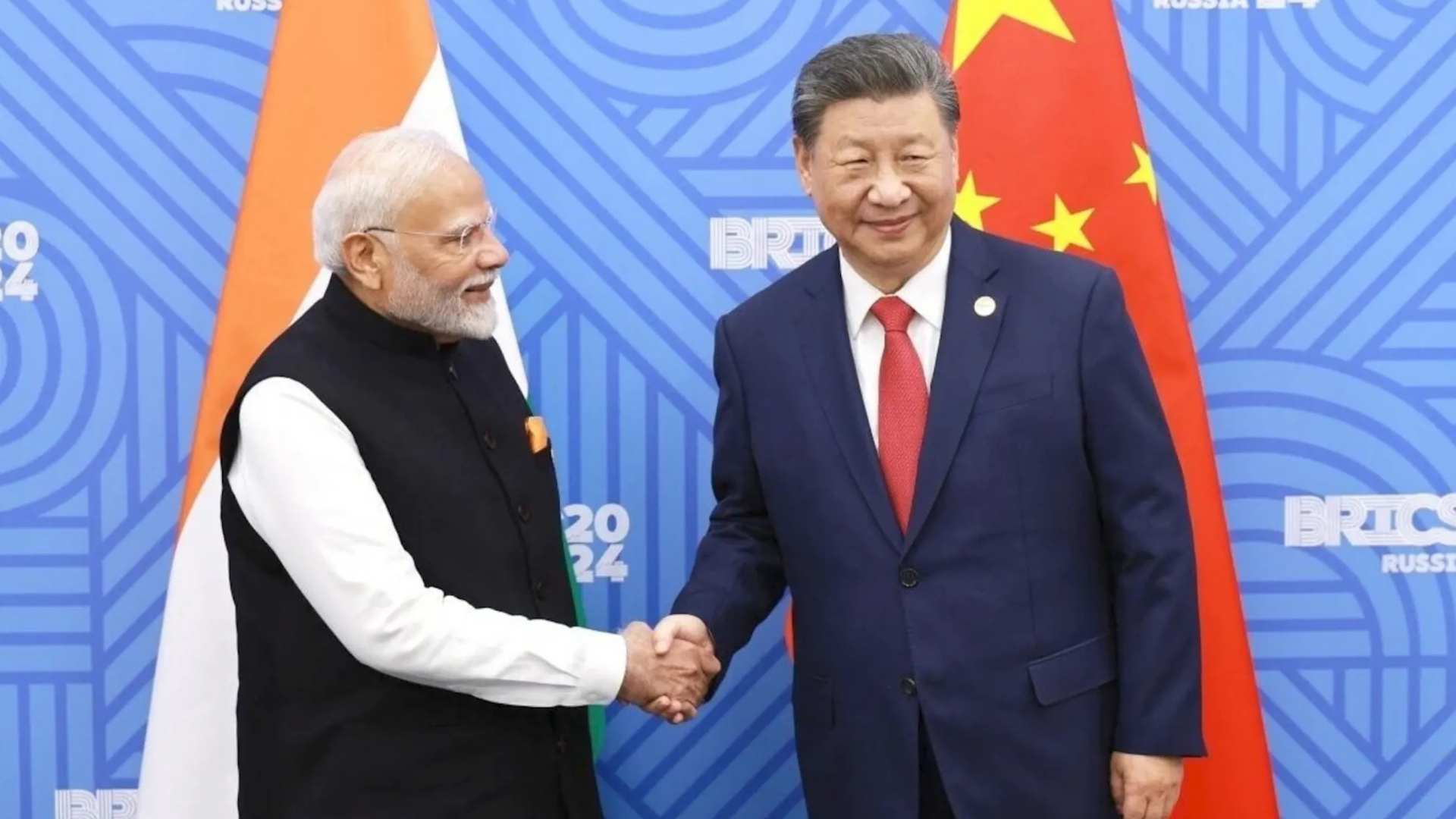
1. Global Context: Reassessment of Economic Ties with China
Middle powers across the world are recalibrating their economic engagement with China. Leaders from Canada, the United Kingdom, and France have recently engaged with Beijing to reset relations, reflecting a broader global reassessment of economic interdependence with China.
The European Union faces a dilemma: balancing the risks of opening domestic markets to Chinese goods against the necessity of retaining Chinese firms within global supply chains. Similarly, high-level diplomatic engagement between the United States and China signals an ongoing effort to manage strategic competition without complete economic decoupling.
In this evolving international environment, India must evaluate whether its current framework governing Chinese investment—especially under Press Note 3 (2020)—adequately balances national security and economic growth imperatives.
Economic interdependence is being restructured globally, not dismantled. If India fails to recalibrate its approach in line with global strategic shifts, it risks either over-isolation from supply chains or under-preparedness against economic vulnerabilities.
“Economic security is national security.” — Janet Yellen, U.S. Treasury Secretary (This reinforces the global framing of investment scrutiny as a security issue.)
2. Press Note 3 (2020): Objectives and Evolution
Press Note 3 was issued in 2020 to mandate prior government approval for investments from countries sharing land borders with India. The policy was primarily aimed at preventing opportunistic takeovers of Indian companies during the economic disruption caused by the COVID-19 pandemic.
The underlying concern was state-linked or state-entangled capital, particularly from China, which could acquire strategic assets at undervalued prices. However, over time, the policy has been selectively relaxed in certain sectors.
The ad hoc nature of these relaxations suggests a lack of a coherent long-term framework. While the policy originated as a protective measure, its continued implementation without systematic review may generate uncertainty in investment flows.
Protective investment screening is justified in times of crisis. However, prolonged uncertainty or selective exemptions weaken regulatory credibility and distort market incentives.
3. Case-Specific Relaxations: The Apple Manufacturing Example
One prominent example of selective relaxation relates to mobile manufacturing. Apple’s expansion into India required the presence of its established Chinese subcontractors and component suppliers, many of whom are embedded in the Pearl River Delta ecosystem.
Reports suggest that case-specific easing was allowed to enable these supply-chain participants to operate in India. This facilitated India’s ambitions to become a global electronics manufacturing hub.
However, such discretionary approvals raise structural concerns. Governments are rarely well-positioned to identify long-term industrial “winners.” Moreover, selective exemptions create asymmetry between large corporations capable of lobbying for approvals and smaller enterprises that lack similar influence.
Implications:
- Larger firms gain preferential access to policy relaxations.
- Smaller enterprises may remain excluded from global supply chains.
- Regulatory opacity may reduce investor confidence.
Industrial policy must be rule-based rather than personality- or firm-driven. If policy flexibility becomes discretionary rather than systematic, it undermines fairness and long-term competitiveness.
4. Definitional Ambiguities: What Constitutes “Chinese Investment”?
A core challenge lies in defining what qualifies as Chinese investment. While concerns primarily relate to mainland state-linked capital, Press Note 3 applies broadly to all countries sharing land borders with India.
This raises several complexities:
- Should Taiwan and Hong Kong be treated identically to mainland China?
- How should investments routed through Singapore be treated, especially when Singapore channels significant mainland capital?
- Do European subsidiaries of Chinese firms count as Chinese?
- What about partial Chinese ownership in multinational companies?
These questions are empirical and dynamic. Ownership structures are layered, global capital is fungible, and tracing ultimate beneficial ownership is increasingly complex.
Challenges:
- Identifying ultimate beneficial ownership.
- Distinguishing state-directed from private capital.
- Ensuring consistency in treatment across jurisdictions.
Over-broad categorisation may block benign capital, while under-inclusive definitions may allow strategic vulnerabilities. Without clarity, enforcement becomes inconsistent and credibility erodes.
5. Economic Security vs Economic Growth: The Strategic Dilemma
India has been relatively slow in articulating a coherent economic security doctrine, unlike countries such as Australia and Japan, which have spent over a decade refining investment screening frameworks.
A modern economic security framework requires identification of:
- Strategic sectors (e.g., telecom, semiconductors, critical infrastructure).
- Potential vectors of hostile influence (technology transfer, data control, supply-chain choke points).
- Clear criteria for risk-based screening.
The current approach, centred on “land neighbours,” may be too geographically simplistic. Economic threats are not confined to contiguous states; they are functional and sector-specific.
“Interdependence is not a vulnerability in itself; it becomes one when it is weaponised.” — (Concept widely discussed in economic security literature; reflects contemporary policy thinking.)
Economic security requires precision. If screening remains geography-based rather than sector-based, India risks both over-securitisation and under-protection in critical domains.
6. Impact on MSMEs and Domestic Industrial Ecosystem
India’s smaller enterprises provide substantial employment and economic dynamism but are often excluded from global value chains. When regulatory relaxations disproportionately favour large multinational firms, it deepens structural inequality within the domestic economy.
Policy asymmetry may lead to:
- Reduced competitive neutrality.
- Barriers to MSME integration into global supply chains.
- Dependence on a few dominant players.
This has implications for inclusive growth, employment generation, and long-term industrial resilience—key themes in GS3 (Indian Economy).
Governance Concerns:
- Transparency in approval processes.
- Level playing field between firms.
- Institutional capacity for investment screening.
An uneven regulatory regime may distort market structure. If smaller firms remain excluded, India’s industrial deepening and employment goals could be compromised.
7. Need for a Comprehensive Negative List Approach
The article suggests that India should move toward a comprehensive negative list for investment. This would explicitly identify sectors where foreign investment—especially from high-risk sources—is restricted or subject to enhanced scrutiny.
Such a framework would:
- Provide clarity and predictability.
- Reduce ad hoc decision-making.
- Align economic security with industrial policy.
Countries like Australia and Japan have adopted structured investment screening regimes, balancing openness with safeguards. India’s evolving geopolitical environment necessitates a similarly coherent approach.
Way Forward:
- Clearly define strategic sectors.
- Develop sector-specific risk criteria.
- Institutionalise transparent approval mechanisms.
- Periodically review the framework in light of global developments.
Predictable rules strengthen both security and growth. Without a comprehensive framework, India risks oscillating between excessive caution and selective liberalisation.
Conclusion
India’s approach to Chinese investment must move from reactive and geography-based restrictions toward a transparent, sector-focused economic security strategy. As global supply chains reorganise and strategic competition intensifies, policy clarity becomes essential.
A calibrated framework—balancing national security, industrial growth, and regulatory fairness—will determine whether India emerges as a trusted manufacturing alternative while safeguarding its strategic interests.
In the long run, economic security and economic dynamism must reinforce, not undermine, each other.