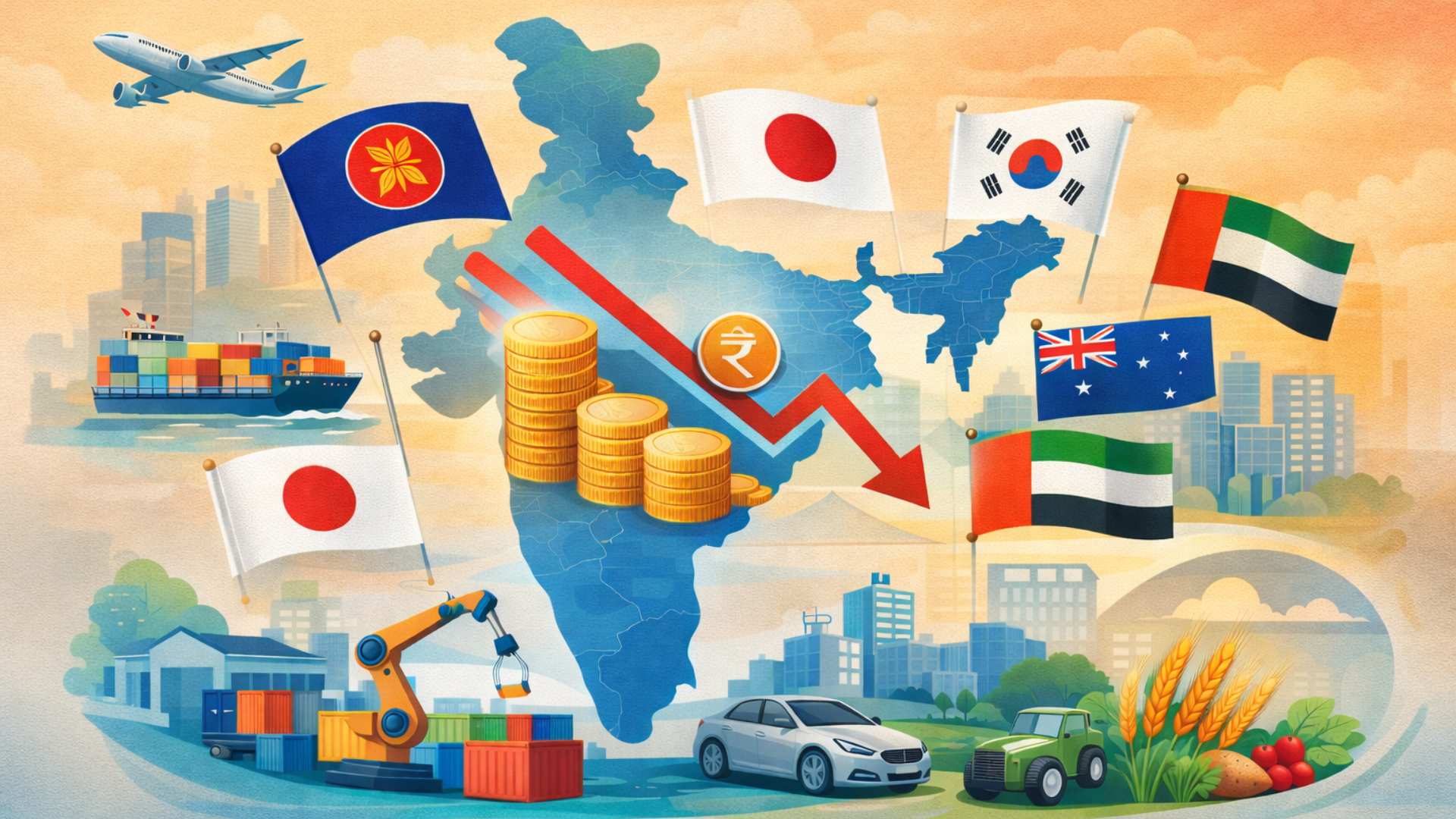
Customs Duty Forgone under FTAs: Fiscal Impact and Trade Policy Debate
1.Rising Revenue Forgone under Free Trade Agreements
India’s customs duty forgone due to preferential tariff reductions under free-trade agreements (FTAs) is projected to cross ₹1 trillion in FY27, according to Budget documents. This marks a significant fiscal impact of India’s expanding trade liberalisation agenda.
In FY26, customs revenue forgone stood at ₹98,569 crore, exceeding the budget estimate of ₹94,172 crore. The increase reflects both higher utilisation of FTA concessions and expansion in trade volumes under preferential arrangements.
As more tariff lines become eligible for preferential treatment and additional trade agreements come into force, the notional revenue impact is expected to rise further. This brings into focus the balance between fiscal prudence and trade competitiveness.
FTA-led tariff reductions reduce immediate customs collections but may enhance long-term economic activity. If not carefully managed, however, they can strain fiscal planning and widen trade imbalances.
2. Partner-wise Revenue Impact and Asean Review
Among India’s trade partners, the revenue impact is highest in the case of the Association of Southeast Asian Nations (Asean), estimated at ₹40,833 crore in FY27. Imports from Asean have grown faster than India’s exports, prompting concerns about widening trade deficits.
India has sought an urgent review of the Asean goods agreement. Although both sides agreed in August 2023 to complete the review by 2025, the deadline has been missed, leading to dissatisfaction over the pace of negotiations.
Other major contributors to customs duty forgone include:
- Japan: ₹11,365 crore
- South Korea: ₹10,872 crore
- UAE: ₹9,267 crore
- Australia: ₹5,107 crore
This highlights how FTAs can produce asymmetric outcomes if export competitiveness does not keep pace with import liberalisation.
Trade agreements must be periodically reviewed to correct structural imbalances. Failure to recalibrate can entrench trade deficits and weaken domestic industry confidence.
3. Customs Duties: Revenue Instrument vs Trade Policy Tool
An internal policy debate persists between revenue authorities and trade policymakers. Customs duties account for roughly 6–7% of the Centre’s gross tax revenue in recent years, making them fiscally relevant.
Revenue officials argue that deep tariff reductions constrain collections and complicate budget management. However, trade policymakers maintain that customs duties are primarily a trade policy instrument rather than a revenue-raising mechanism.
Lower input tariffs can reduce production costs, improve export competitiveness, and integrate India into global value chains (GVCs). Over time, increased economic activity may expand the broader tax base through GST and direct taxes.
“Trade policy is growth policy.” — Jagdish Bhagwati
Viewing customs duties solely as a revenue source may limit trade reform. However, ignoring fiscal implications may weaken macroeconomic stability. A balanced approach is essential.
4. Tariff Structure and Negotiation Constraints
India’s applied Most-Favoured-Nation (MFN) tariffs remain higher than those of many major economies, particularly in sectors such as agriculture, automobiles, and certain consumer goods. As a result, FTA negotiations often require India to undertake substantial tariff cuts to offer meaningful market access.
Over time, as preferential coverage expands and imports rise, the estimated revenue forgone increases. This reflects both policy choices and structural features of India’s tariff regime.
Commerce and Industry Minister Piyush Goyal has stated that India now enjoys preferential market access to almost 70% of global trade through its FTA network. Recent agreements include:
- EFTA (in force since October 2025)
- United Kingdom
- Oman
- New Zealand
- European Union
- Interim trade deal with the United States
Many of these are expected to come into force in FY27, potentially increasing fiscal impact further.
Higher baseline tariffs make FTA concessions more fiscally visible. However, sustained integration into global trade requires calibrated but credible tariff rationalisation.
5. Revenue Projections and Underestimation Concerns
The government has projected customs duty collections to increase by 5% in FY27 to ₹2.7 trillion, compared to a 10% rise in FY26. Meanwhile, customs revenue forgone is assumed to rise by 2.9% in FY27.
Experts suggest this may underestimate the fiscal impact, given that India has concluded nine trade agreements involving 38 countries in the last five years. As these agreements become operational, preferential utilisation rates may rise significantly.
The actual fiscal effect depends on:
- Utilisation rates by importers
- Trade diversion effects
- Changes in sourcing patterns
Therefore, static projections may not fully capture dynamic trade responses.
Budget forecasting must account for behavioural changes in trade flows. Underestimation can create fiscal pressures, while overestimation may discourage necessary liberalisation.
6. Broader Implications: Trade Deficit, Competitiveness and GVC Integration
The rising revenue forgone must be assessed alongside trade performance. If FTAs lead to higher imports without commensurate export growth, trade deficits may widen, as seen in concerns over Asean.
However, if lower tariffs reduce input costs and boost manufacturing competitiveness, India can integrate more deeply into global value chains. This aligns with GS3 objectives of export promotion, industrial growth, and Make in India.
The challenge lies in synchronising tariff liberalisation with domestic capability building—logistics, infrastructure, ease of doing business, and standards compliance.
FTAs are neither inherently beneficial nor harmful; their impact depends on domestic competitiveness. Without complementary reforms, tariff cuts alone may not yield export gains.
Conclusion
India’s projected customs duty forgone crossing ₹1 trillion in FY27 reflects the expanding footprint of its free-trade agreements. While the immediate fiscal cost is significant, the long-term developmental impact depends on export performance, competitiveness gains, and integration into global value chains.
A calibrated approach—periodic FTA reviews, realistic revenue forecasting, and complementary domestic reforms—can ensure that trade liberalisation strengthens growth without undermining fiscal stability. In this balance between revenue and competitiveness lies the sustainability of India’s trade policy trajectory.