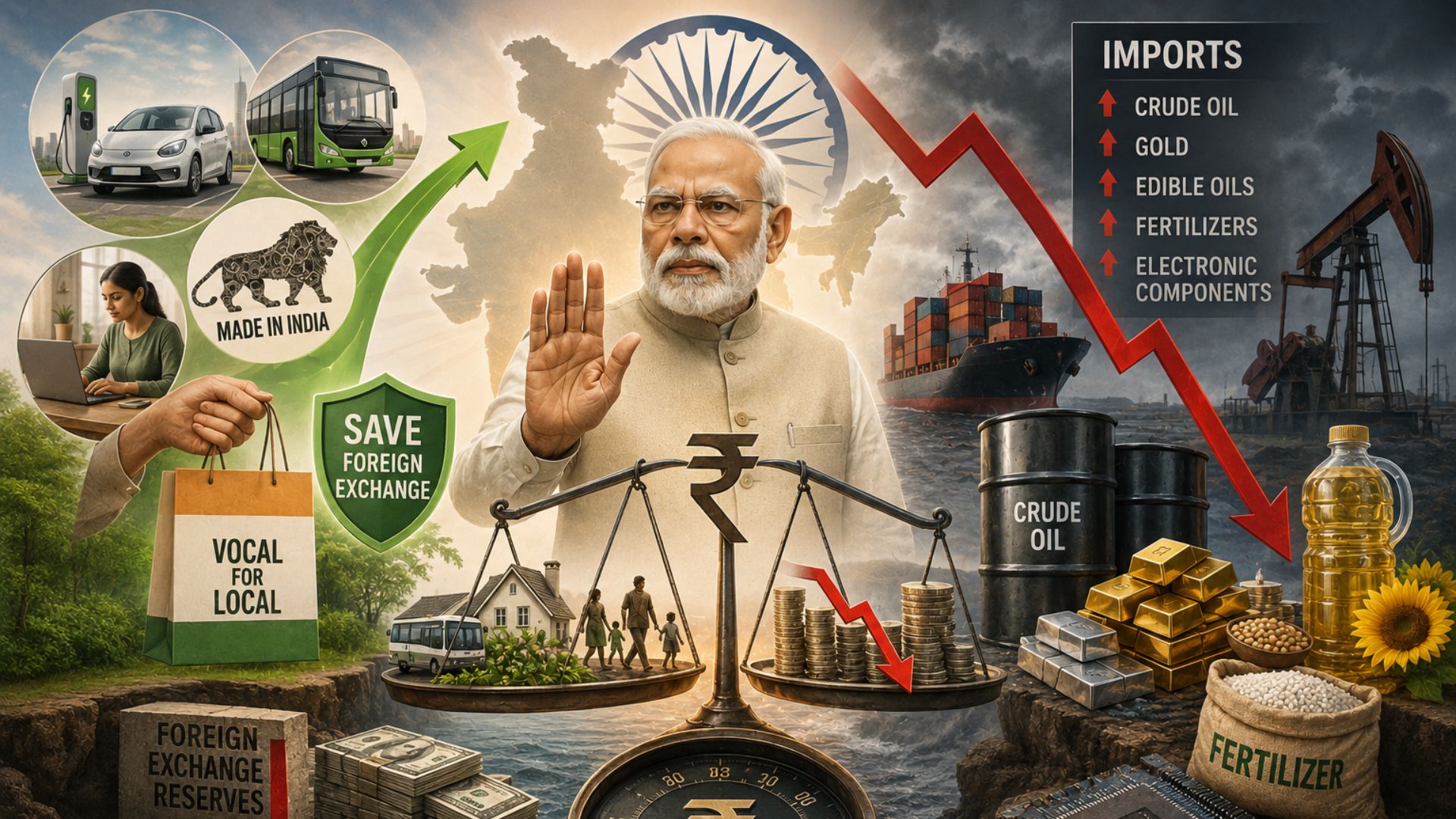
India's Foreign Exchange Alarm

"This is an alarm bell that no government has sounded before — not even during the severe economic crisis of 1991."
In an unprecedented move, Prime Minister Narendra Modi recently urged Indian citizens to cut petroleum consumption, reduce edible oil use, defer gold purchases, avoid unnecessary foreign travel, and embrace work-from-home — all aimed at a single objective: reducing India's foreign currency spending. The urgency behind these appeals reflects a deepening stress in India's external trade account that demands serious policy attention.
How Serious Is the Situation?
To contextualise the alarm, consider what 1991 looked like:
1991 Crisis Snapshot:
- Forex reserves: < $1 billion
- Import cover: barely 2 weeks
- RBI pledged gold to Bank of England, Bank of Japan,
  and Union Bank of Switzerland to avoid debt default
India today is not in that position — but the direction of travel is concerning. In 2025-26, India's merchandise trade deficit hit a record 775 billion, while exports remained nearly stagnant at $442 billion.
Adding to the pressure: crude oil prices have risen 53% since the US-Israel war against Iran began, and these figures are yet to be fully reflected in India's import bill.
The Four Pressure Points in India's Import Basket
-
Precious metals — Gold and silver imports crossed $90 billion, accounting for 12% of the total import bill. Gold imports alone rose 24%, silver surged 150%. Exports of gems and jewellery fell by over 5%, meaning increased imports were absorbed domestically, not re-exported. In April 2026, gold imports jumped 82% year-on-year.
-
Edible oils — Imports rose 12% in 2025-26 and accelerated to 40% growth in April 2026. India sources over 56% of its edible oil demand from abroad — a direct consequence of stagnant domestic oilseed production. The government, unable to fix supply, is now asking citizens to consume less.
-
Fertilizers — Global fertilizer prices rose 46% between December 2025 and April 2026; urea prices doubled. War-related disruptions in West Asia pushed India's fertilizer import bill up by nearly 80%. Imports now meet over 50% of India's fertilizer requirements — up from 31–37% in previous years — raising both the foreign exchange burden and the fertilizer subsidy bill simultaneously.
-
Electronic components — Despite six years and significant budgetary outlays under the PLI scheme, electronic component imports grew over 20%. Imports of batteries and accumulators — critical for the EV transition — rose 50%, indicating that technological modernisation is coming at a steep foreign currency cost.
The Rupee in the Crossfire
A widening trade deficit does not stay confined to trade statistics — it pressures the currency. The RBI has been intervening selectively to prevent a free-fall of the rupee. But:
- Forex reserves have fallen by over $21 billion since end-February 2026
- Further depletion through aggressive market intervention carries its own risks
- A weaker rupee makes imports costlier, creating a self-reinforcing spiral
The customs duty on gold and silver was raised to 15% last week — a fiscal measure to complement the Prime Minister's appeal. Whether this is sufficient to arrest the trend remains doubtful, especially as market volatility is driving retail investors toward gold ETFs anyway.
Way Forward
- Oilseed mission with teeth — India's edible oil import dependence has persisted for decades; a time-bound, incentive-backed oilseed production programme is overdue
- Fertilizer self-reliance — Domestic urea capacity must be expanded; natural gas availability for fertilizer plants and investment in nano-urea technology deserve policy priority
- PLI recalibration — Electronics and battery PLI schemes must shift focus from assembly to component manufacturing to genuinely reduce import content
- Gold demand management — Sovereign Gold Bond schemes and gold monetisation must be made more attractive to channel demand away from physical imports
- Export push — Stagnant exports at 775 billion is structurally unsustainable; services exports and merchandise diversification need simultaneous attention
Conclusion
When a Prime Minister appeals to citizens to defer gold purchases and revive work-from-home to save foreign exchange, it signals that structural vulnerabilities in India's trade account can no longer be deferred. The record trade deficit of $333 billion is not a one-year anomaly — it reflects years of underinvestment in domestic production across oil, fertilizers, and electronics. Demand-side appeals from the top can buy time. Supply-side reform is what will buy resilience.
Attribution
Original content sources and authors


Syllabus classification
How this article maps to GS papers
Main syllabus
GS3Indian-EconomyQuick Q&A
What does the widening merchandise trade deficit indicate about the structural vulnerabilities of the Indian economy?
Major contributing sectors include:
- Crude oil imports due to high energy dependence
- Gold and silver imports driven by domestic investment behavior
- Edible oils due to weak oilseed productivity
- Fertilizers owing to inadequate domestic production
- Electronic components linked to industrial import reliance
This has macroeconomic implications. A persistent deficit increases demand for foreign exchange, weakens the rupee, and raises imported inflation. It also limits fiscal flexibility as subsidies rise, especially in fertilizers and fuel. The 1991 crisis demonstrates how unsustainable trade deficits can trigger broader balance-of-payments crises when reserves decline sharply.
In policy terms, this reflects incomplete structural transformation. While India has advanced in services exports, manufacturing self-reliance remains partial. Without boosting domestic production and value-added exports, trade deficits may become a recurring source of macroeconomic stress.
Why has the Prime Minister’s appeal to reduce petroleum use and imports been considered a significant policy signal?
The significance lies in timing. Even during the 1991 crisis, the government relied more on institutional measures than public austerity appeals. The current concern stems from rising crude prices after geopolitical conflict in West Asia, a depreciating rupee, and declining forex reserves. These factors together increase vulnerability.
Examples include:
- Rising international oil prices after the U.S.-Israel-Iran conflict
- Higher fertilizer and edible oil import bills
- Growing import of precious metals and electronics
This is also a political-economic signal. It suggests that voluntary behavioral changes are being encouraged because supply-side adjustments are slow. While citizens can reduce discretionary demand, long-term resilience requires structural reforms in domestic energy, agriculture, and industrial production.
How does import dependence on edible oils and fertilizers affect India’s food security and economic sovereignty?
Edible oil dependence reflects agricultural stagnation. Despite several schemes, domestic oilseed productivity has not kept pace with demand. Similarly, fertilizer imports expose farmers to global price shocks. When international prices rise, the government must increase subsidies, adding fiscal pressure.
Consequences include:
- Higher food inflation due to imported cost escalation
- Pressure on subsidy expenditure
- Reduced policy autonomy in crisis periods
- Supply insecurity during geopolitical conflicts
Case study: The Russia-Ukraine war disrupted sunflower oil supply globally, while the West Asia conflict has raised fertilizer prices. These show how external events can affect Indian households and agriculture.
Strategically, self-reliance in food-related imports is as important as defense self-reliance. Increasing domestic oilseed cultivation, alternative fertilizers, and efficient nutrient management are necessary to strengthen economic sovereignty.
What are the reasons behind the sharp rise in gold imports despite policy measures to discourage them?
Key reasons include:
- Volatile equity markets leading to portfolio diversification
- Expectation of further inflation
- Cultural preference for physical gold
- Growth of gold ETFs making investment easier
Customs duty increases may have limited effect. Higher duties may discourage some imports but often increase smuggling or push consumers toward digital gold instruments. The elasticity of demand for gold is relatively low in India due to its role in savings and social customs.
For example, previous increases in import duty during 2013-14 temporarily reduced official imports but also expanded informal channels. Therefore, the current rise suggests deeper behavioral patterns rather than a temporary spike.
The broader issue is weak trust in financial assets and insufficient depth of domestic investment alternatives. Strengthening bond markets, inflation-protected savings, and financial literacy may gradually reduce excessive gold dependence.
Critically analyse whether Atmanirbhar Bharat has reduced India’s import dependence in strategic sectors.
Achievements:
- Growth in assembly-based electronics manufacturing
- Expansion of domestic solar and battery capacity
- Increased industrial investment in selected sectors
Limitations:
- High import content in semiconductors and electronics
- Dependence on imported battery cells
- Limited domestic value addition
- Slow technological capability development
The current trade data reveals these gaps. Electronic component imports rose by over 20%, and battery imports by 50%, showing that assembly-led industrialization has not translated into ecosystem-level self-reliance.
Critical evaluation: Atmanirbhar cannot succeed through subsidies alone. It requires R&D, skill development, logistics efficiency, and global integration. South Korea’s electronics success came through technological deepening, not only tariff protection. India must move from assembling imported inputs to creating domestic innovation-led manufacturing.
How can the current foreign exchange pressure be understood in the context of India’s past balance-of-payments crises?
Similarities:
- Widening trade deficit
- External commodity shocks
- Rupee depreciation
- Pressure on reserves
Differences:
- Current reserves are substantially larger
- India has stronger service exports
- Capital markets are more developed
- RBI has better intervention capacity
Case analysis: The RBI’s selective intervention mirrors crisis management but must be calibrated to avoid rapid reserve depletion. Public austerity appeals suggest concern over future sustainability if geopolitical tensions persist.
The lesson from 1991 is that crises emerge gradually before becoming visible. Policy responses should therefore focus on structural trade correction, domestic capacity building, and export competitiveness, rather than temporary demand restraint alone.
Practice questions
1 question for mains preparation