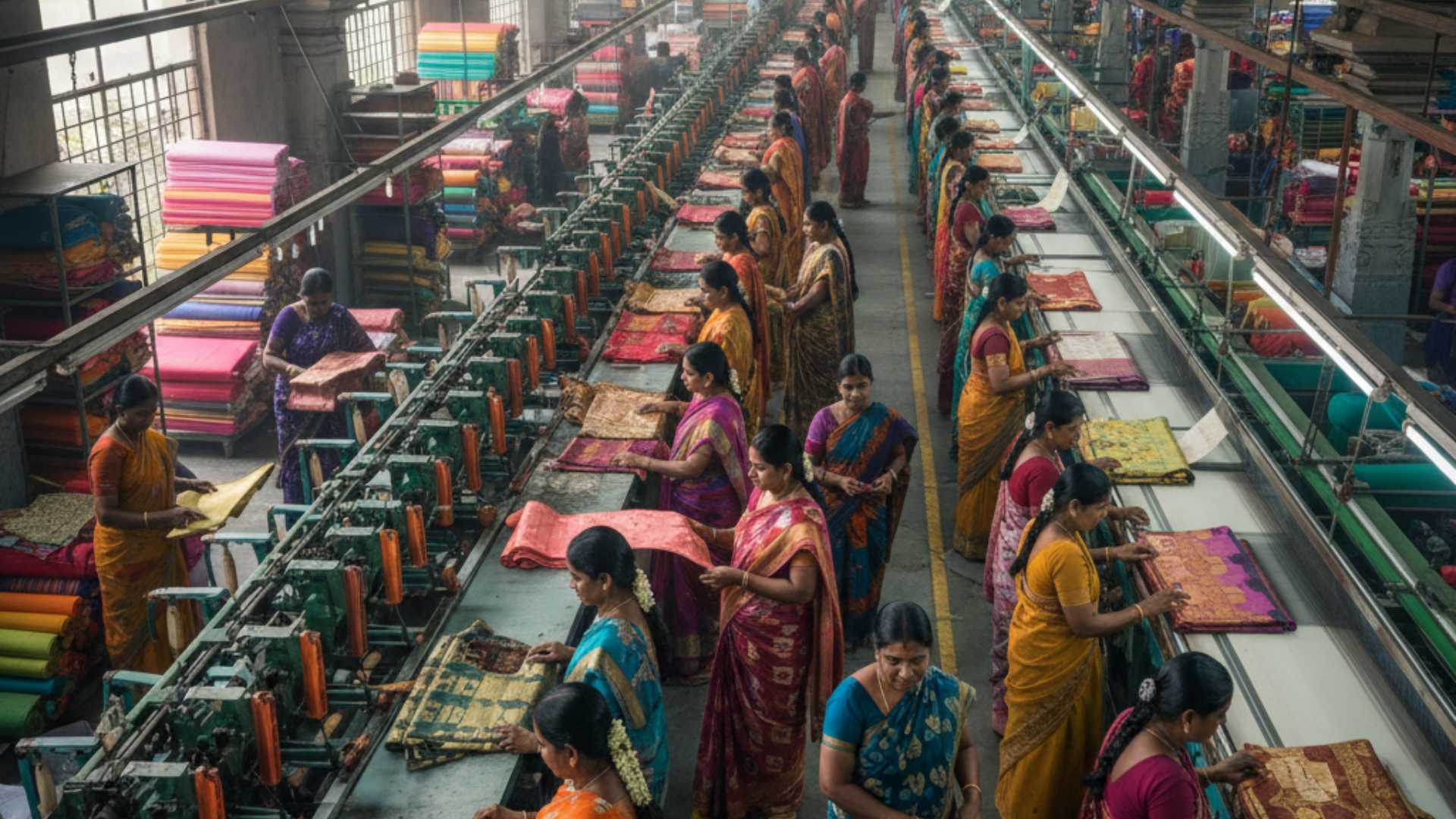
1. Context: Shrinking Operational Base of Textile Units in Tamil Nadu
Tamil Nadu has historically been one of India’s leading textile hubs, contributing significantly to spinning, weaving, processing and garment exports. The sector is deeply embedded in the State’s MSME ecosystem and provides large-scale employment, especially in western districts.
Recent data from the Annual Survey of Industries (Union Ministry of Textiles) indicates a sharp contraction in operational textile mills between 2021-22 and 2023-24. This decline signals structural stress in a sector critical for exports, rural employment, and value addition.
- In 2021-22, Tamil Nadu had 2,773 textile mills, of which 2,121 were operational
- In 2023-24, total mills fell to 2,455, with only 1,672 operational
- Industry estimates suggest another 300 mills closed in the last two years
Textile and apparel manufacturers:
-
2021-22: 11,460 units, 8,771 operational
-
2023-24: 11,467 units, 8,503 operational
-
Nearly 2 lakh powerlooms scrapped in recent years
The data reveals not merely stagnation but a contraction in operational capacity, especially in spinning and powerloom segments. This is significant as Tamil Nadu accounts for a substantial share of India’s yarn production and export-oriented garment manufacturing.
When operational units shrink despite overall presence remaining similar, it reflects stress in viability rather than lack of entrepreneurship. If sustained, this erosion weakens employment generation, export capacity, and regional industrial balance.
2. Structural Cost Disadvantages and Competitive Pressures
The textile industry in Tamil Nadu is predominantly composed of micro, small and medium enterprises (MSMEs). These units operate on thin margins and are highly sensitive to input costs and credit conditions.
Industry representatives highlight a cost-competitiveness gap vis-à-vis other States:
- Power cost in Tamil Nadu: ₹9.25 per unit, at least ₹1 higher than competing States
- Processing units face high compliance costs due to Zero Liquid Discharge (ZLD) requirements
- Other States such as Gujarat permit marine discharge of treated effluent, reducing costs
- Raw materials (cotton, polyester, viscose) are largely sourced from northern India, increasing transportation costs
- Import duty on cotton and previous quality control measures added to input pressures
- Rising bank interest rates disproportionately affect MSMEs
Only units that invested in wind and solar energy have partially insulated themselves due to Tamil Nadu’s relatively flexible renewable energy policy.
"Tamil Nadu textile industry is finding it increasingly difficult to remain cost-competitive compared with other States." — Industry spokesperson
The cost asymmetry is not merely financial but structural. Power tariffs, compliance norms, logistics, and credit terms collectively determine competitiveness in a global value chain environment.
Cost disadvantages compound in labour-intensive sectors. If MSMEs are unable to absorb input shocks, closures become rational economic choices, leading to deindustrialisation pockets within otherwise industrially advanced regions.
3. Environmental Compliance and Regulatory Trade-offs
Processing units in Tamil Nadu incur high operational costs due to stringent Zero Liquid Discharge (ZLD) norms. While environmentally progressive, ZLD systems require significant capital and recurring operational expenditure.
In contrast, States permitting marine discharge of treated effluent offer relatively lower compliance costs. This creates an uneven competitive landscape within the federal structure.
The regulatory asymmetry raises a broader governance issue: balancing environmental sustainability with industrial competitiveness. Textile processing is water-intensive and pollution-prone, making environmental regulation essential. However, disproportionate compliance costs can disincentivise operations.
This reflects a classic developmental trade-off between ecological safeguards (GS3: Environment) and industrial growth (GS3: Industry & MSMEs).
If environmental standards are not harmonised or supported through fiscal incentives, compliant States may lose industry to relatively lenient jurisdictions, undermining both environmental and economic objectives.
4. Implications for Employment, MSMEs, and Regional Development
The textile sector in Tamil Nadu supports large-scale direct and indirect employment, particularly in spinning clusters such as Coimbatore, Tiruppur, Erode and Karur.
- Closure of over 300 mills and scrapping of ~2 lakh powerlooms implies significant job losses
- MSMEs form the backbone of the sector, making closures socially consequential
- Reduced operational units weaken backward linkages (cotton farmers) and forward linkages (garment exports)
The slowdown has broader macroeconomic implications:
- Reduced export competitiveness
- Lower capacity utilisation
- Potential migration of investments to other States
- Strain on credit portfolios of banks lending to MSMEs
This development intersects with national priorities such as Make in India, export diversification, and employment-led growth.
Labour-intensive sectors act as employment multipliers. If structural stress persists, the burden shifts to informal employment or migration, weakening inclusive growth objectives.
5. Policy Response and Way Forward
The State government has recently introduced an integrated textile policy, acknowledging sectoral stress. However, industry representatives argue for further reforms.
- Removal of subsidy caps under textile schemes
- Rationalisation of power tariffs
- Support for renewable energy integration
- Addressing raw material logistics and input duties
- Harmonisation of environmental compliance frameworks across States
A calibrated approach is required to ensure that environmental safeguards are maintained while reducing cost disadvantages. Targeted MSME support through credit easing and technology upgradation can improve productivity and resilience.
The issue also underscores the importance of cooperative federalism in industrial policy, ensuring that inter-State regulatory differences do not distort competitiveness.
Industrial sustainability requires alignment between fiscal policy, environmental regulation, energy pricing, and MSME support. Ignoring these linkages risks gradual erosion of manufacturing clusters that have taken decades to build.
Conclusion
The decline in operational textile mills in Tamil Nadu reflects deeper structural challenges in cost competitiveness, regulatory asymmetry, and MSME vulnerability. Addressing these concerns through coordinated policy support, energy reforms, and competitive neutrality across States is essential to safeguard employment, exports, and regional industrial strength.
A balanced approach that integrates environmental responsibility with economic viability will determine whether Tamil Nadu retains its position as India’s textile powerhouse in the coming decade.