
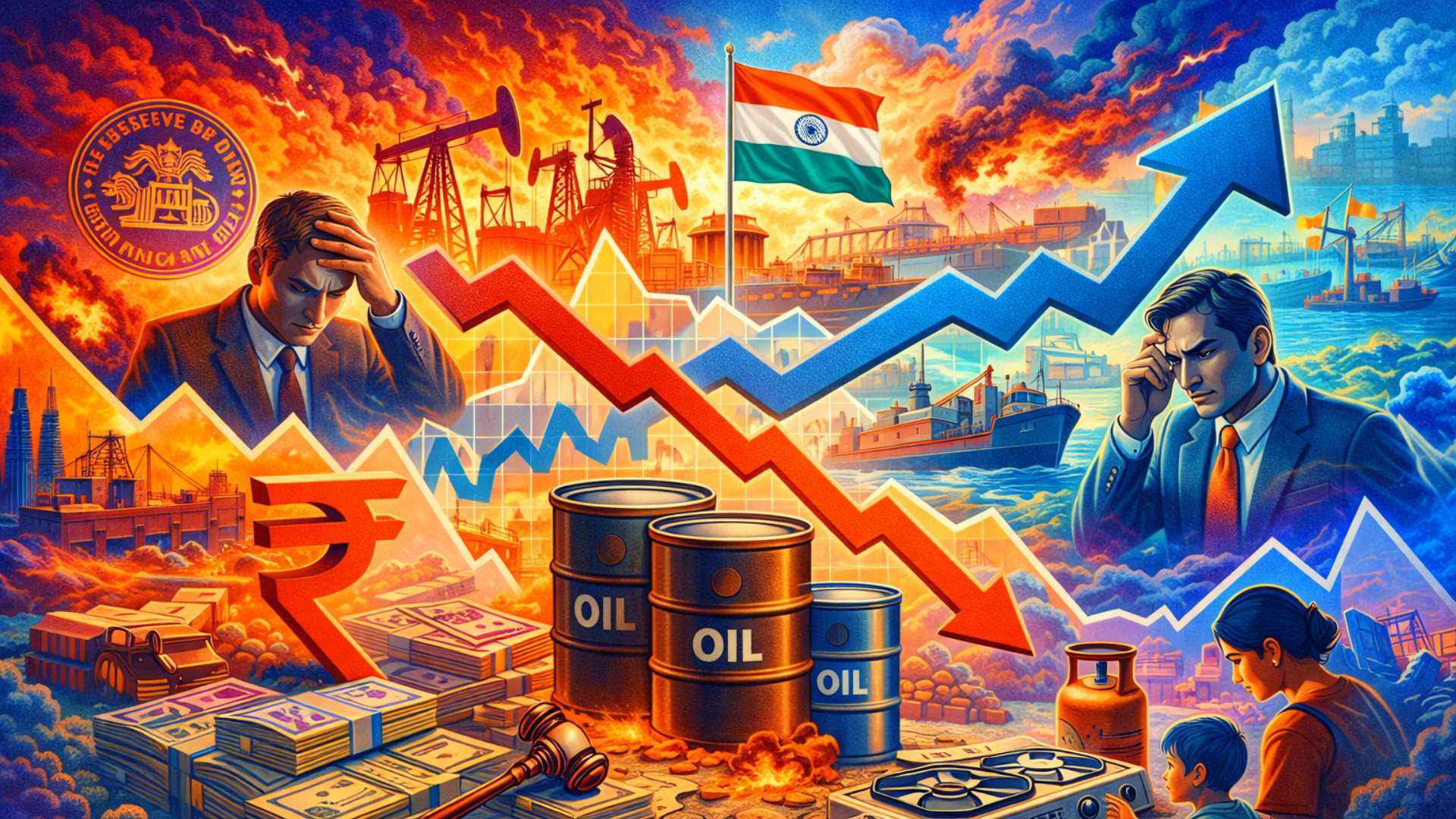
India's Macroeconomic Resilience Under West Asia Geopolitical Stress

Examining how geopolitical instability shakes India’s economy and the necessity for rebalancing toward income-led demand and energy diversification.
SuryaSurya
5 mins read
Oil shocks expose India’s macroeconomic fragility

Introduction

"No nation is an island unto itself in a globalised economy — least of all one that imports 87% of its crude oil."

India's macroeconomic indicators project strength — yet the West Asia conflict has exposed deep structural fault lines beneath the headline numbers. A record-low rupee, surging crude prices, and rising household debt reveal how quickly external shocks can unravel a capex-led, transaction-taxed growth model.

Stress IndicatorStatus (2026)
Rupee₹95/$ (record low)
Crude oil (Indian basket)$156.29/barrel
Forex reserves$709.76 billion
FPI outflows (post-conflict)$8 billion+
Household liabilities41% of GDP

Background and Context

India imports 85–87% of its crude oil, making it structurally exposed to West Asian geopolitical instability. The Iran-Israel-U.S. conflict in 2026 has disrupted shipping routes, spiked energy prices, and triggered currency depreciation — replicating and amplifying the transmission channels seen during the Russia-Ukraine war (2022), when the Indian crude basket surged from 59to59 to 120/barrel.

India's fiscal architecture has undergone a quiet structural shift: from income-broadening taxation toward transaction-linked revenue (GST, financial transaction levies) and from welfare expenditure toward capital formation. This model is efficient in stable conditions but fragile under external commodity shocks.


India's Revenue Structure: Strength or Vulnerability?

Revenue receipts have risen from 8.5% of GDP (FY16–20) to 9.1% (FY22–25) — but this reflects recomposition, not broadening.

  • GST collections: ₹22.8 lakh crore in FY25 — the backbone of indirect tax buoyancy.
  • Direct tax growth remains constrained by limited formal employment expansion.
  • Revenue is increasingly activity-dependent — when energy shocks compress consumption and transactions, GST buoyancy weakens simultaneously with rising expenditure pressures.

Historical Precedent: During COVID-19, GST shortfalls forced the Union government to borrow ₹2.69 lakh crore (2020–22) to compensate states — illustrating the fiscal fragility of transaction-linked revenue under demand shocks.


Oil Price Shock: Fiscal Transmission Channels

Empirical estimates of a $10/barrel rise in crude:

Impact ChannelMagnitude
CPI inflation increase~0.2 percentage points
Current account deficit widening~$9–10 billion (~0.4% of GDP)
GDP growth reduction~0.5 percentage points

ICRA estimates for oil averaging $100/barrel in the current conflict scenario:

  • Current account deficit widens from 0.7–0.8% to ~1% of GDP
  • Government expenditure rises by ₹3.6 trillion (subsidies + compensation)

Ukraine War Precedent (2022):

  • Excise duty cuts on petrol/diesel: ₹13 and ₹16/litre → revenue loss of ₹2.2 lakh crore
  • Fertiliser subsidies surged; total energy subsidies reached ₹3.2 lakh crore
  • Jet fuel doubled to ₹2.07 lakh/kl; commercial LPG rose ₹195.50

Household Vulnerability: The Demand-Side Risk

Private consumption constitutes 61.4% of India's GDP — making household financial health a macroeconomic priority, not merely a social one.

  • Household liabilities rose from 36–37% of GDP (2022) to 41% (2025) — consumption increasingly credit-financed, not income-driven.
  • Net financial savings fell to 3–4% of GDP before recovering to ~7.6% — indicating eroding buffers.
  • LPG supply disruption: Over 60% of LPG imports transit West Asia; current conflict has caused longer refill cycles and local shortages, raising household energy costs on already leveraged balance sheets.
  • MGNREGA underfunding: Allocation fell to ₹60,000 crore in 2023–24 — 33% below revised estimates — even as states had already spent 117% of available funds by December 2022, leaving ₹8,449 crore in pending liabilities.

Industrial Sector: Concentration Without Inclusion

India's industrial recovery is real but narrow:

  • Industrial output growth: 7.8% (December 2025); manufacturing: 8.1% YoY
  • High- and medium-technology industries: 46% of manufacturing value added (Economic Survey 2025–26)
  • Private project announcements: 80% by private firms — but only 9% reached completion (2022–23)

Labour-intensive industries remain weak. The LPG crisis has already caused 50–60% decline in food delivery orders (gig worker unions), closure of restaurants and cloud kitchens — demonstrating how energy shocks disproportionately devastate informal, labour-intensive sectors while capital-intensive industries remain relatively insulated.


Fiscal Optionality: The Core Policy Challenge

India's fiscal space is structurally constrained by its own strategic choices:

Fiscal PriorityImplication Under Shock
Capital expenditure (₹17.15 lakh crore)Crowds out welfare stabilisers
Transaction-linked revenue modelWeakens when consumption falls
Fiscal consolidation (4.3% deficit target)Limits counter-cyclical intervention
Energy subsidy expansion (shock response)Compresses fiscal room further

The result: external shocks simultaneously weaken revenues, expand expenditures, and narrow the room for compensatory action — a fiscal triple squeeze.


Way Forward

Energy Diversification: Accelerate renewable energy transition to reduce structural crude import dependence. India's target of 500 GW non-fossil capacity by 2030 is a long-term buffer against oil shocks.

Revenue Base Broadening: Shift from transaction-linked buoyancy to income-deepening through formal employment expansion — making revenue more resilient to demand compression.

Household Income Support: Strengthen automatic stabilisers — MGNREGA funding, food security buffers — that protect consumption during external shocks without discretionary fiscal decisions.

Strategic Petroleum Reserve: Accelerate filling of India's SPR capacity (currently ~5 days of import cover) toward the IEA benchmark of 90 days.

Diplomatic Diversification: Reduce West Asia dependence through energy partnerships with the Americas, Africa, and Central Asia.


Conclusion

India's macroeconomic resilience is genuine but asymmetric — strong in headline aggregates, fragile at the transmission points where global shocks meet domestic structural weaknesses. The West Asia crisis has compressed the margin for error between a growth story and a vulnerability story. Sustaining the former requires moving beyond capex-led, transaction-taxed, oil-dependent growth toward a model with broader income generation, deeper fiscal buffers, and genuine energy security. The post-Budget season of 2026 may well be remembered as the moment India was forced to confront the difference between growth that is robust and growth that is merely resilient on paper.


Quick Q&A

Everything you need to know

India’s macroeconomic contradiction lies in the coexistence of strong headline growth indicators with underlying structural vulnerabilities. On one hand, GDP growth remains robust (around 8.1%), fiscal consolidation targets are on track, and public capital expenditure is high. On the other hand, external vulnerabilities—such as a depreciating rupee (₹95/),decliningforeignexchangereserves,andrisingoilpricesareintensifying.<br/><br/>Thiscontradictionarisesbecause<strong>traditionalmacroindicatorslikeGDPgrowthdonotfullycaptureexternalsectorfragility</strong>.Forinstance,despitehighgrowth,foreignportfoliooutflowsofover), declining foreign exchange reserves, and rising oil prices—are intensifying.<br/><br/>This contradiction arises because <strong>traditional macro indicators like GDP growth do not fully capture external sector fragility</strong>. For instance, despite high growth, foreign portfolio outflows of over 8 billion and rising crude prices (above $150/barrel) expose India’s dependence on global conditions. The Reserve Bank of India has had to intervene heavily using forex reserves, indicating stress beneath the surface.

Additionally, domestic demand conditions remain weak. Real wages are subdued, household debt has risen to over 41% of GDP, and private investment is lagging behind government-led capital expenditure. This suggests that growth is not broad-based but rather driven by public spending.

Thus, the contradiction reflects a deeper issue: India’s growth model is resilient in stable conditions but vulnerable to external shocks. It highlights the need to reassess macroeconomic strength beyond GDP, incorporating indicators such as energy dependence, financial stability, and household resilience.

India’s fiscal structure has increasingly shifted toward transaction-linked taxation, such as GST and taxes on financial and cross-border transactions. While this system has improved revenue buoyancy during periods of economic expansion, it also introduces vulnerability during external shocks.

The key issue is that transaction-based taxes depend on the volume of economic activity rather than income growth. When external shocks like oil price spikes occur, they reduce consumption by increasing transportation and production costs. This leads to a decline in transactions across sectors, thereby reducing GST collections and other indirect tax revenues.

For example, during the COVID-19 pandemic, GST shortfalls forced the Union government to borrow ₹2.69 lakh crore to compensate States. Similarly, rising oil prices today can compress household spending and reduce demand, thereby weakening tax revenues. This creates a pro-cyclical fiscal system where revenues fall precisely when expenditure needs increase.

Moreover, direct taxes have not expanded proportionately due to limited formal job creation. This limits the stability of revenue streams. In contrast, economies with stronger income tax bases are better insulated from such shocks.

Thus, reliance on transaction-linked taxes makes India’s fiscal system more sensitive to global disruptions, highlighting the need to broaden the tax base and strengthen income-based taxation for long-term resilience.

Crude oil prices act as a key transmission channel for macroeconomic stress in India due to the country’s heavy import dependence (around 85–87%). When global oil prices rise, the effects ripple across multiple sectors of the economy.

First, inflationary pressures increase. A 10/barrelriseincrudecanincreaseCPIinflationbyabout0.2percentagepoints.Higherfuelcostsraisetransportationandlogisticsexpenses,whichinturnincreasethepricesofgoodsandservicesacrosstheeconomy.<br/><br/><strong>Second,theexternalsectordeteriorates</strong>.Higheroilimportbillswidenthecurrentaccountdeficit(CAD),potentiallyby10/barrel rise in crude can increase CPI inflation by about 0.2 percentage points. Higher fuel costs raise transportation and logistics expenses, which in turn increase the prices of goods and services across the economy.<br/><br/><strong>Second, the external sector deteriorates</strong>. Higher oil import bills widen the current account deficit (CAD), potentially by 9–10 billion per $10 increase in oil prices. This puts pressure on the rupee and depletes foreign exchange reserves as the RBI intervenes to stabilize currency volatility.

Third, fiscal stress intensifies. Governments often respond by reducing excise duties or increasing subsidies (e.g., LPG and fertilisers) to shield consumers. For example, during the Ukraine crisis, excise cuts led to a revenue loss of ₹2.2 lakh crore, while energy subsidies rose to ₹3.2 lakh crore.

Thus, oil price shocks simultaneously affect inflation, external balance, and fiscal health, making them one of the most critical macroeconomic risks for India.

Household vulnerability in India has increased due to a combination of rising debt, weak income growth, and external shocks. These factors have reduced the financial resilience of households, making them more susceptible to economic disruptions.

One major reason is the rise in household liabilities, which have increased from around 36–37% of GDP in 2022 to over 41% in 2025. This indicates that consumption is increasingly being financed through credit rather than income growth. In a low-wage environment, this creates risks as debt servicing obligations remain fixed even when incomes fluctuate.

Second, real wages have remained subdued, limiting purchasing power. When combined with rising inflation—especially due to energy costs—this compresses disposable income and reduces consumption demand.

Third, financial buffers have weakened. Net financial savings have been volatile, falling to as low as 3–4% of GDP before recovering. This reduces the ability of households to absorb shocks such as fuel price increases or job losses.

For example, the LPG supply disruptions have increased household energy costs and affected daily consumption patterns. Such shocks disproportionately impact middle- and lower-income groups.

Thus, rising leverage, weak income growth, and external price shocks together explain the growing fragility of household balance sheets in India.

External shocks such as the LPG crisis disproportionately affect informal and labour-intensive sectors, which rely heavily on daily demand and lack institutional protection mechanisms.

A clear example is the recent LPG shortage, where disruptions in supply chains—over 60% of LPG being imported—led to increased costs and limited availability. This directly impacted sectors like restaurants, cloud kitchens, and small food businesses. Many of these establishments were forced to shut down temporarily due to the inability to afford or access fuel.

The ripple effects extended to gig workers. Food delivery platforms witnessed a 50–60% decline in orders, significantly reducing incomes for delivery workers who depend on daily earnings. Unlike formal sector employees, these workers lack job security or social protection, making them highly vulnerable.

In contrast, capital-intensive sectors remained relatively insulated. Industries linked to infrastructure or high-technology manufacturing continued to benefit from public investment and stable financing, highlighting the uneven impact of shocks across sectors.

This example demonstrates that external shocks amplify structural inequalities in the economy. Informal and labour-intensive sectors bear the brunt due to their dependence on consumption demand and lack of financial buffers.

Thus, policies must focus on strengthening social safety nets and ensuring energy security to protect vulnerable segments of the economy.

India’s fiscal strategy has increasingly prioritised capital expenditure (capex) to drive long-term growth, with allocations reaching ₹17.15 lakh crore in the Union Budget 2026–27. While this approach has clear advantages, it also raises concerns, especially in the context of external shocks.

Advantages of capex-led growth:

  • Enhances long-term productive capacity through infrastructure development
  • Crowds in private investment by improving business confidence
  • Generates multiplier effects across sectors
However, these benefits materialise over time and may not address immediate economic distress.

Challenges in the current context:
  • Reduced fiscal space for welfare schemes like MGNREGA, which saw declining allocations
  • Limited support for households facing inflation and income shocks
  • Increased vulnerability during crises, as automatic stabilisers are weak

For instance, during periods of high inflation caused by oil price shocks, households need income support to maintain consumption. However, a capex-heavy strategy may not provide immediate relief, leading to reduced demand and slower economic recovery.

Critical evaluation: While capex is essential for sustainable growth, an imbalance between investment and welfare can exacerbate short-term vulnerabilities. A more balanced approach is needed, combining infrastructure development with robust social protection mechanisms.

Thus, India’s fiscal strategy must evolve to ensure both long-term growth and short-term resilience, especially in an increasingly volatile global environment.

The recent geopolitical tensions in West Asia provide a clear case study of how external shocks constrain India’s fiscal and policy flexibility. The conflict has led to a surge in oil prices, currency depreciation, and capital outflows, creating multiple macroeconomic pressures simultaneously.

Impact on fiscal flexibility:

  • Higher oil prices increase subsidy burdens (fertiliser, LPG) and force tax reductions
  • Revenue losses occur due to lower consumption and reduced GST collections
  • Fiscal deficit targets become harder to maintain
For example, if oil prices average 100perbarrel,governmentexpenditurecouldriseby3.6trillionduetoincreasedsubsidies.<br/><br/><strong>Impactonmonetaryandexternalstability:</strong><ul><li>Therupeedepreciates(to95/100 per barrel, government expenditure could rise by ₹3.6 trillion due to increased subsidies.<br/><br/><strong>Impact on monetary and external stability:</strong><ul><li>The rupee depreciates (to ₹95/), increasing import costs
  • Forex reserves decline as RBI intervenes
  • Foreign portfolio outflows intensify financial volatility

  • Policy constraints: In such a scenario, the government faces limited options. Increasing welfare spending may widen deficits, while maintaining fiscal discipline may reduce support for vulnerable sectors. Similarly, monetary tightening to control inflation can slow growth.

    This case illustrates the concept of “fiscal optionality”—the ability of the state to respond to shocks. With revenues dependent on transactions and expenditures tied to capex, India’s flexibility is constrained.

    Thus, the West Asia crisis highlights the need for diversified energy sources, stronger fiscal buffers, and a more resilient economic structure to withstand future shocks.

    Attribution

    Original content sources and authors

    Sign in to track your reading progress

    Comments (0)

    Please sign in to comment

    No comments yet. Be the first to comment!