
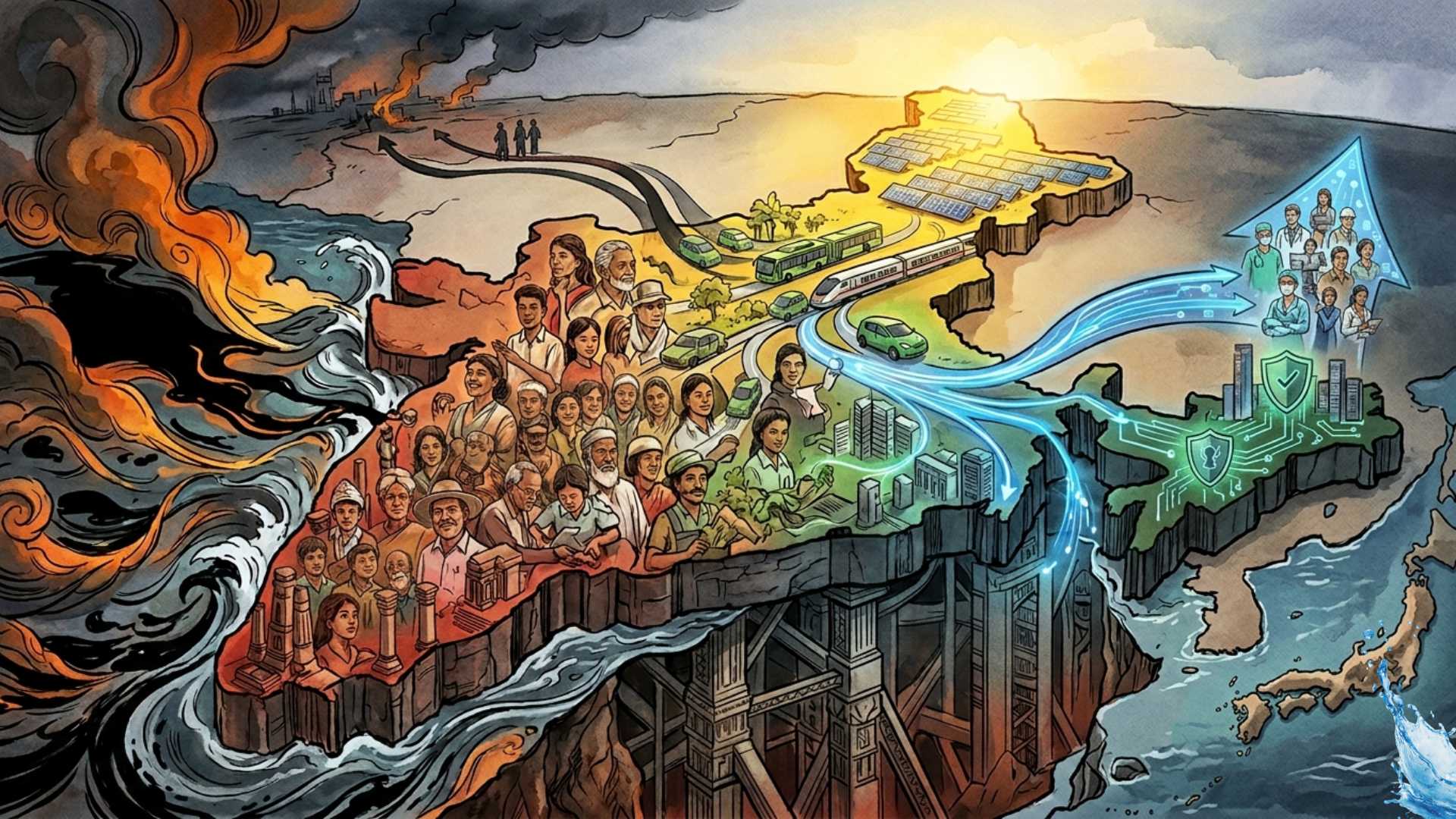
West Asia accounts for nearly 60% of India's crude oil imports and hosts over 8 million Indian workers remitting $40+ billion annually. As the ongoing conflict disrupts global energy markets and growth forecasts, India's structural advantages — demographic depth, solar potential, and geopolitical positioning — offer a differentiated buffer unavailable to most emerging economies.
"India will be better than many others even if this war continues — it has structural advantages that are often underappreciated even within India itself." — Keiko Honda, Former CEO, MIGA (World Bank Group)
| Vulnerability | Structural Advantage |
|---|---|
| 60% crude imports from West Asia | Solar irradiance 300+ days/year → renewable transition |
| PSU oil companies absorbing daily losses | EV push + urban public transport reducing hydrocarbon dependence |
| Remittance corridor at risk | Skill mix shifting → data scientists, cybersecurity professionals |
| Energy price inflation → growth disruption | Diversified economic base ≠ hydrocarbon-dependent Gulf states |
Background and Context
The West Asia conflict has triggered a cascading effect across global energy markets, supply chains, and remittance flows. For India, the exposure is real but asymmetric — while import costs rise and remittance corridors face pressure, India's demographic scale, renewable energy potential, and geopolitical positioning create structural buffers that hydrocarbon-dependent economies cannot replicate.
Key Concepts
Cascading Shock Absorption Unlike Gulf states whose social compacts rest on hydrocarbon wealth, India's economic foundation is diversified across agriculture, services, manufacturing, and a growing digital economy — making it more resilient to energy price volatility.
Demographic Dividend as Buffer A predominantly young population of 1.4 billion creates domestic consumption depth, labour market flexibility, and internal cohesion that insulates India from external shocks in ways smaller, resource-dependent economies cannot manage.
Remittance Corridor Risk India is the world's largest remittance recipient (~$125 billion in 2023). A significant share originates from West Asia's hydrocarbons sector. Conflict-driven disruption could compress household incomes and consumption, particularly in Kerala, UP, Bihar, and Rajasthan.
India's Structural Advantages: An Assessment
| Dimension | Current Status | Long-term Potential |
|---|---|---|
| Solar Energy | 4th largest solar capacity globally | Reduce hydrocarbon import dependence structurally |
| EV Transition | FAME scheme + PLI for batteries | Compress urban fossil fuel demand |
| Skilled Diaspora | High-skilled worker ratio rising | Higher remittances + global professional mobility |
| Cybersecurity | Emerging hub | "Probably the biggest area" of future employment — Honda |
| Geopolitical Position | Indo-Pacific pivot point | Cornerstone of stable global order |
Vulnerabilities That Cannot Be Ignored
- PSU losses: State-owned oil companies absorbing daily losses as global energy prices remain elevated — disrupts even conservative GDP growth projections
- Remittance dependence: Low-skilled West Asia corridor remains dominant in volume; structural shift to high-skilled is underway but incomplete
- Import substitution gap: Renewable transition takes decades; short-term hydrocarbon exposure is unavoidable
- Inflation pass-through: Elevated energy prices feed into transport, manufacturing, and food costs — disproportionately affecting lower-income households
Governance and Policy Implications
- Energy security: Accelerate renewable capacity addition under National Solar Mission + Green Hydrogen Mission as strategic import substitution
- Remittance resilience: Skilling programmes (Skill India, PM Kaushal Vikas) must explicitly target West Asia-bound workers for upward mobility
- Diaspora policy: Formal bilateral labour agreements with Gulf states to protect workers during conflict-driven disruptions
- Cybersecurity investment: Position India as a global cybersecurity hub through dedicated policy, talent pipelines, and CERT-In upgradation
- Strategic autonomy: India's geopolitical positioning demands active engagement — not just passive beneficiary status — in West Asia peace processes
Conclusion
India's resilience to the West Asia conflict is neither accidental nor guaranteed — it is the product of structural advantages that must be actively leveraged through policy. The transition from a low-skilled remittance economy to a high-skilled global professional hub, the acceleration of the renewable energy shift, and the deepening of India's geopolitical role are not merely economic imperatives — they are strategic necessities. As Keiko Honda observed, India is not just a large nation managing a crisis; it is a cornerstone of global stability whose moment demands proportionate ambition.