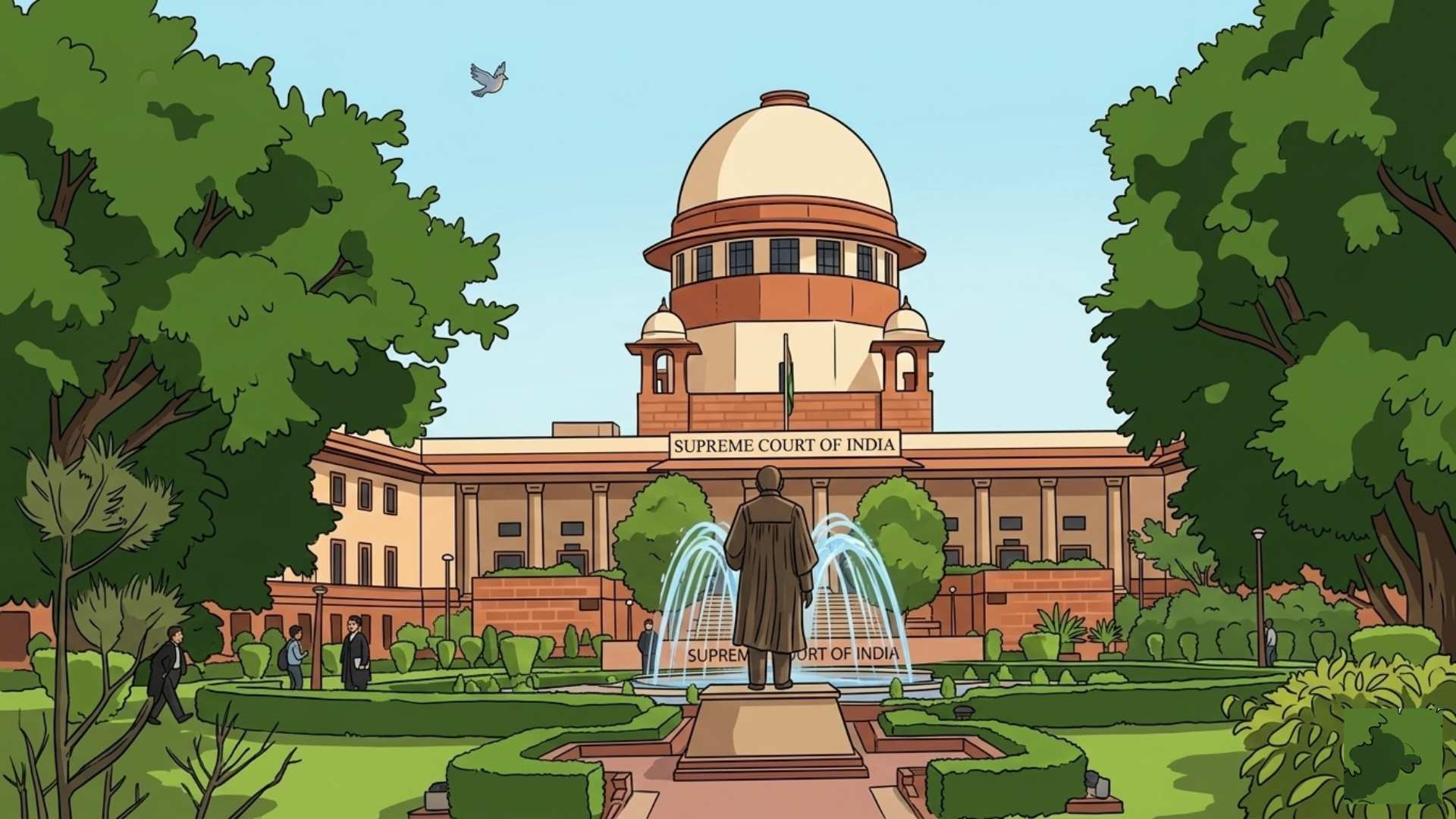
Supreme Court and the New Income Tax Law (2025)
On March 9, 2026, the Supreme Court of India dealt with a petition challenging certain provisions of the new Income Tax Act, 2025, particularly those related to search and seizure powers of tax authorities. The law is scheduled to come into force on April 1, 2026.
The petition questioned whether the expanded powers given to tax authorities could violate individual privacy and procedural fairness. However, the Supreme Court did not examine the constitutional validity of the provisions at this stage. Instead, it allowed the petitioner to approach the Union government with a representation and dismissed the petition as withdrawn.
Background of the Case
The petition was filed by Vishwaprasad Alva, who challenged provisions related to search and seizure operations under the tax law.
The provisions under challenge included:
- Section 132 of the Income Tax Act, 1961
- Section 247 of the Income Tax Act, 2025 (corresponding provision)
- Section 249 of the 2025 Act, which allows non-disclosure of reasons for initiating search and seizure
These provisions permit tax authorities to conduct searches and seizures without revealing the reasons behind such actions to the concerned taxpayer at the time of the operation.
The petitioner argued that these provisions could lead to excessive state power and possible misuse.
Expansion of Search Powers in the New Law
One of the important features of the Income Tax Act, 2025 is the expansion of the definition of assets and locations that can be searched.
Under Section 261(e), the term “computer system” includes:
- Remote servers
- Cloud servers
- Virtual digital space
This means that tax authorities may search not only physical premises but also digital environments such as laptops, mobile phones, and cloud storage.
The provision reflects the increasing role of digital assets and online financial activity in modern economies. However, it also raises concerns about the extent of state intrusion into personal digital data.
Concerns Raised in the Petition
The petitioner argued that search operations under the law could result in serious intrusion into an individual’s privacy, especially when personal electronic devices are seized.
Key concerns included:
- The non-disclosure of reasons for initiating search and seizure operations.
- The possibility that personal digital devices such as laptops and smartphones could be searched.
- The potential violation of the right to informational privacy.
The petition referred to the Puttaswamy judgment (2017), where a nine-judge bench of the Supreme Court declared the Right to Privacy as a fundamental right under Article 21 (Right to Life and Personal Liberty).
The argument was that unrestricted search of digital devices could undermine informational privacy, which forms an important part of individual dignity.
Demand for Procedural Safeguards
Senior advocate Sanjay Hegde, representing the petitioner, accepted that authorities may not be required to disclose reasons in advance. However, he argued that the law should contain internal safeguards ensuring that the reasons actually exist and are recorded within the system.
According to the argument, if reasons are never disclosed or examined, there is a risk that authorities may later justify searches after the fact.
The petition also suggested that taxpayers should not have to approach a High Court in every case merely to know why a search was conducted. Instead, reasons could at least be presented before a tax tribunal or internal review mechanism.
The underlying concern was that without accountability mechanisms, the power of search could lead to harassment of taxpayers.
Reference to Administrative Weaknesses
The petitioner also referred to a Comptroller and Auditor General (CAG) audit report, which pointed out problems in some past tax search operations.
The report highlighted:
- Inadequate diligence before initiating searches
- Insufficient research and information gathering
- Weak justification for some search actions
These observations were used to argue that stronger safeguards are needed to prevent misuse of search powers.
Observations of the Supreme Court
The Bench was headed by Chief Justice of India Surya Kant, along with Justice Joymalya Bagchi.
During the hearing, the Chief Justice observed that tax laws require strong enforcement powers because they often deal with individuals attempting to evade taxes.
Tax evasion frequently involves powerful and influential individuals, which makes enforcement difficult. Strong legal tools are therefore necessary for authorities to effectively investigate hidden income and assets.
However, the petitioner’s counsel pointed out that laws designed to target major offenders may also affect ordinary individuals. The concern was that rules created to catch large-scale tax evaders could unintentionally impact smaller taxpayers.
Court’s Position on Constitutional Review
The Supreme Court emphasised that its role in examining the constitutionality of a law is limited. Courts usually intervene only if:
- There is no mechanism for judicial review, or
- The provision clearly violates constitutional rights.
In this case, the court noted that the High Courts retain the power of judicial review over actions taken under the Income Tax Act. Therefore, taxpayers who believe that search operations were illegal or arbitrary can challenge them in the courts.
Because such a legal remedy exists, the Supreme Court did not find sufficient grounds to declare the provisions unconstitutional at this stage.
Judicial Approach to Potential Misuse
The court also recognised that some legal provisions may initially appear harmless but later lead to systematic misuse. In such situations, courts may intervene after observing how the law operates in practice.
At the same time, certain laws may appear capable of misuse but function effectively because administrative systems prevent abuse.
This reasoning suggests that the real impact of the provisions will become clearer only after implementation.
Key Issues Raised by the Case
The debate around the new Income Tax law highlights several broader issues in governance and constitutional law:
- Balancing effective tax enforcement with protection of civil liberties
- Ensuring that investigative powers do not violate privacy rights
- Creating institutional safeguards to prevent abuse of authority
- Maintaining judicial oversight over executive actions
The case reflects the growing tension between state surveillance powers in the digital era and individual rights to privacy and dignity.
Conclusion
The Supreme Court did not rule on the constitutionality of the search and seizure provisions of the Income Tax Act, 2025, but allowed the petitioner to raise concerns before the government.
The issue highlights the challenges faced by modern legal systems in regulating digital assets, financial transparency and taxpayer rights. As the new law comes into force in April 2026, its implementation will likely shape future debates on privacy, tax enforcement and administrative accountability in India.