Compressed Biogas (CBG) & India's Energy Security: Structural Shift or Missed Opportunity?

"India's energy transition must be driven not just by ambition but by execution discipline — the gap between policy intent and ground reality remains India's biggest energy challenge." — TERI (The Energy and Resources Institute), New Delhi
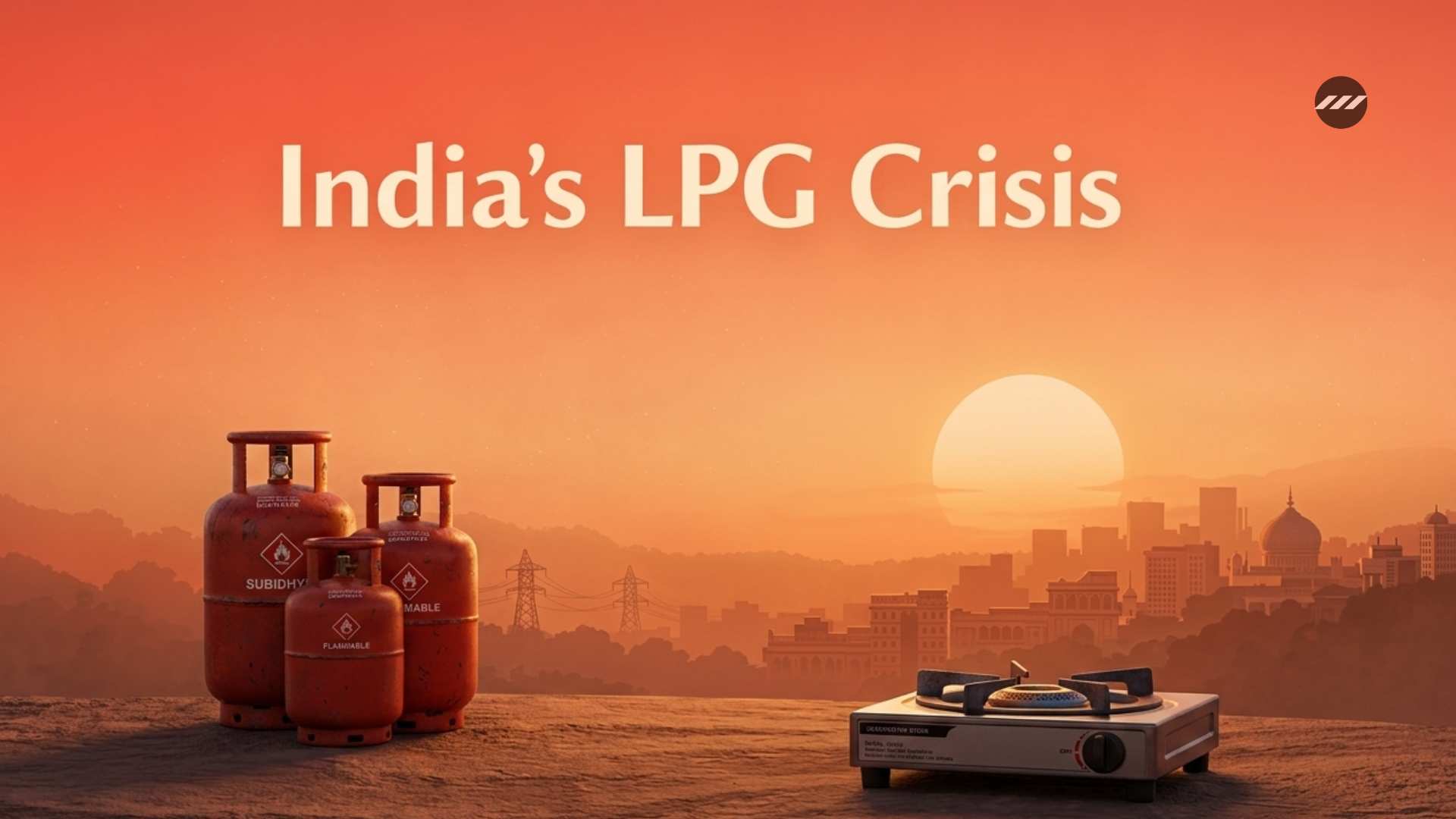
India imports 88.6% of its crude oil and meets barely half its gas demand domestically, even as energy demand is projected to triple by 2047. The 2026 gas crisis — marked by LPG shortages in Mumbai and Bengaluru and price spikes of up to 5x — is not a disruption. It is a structural indictment of India's energy dependence model.
Background / Context
India's LNG regasification capacity exceeds 50 MMT annually, yet utilisation sits at only 50–60% due to pipeline bottlenecks and demand mismatches. LNG imports are projected to hit 28–29 MMT this year. Meanwhile, domestic gas production stagnates — unable to meet industrial, fertilizer, or household demand.
Every West Asian conflict, every global price shock, every currency fluctuation transmits directly into India's inflation numbers and fiscal deficit. Energy insecurity is no longer a sector-specific problem — it is a macroeconomic vulnerability.
Key Concepts / Definitions
Compressed Biogas (CBG) Biogas purified and compressed to natural gas standards (>90% methane). Produced from agricultural residues, animal waste, and municipal solid waste. Chemically equivalent to CNG — can use the same distribution infrastructure.
LNG vs LPG — Key Distinction for Prelims
| Parameter | LNG | LPG |
|---|---|---|
| Full Form | Liquefied Natural Gas | Liquefied Petroleum Gas |
| Composition | Primarily Methane (CH₄) | Propane + Butane |
| Use | Power, Industry, City Gas | Cooking, Transport |
| Storage Temp | –162°C | Ambient pressure |
| Import Source | Qatar, USA, Australia | West Asia (primarily) |
Digestate Nutrient-rich by-product of biogas production. Can replace chemical fertilizers — a critical but underdeveloped market in India's CBG ecosystem.
Data / Key Facts
| Indicator | Figure |
|---|---|
| Crude oil import dependence | 88.6% |
| LNG import projection (2026) | 28–29 MMT |
| LNG regasification capacity | >50 MMT/year |
| Regasification utilisation | 50–60% |
| CBG potential (annual) | 62 MMT |
| Current CBG output | ~920 tonnes/day |
| Operational CBG plants | 132 |
| Energy demand growth by 2047 | 3x current levels |
Government Steps / Policy Measures
| Scheme | Focus | Key Feature |
|---|---|---|
| SATAT (2018) | CBG production & supply | Assured offtake by OMCs; targets 5,000 plants |
| GOBAR-DHAN | Rural biogas from cattle waste | Links waste management + energy + farmer income |
| PM KUSUM | Solar for agriculture | Reduces farm energy import dependence |
| National Bioenergy Programme | MNRE umbrella scheme | Financial support for biogas/biomass projects |
| Ethanol Blending Programme | Petrol blending | 20% blending target by 2025-26 — model for CBG |
Analysis / Significance
Multi-Dimensional Impact
Economic: Every 10% reduction in LNG imports = significant forex savings + lower current account deficit pressure. CBG at scale = import substitution + rural employment.
Agricultural: Digestate replaces urea → reduces fertilizer import dependence. Stubble-to-CBG model eliminates paddy stubble burning → solves two crises simultaneously.
Environmental: CBG = circular economy in action. Waste → Energy → Fertilizer. Reduces methane emissions from agricultural waste decomposition — a potent GHG.
Social: Rural CBG plants = decentralised energy + farmer income + waste management. Aligns with SHG models and gram panchayat energy autonomy.
INDIA'S ENERGY CRISIS — STRUCTURAL LOGIC
━━━━━━━━━━━━━━━━━━━━━━━━━━━━━━━━━━━━━━━━━━━

PROBLEM
Import dependence ↑ (88.6% crude, ~50% gas)
→ Price shock vulnerability ↑
→ Inflation ↑ + Fiscal stress ↑
→ Fertilizer / LPG shortage → Agriculture hit

EXISTING RESPONSE
LNG infrastructure ↑ (50 MMT capacity)
≠ Utilisation (50-60% only)
Policy intent ✓ (SATAT, GOBAR-DHAN)
≠ Execution (132 plants vs 5,000 target)

GAP
Feedstock fragmentation + Financing delays
+ Regulatory bottlenecks (6-9 months approvals)
+ Digestate market underdeveloped

SOLUTION
CBG scale-up → 20 MMT by 2030
= Import substitution + Rural jobs
+ Stubble burning ↓ + Fertilizer import ↓
+ Circular economy ✓
Challenges / Issues
- Feedstock Fragmentation → No national aggregation model; supply unreliable across seasons and geographies
- Financing Gaps → Traditional subsidy model ≠ sufficient for project viability; private investment hesitant
- Regulatory Delays → Single project approval: 6–9 months across multiple departments ≠ investor-friendly
- Digestate Market Absent → Key by-product has no organised buyer → project economics weaken
- Pipeline Infrastructure → Gas grid doesn't reach most rural and semi-urban areas → CBG distribution bottleneck
- Technology-Feedstock Mismatch → Not all feedstock types suit all biogas technologies → efficiency losses
Case Study: Ethanol Blending as a Model
India's Ethanol Blending Programme achieved ~15% blending by 2024 through:
- Price assurance to sugarcane farmers
- OMC offtake guarantee
- Clear annual targets with public tracking
Lesson for CBG: Same policy architecture — assured offtake (SATAT already does this) + feedstock security + financing clarity = replicable success. The model exists. The execution discipline is missing.
Way Forward
IMMEDIATE   → National Feedstock Security Framework
              State-wise biomass mapping + aggregation models
              + Long-term feedstock contracts for developers

SHORT-TERM  → Single-window clearance (mandatory, time-bound)
              Viability Gap Funding for unviable but strategic projects
              Green bonds + Carbon credit integration for CBG plants

MEDIUM-TERM → Dedicated energy crop policy
              2-3% agricultural land → Napier grass / energy crops
              ≠ Food security compromise = strategic diversification

LONG-TERM   → Digestate market development → replace urea imports
              CBG-PNG grid integration at district level
              Target: 20 MMT CBG by 2030
              = 62 MMT potential → execution gap must close
India's ethanol story proves that policy clarity + execution discipline = transformative scale. CBG has stronger fundamentals — it solves energy, agriculture, environment, and rural income challenges simultaneously. The infrastructure exists. The policy intent exists. What is missing is a National CBG Mission with the same urgency as the Ethanol Blending Programme.
Attribution
Original content sources and authors

Syllabus classification
How this article maps to GS papers
Main syllabus
GS3InfrastructureQuick Q&A
What are the structural factors behind India’s energy insecurity as highlighted by the 2026 gas crisis?
A key structural issue is the mismatch between infrastructure and utilisation. While India has developed LNG regasification capacity exceeding 50 MMT annually, utilisation remains at only 50–60% due to inadequate pipeline connectivity and regional demand imbalances. Similarly, LPG supply chains are fragile and concentrated in import-dependent regions, particularly from West Asia, making them susceptible to geopolitical disruptions.
Core structural drivers include:
- Rapidly growing energy demand projected to triple by 2047
- Underperforming domestic exploration and production
- Logistical bottlenecks in distribution networks
Why does India’s heavy reliance on energy imports pose macroeconomic and strategic risks?
From a strategic perspective, dependence on imports exposes India to geopolitical risks. Supply disruptions due to conflicts in regions like West Asia can destabilize domestic markets. This reduces India’s policy autonomy, as decisions must account for external uncertainties rather than purely domestic priorities.
Key implications include:
- Reduced fiscal space due to subsidies and higher import costs
- Exchange rate volatility and inflationary pressures
- Energy supply insecurity during global crises
How can a national feedstock security framework enable the scaling up of Compressed Biogas (CBG) in India?
Such a framework would involve state-wise mapping of biomass resources, development of aggregation systems, and creation of long-term contracts between suppliers and plant operators. For instance, farmer producer organizations (FPOs) or cooperatives could play a role in aggregating crop residues, reducing logistical inefficiencies. Aligning specific feedstock types with suitable technologies would further enhance efficiency and output.
Expected benefits:
- Reduced input cost volatility for CBG plants
- Increased investor confidence and project scalability
- Better integration of rural economies into energy markets
What explains the gap between India’s CBG potential and its current production levels?
Another factor is the regulatory and financial bottlenecks. Developers often face delays of six to nine months in obtaining approvals, increasing project costs and discouraging investment. Financing is also limited, as traditional subsidy-based models do not adequately address the high capital requirements and risks associated with CBG projects.
Additional constraints include:
- Underdeveloped market for digestate (organic fertilizer by-product)
- Lack of awareness and technical expertise
- Poor coordination between policy and ground-level implementation
These factors highlight that while India has a strong policy vision through initiatives like SATAT, the absence of efficient execution mechanisms has prevented large-scale adoption of CBG.
Critically analyse the role of Compressed Biogas (CBG) as a long-term solution to India’s energy crisis.
However, its effectiveness depends on overcoming several limitations. The current ecosystem suffers from supply chain inefficiencies, regulatory delays, and limited financial incentives. Moreover, scaling up to the targeted 20 MMT by 2030 requires substantial investment, technological adaptation, and institutional coordination.
Critical evaluation:
- Advantages: घरेलically available resource, lower emissions, rural employment generation
- Challenges: High initial costs, fragmented feedstock supply, weak market linkages
In conclusion, while CBG is not a standalone solution, it can play a transformative role if integrated with broader energy policies, including renewables and efficiency measures. Its success will depend on bridging the gap between policy intent and execution.
How does the ethanol blending programme provide lessons for implementing large-scale energy reforms like CBG expansion?
Applying these lessons to CBG, it is evident that similar mechanisms are required. For instance, assured offtake agreements under the SATAT scheme can provide market certainty to producers. Additionally, integrating CBG into existing gas distribution networks and offering viability gap funding can improve project economics.
Key takeaways:
- Importance of policy consistency and long-term vision
- Need for strong institutional coordination
- Role of financial innovation such as green bonds and carbon credits
The ethanol programme demonstrates that India can achieve ambitious energy goals when execution matches intent. Replicating this model for CBG can accelerate the transition toward energy self-reliance and sustainability.
Practice questions
1 question for mains preparation