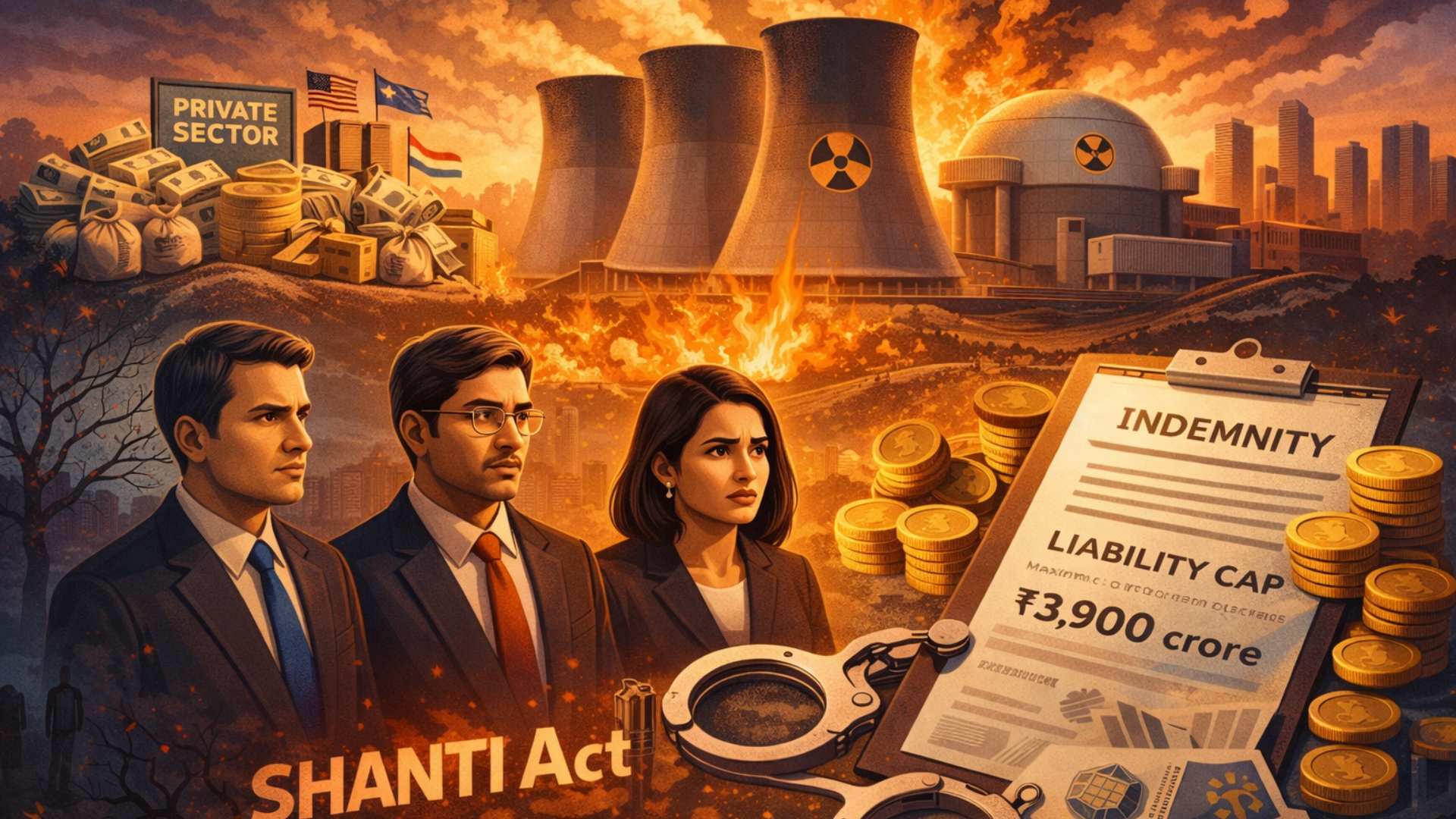
SHANTI Act and Nuclear Liability Reform
1.Liberalisation of India’s Nuclear Power Sector
The SHANTI Act, passed in the Winter Session of Parliament, marks a structural shift in India’s nuclear energy governance. It opens the sector to private operators and substantially modifies the liability framework established under the Civil Liability for Nuclear Damage Act (CLNDA).
The earlier framework balanced expansion of nuclear energy with strict liability principles, including a “right of recourse” against suppliers. The new Act alters this balance by capping operator liability and indemnifying suppliers, raising questions about safety, accountability, and victim compensation.
This reform is significant in the context of India’s long-term target of 100 GW nuclear capacity by 2047, despite nuclear energy contributing only about 3% of electricity generation for decades.
When high-risk sectors are liberalised without proportionate safeguards, governance must ensure that expansion does not dilute safety and accountability standards.
2. Key Features of the SHANTI Act
The Act introduces three major changes.
First, it ends the Union government’s exclusive control over nuclear plant operations and permits private entities to operate reactors. This represents a major departure from the earlier state-dominated model under the Atomic Energy framework.
Second, it channels liability exclusively to the operator and removes the “right of recourse” against suppliers in case of defective equipment. The operator’s liability is capped between ₹100 crore (small plants) and ₹3,000 crore (largest plants). The total liability, including that of the Centre, is capped at 300 million Special Drawing Rights (≈ ₹3,900 crore). Clause 46 of the CLNDA, which allowed victims to seek remedies under other laws including criminal law, has been omitted.
Third, while the Act provides a legislative framework for the Atomic Energy Regulatory Board, it restricts its autonomy by mandating that members be selected by a committee constituted by the Atomic Energy Commission.
Limiting liability and regulatory independence in a hazardous sector alters the risk-distribution framework from “polluter pays” to “risk socialisation,” potentially weakening deterrence.
Liability Framework:
- Operator liability: ₹100 crore – ₹3,000 crore
- Total accident cap: 300 million SDR (~₹3,900 crore)
- Omission of supplier recourse and Clause 46 (criminal remedies)
3. Supplier Indemnity and Historical Accident Lessons
The Act indemnifies nuclear suppliers despite historical evidence that design defects contributed to major nuclear accidents.
The Fukushima (2011) disaster involved weaknesses in reactor containment design. The International Nuclear Safety Advisory Group identified the reactor’s “positive power coefficient” and deficient shutdown systems as key causes of the Chernobyl (1986) accident. The U.S. Presidential Commission on the Three Mile Island (1979) accident noted serious control room design flaws and failure of suppliers to communicate vulnerabilities.
Despite such precedents, the SHANTI Act ensures that suppliers will not face civil or criminal consequences in India, even if defects in supplied equipment cause accidents. This change aligns with demands from multinational suppliers and is consistent with the 2026 U.S. National Defense Authorization Act, which calls for India to align liability rules with international norms favourable to suppliers.
Removing supplier accountability reduces incentives for design diligence and shifts systemic risk to operators, the state, and ultimately citizens.
4. Liability Cap vs Potential Damage
The liability cap under the SHANTI Act is significantly lower than historical accident costs.
The Japan Centre for Economic Research estimates that Fukushima-related costs may reach 80 trillion yen (~₹46 lakh crore). A joint UN agencies report noted that Belarus alone estimated Chernobyl losses at $235 billion (~₹21 lakh crore). The Chernobyl Exclusion Zone, comparable in size to Goa, remains uninhabitable nearly 40 years later.
In comparison, India’s total liability cap of approximately ₹3,900 crore is about 1,000 times smaller than Fukushima-level damage. Even with supplementary compensation conventions, total compensation is unlikely to reach 1% of potential damage.
Victims would have no legal right to compensation beyond this cap, potentially bearing losses independently.
When liability ceilings are disproportionately low, catastrophic risks become partially uninsured, effectively transferring long-term economic and environmental costs to society.
5. Safety Implications and Moral Hazard
Economic theory recognises that shielding entities from consequences creates a “moral hazard,” encouraging greater risk-taking.
Beyond liability caps, the Act indemnifies operators for accidents caused by “a grave natural disaster,” despite Fukushima being triggered by a tsunami. This departs from India’s earlier “absolute liability” principle applied to hazardous industries.
By reducing financial exposure, the Act may weaken incentives to build resilient infrastructure in a country prone to earthquakes, floods, and other natural disasters.
“The problem of social cost is one of reciprocal nature.” — Ronald Coase, The Problem of Social Cost (1960)
This principle underscores that how liability is allocated affects behaviour and risk prevention.
Diluted liability frameworks can reduce preventive investment in safety systems, potentially increasing systemic vulnerability in high-risk technologies.
6. Nuclear Energy in India: Capacity and Targets
Despite ambitious announcements, nuclear power has remained marginal in India’s energy mix.
- Share in electricity generation: ~3%
- Target (1980s): 10 GW by 2000 → Actual: 2.86 GW
- Target (2006): 20 GW by 2020 → Actual: 6.78 GW
- New target: 100 GW by 2047
Past shortfalls were attributed to high capital costs and safety concerns. The proposed “small modular reactors” remain untested and have even higher estimated capital costs per unit.
This raises questions about the economic viability of large-scale nuclear expansion.
Ambitious capacity targets without addressing structural constraints may create policy–performance gaps and fiscal stress.
7. Economic and Commercial Dimensions
Nuclear projects involve large capital flows and commercial opportunities. For example, two Westinghouse AP1000 reactors in Georgia, U.S., reportedly cost about $18 billion each.
Opening the sector to private and multinational players potentially expands investment avenues. However, with capped liabilities and limited regulatory independence, risk distribution may favour corporations while limiting accountability.
This creates a governance dilemma: balancing energy security and commercial interests with public safety and environmental protection.
Energy expansion policies must align commercial incentives with robust regulatory oversight to prevent externalisation of risk.
8. Way Forward
India’s energy transition requires diversification, including nuclear power. However, reforms must balance growth with safety and justice.
- Strengthen regulatory independence of the Atomic Energy Regulatory Board
- Reconsider supplier indemnity in cases of proven design defects
- Align liability caps with realistic damage assessments
- Ensure transparent public consultation and environmental risk audits
A calibrated approach can maintain investor confidence while safeguarding public interest.
Conclusion
The SHANTI Act represents a significant shift in India’s nuclear governance — liberalising operations, capping liability, and indemnifying suppliers. While it may attract private investment and international collaboration, its liability and regulatory provisions raise critical questions about safety, accountability, and victim compensation.
In high-risk sectors such as nuclear energy, sustainable development depends not merely on expansion targets but on credible institutions, resilient infrastructure, and equitable risk-sharing frameworks.