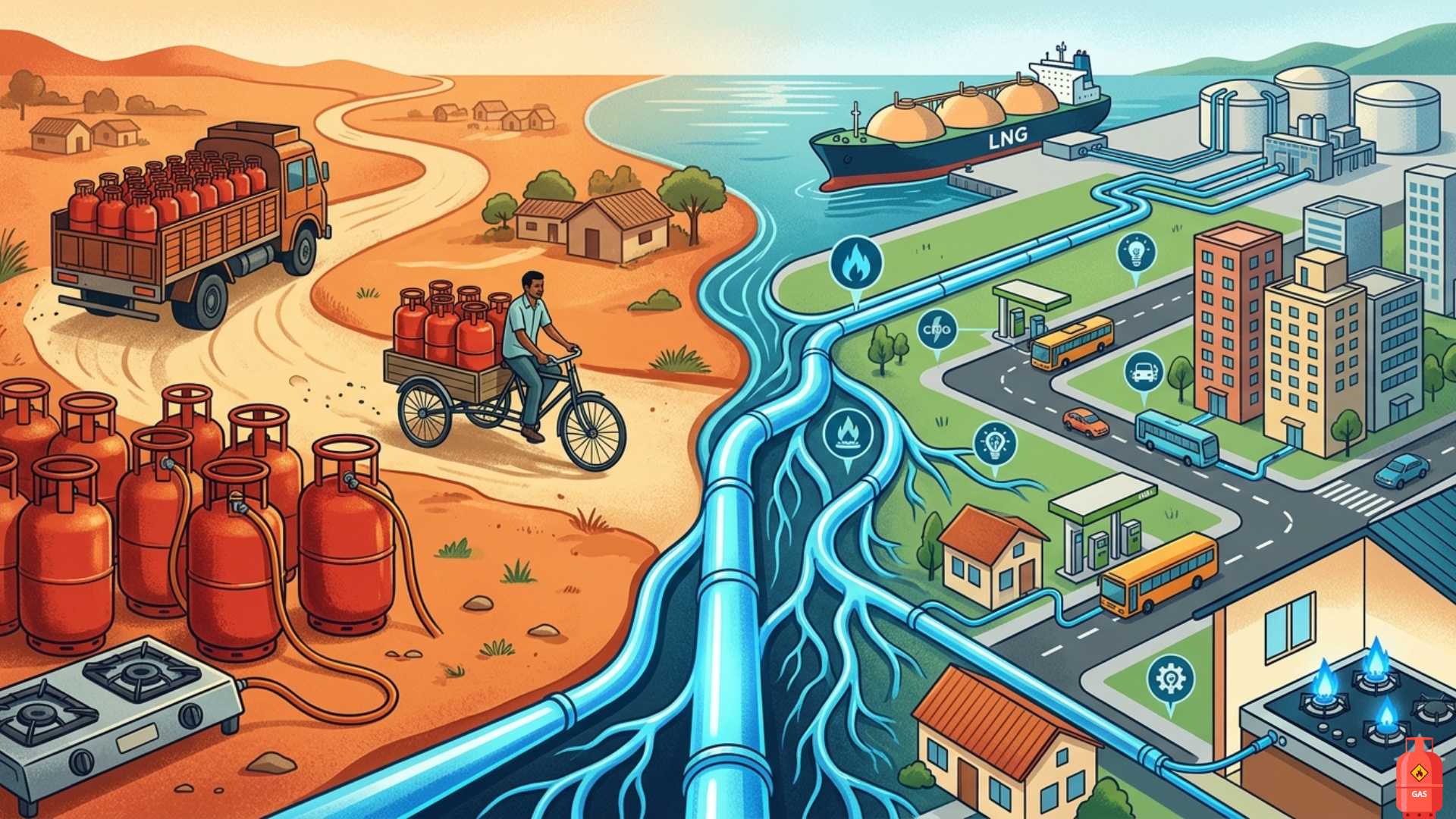
India's domestic energy security is at an inflection point, as geopolitical disruptions to the Strait of Hormuz have exposed the structural vulnerability of its LPG-dependent cooking fuel model. With over 90% of LPG imports routed through this single chokepoint, the government is now accelerating a strategic pivot to Piped Natural Gas (PNG) — a shift backed by regulatory mandates, pipeline expansion targets, and domestic production ambitions.
"Domestic natural gas production alone could cater to 30 crore connections if all were to switch to piped natural gas." — Anjan Kumar Mishra, Secretary, PNGRB
| Parameter | LPG | Natural Gas (PNG) |
|---|---|---|
| Annual consumption | 34 million tonnes | — |
| Domestic production | 12 million tonnes (~35%) | ~27 million tonnes |
| Import dependency | ~65% | ~50% |
| Primary import sources | Saudi Arabia, Qatar | Diversified (global LNG market) |
| Chokepoint exposure | High (Strait of Hormuz) | Low (multiple LNG terminals) |
Key Concepts: LPG vs. PNG vs. CNG vs. LNG
| Fuel | Full Form | State | Primary Use | Transport Mode |
|---|---|---|---|---|
| LPG | Liquefied Petroleum Gas | Liquid (pressurised) | Domestic cooking, MSMEs | Cylinders via trucks/tricycles |
| PNG | Piped Natural Gas | Gas | Domestic cooking, industry | Underground pipelines |
| CNG | Compressed Natural Gas | Compressed gas | Vehicular fuel | Filling stations |
| LNG | Liquefied Natural Gas | Liquid (−160°C) | Import/shipping of natural gas | LNG carriers/ships |
Key distinction: LPG is a co-product of oil refining and gas processing. Natural gas (PNG/CNG/LNG) comes from geological gas fields and has more diversified global sources.
Why the Shift Now? — Context and Drivers
1. Supply Chain Vulnerability India sourced ~90% of its LPG imports from Saudi Arabia and Qatar, routed through the Strait of Hormuz. The West Asia conflict has disrupted this corridor, exposing a critical single-point-of-failure in energy supply chains.
2. Import Substitution India imported ~27 million metric tonnes of LNG last year — roughly matching domestic production. For LPG, however, India produced only 12 million out of 34 million tonnes consumed annually. LNG has far more diversified global suppliers, reducing geopolitical risk.
3. Domestic Production Potential PNGRB Secretary Anjan Kumar Mishra noted that domestic natural gas production alone could serve 30 crore connections if all households switched to PNG — a significant untapped potential.
4. Regulatory Push A recent gazette notification mandates that households cannot hold both LPG and PNG connections simultaneously, requiring ~60 lakh dual-connection households to surrender LPG within three months — pushing total PNG connections toward 2 crore.
Status of PNG Expansion
| Parameter | Current Status |
|---|---|
| Total LPG connections | 33 crore |
| PNG connections (as of 2025) | ~1.5 crore |
| Target PNG connections | 12 crore by 2034–35 |
| CAGR required to meet target | ~24% (current CAGR: 18%) |
| Existing gas pipeline network | ~25,000 km |
| Pipeline under construction | ~10,500 km |
| CGD geographical areas licensed | 300+ |
| CGD areas not yet connected to trunk pipeline | ~90 |
Challenges in Scaling PNG
Infrastructure Gaps The GAIL pipeline network is concentrated in western and northern India, with limited coverage in central, southern, and northeastern regions. Last-mile connectivity — navigating dense urban infrastructure — remains the foremost operational bottleneck.
Gas Availability and Sectoral Competition Natural gas use in India is currently distributed as: fertilisers (~30%), industries/refineries (~35%), city gas distribution (~20%), and power (~13%). Scaling household PNG will require either significant production ramp-up or diversion from industrial uses — creating difficult sectoral trade-offs.
Storage Deficit India's LNG system operates on a near-just-in-time basis with little long-term storage infrastructure, unlike Europe. Any import disruption directly and immediately affects availability — a structural vulnerability.
Production Ramp-Up Needed To supply 13 crore PNG connections, India must increase domestic gas production by at least one-third. Rystad Energy projects a 25% production increase as feasible. ONGC's KG-DWN 98/2 Block in the Krishna-Godavari basin (commenced 2024, peak output expected at 10 MMSCMD) could add ~10% to overall national gas production.
Industrial Transition Friction MSMEs using LPG for welding and cutting face technical and awareness barriers in transitioning to PNG, as equipment may require recalibration or replacement.
Government Policy Measures
- Gazette notification with specific timelines for pipeline approvals in housing and non-housing areas
- Mandatory surrender of LPG connections upon availing PNG
- MoPNG targeting 12 crore PNG connections by 2034–35 with a ₹-competitive PNG pricing policy
- Parliamentary Standing Committee reviewing CGD expansion hurdles: permissions, land acquisition, NOC requirements
Conclusion
India's PNG push represents a strategic reorientation of domestic energy policy — from a geographically concentrated import-dependent model toward a diversified, infrastructure-led gas economy. However, the transition hinges on three simultaneous deliverables: pipeline infrastructure expansion at an unprecedented pace, domestic gas production scaling by at least one-third, and sectoral reallocation without disrupting fertiliser and power security. The government's regulatory interventions are necessary but insufficient in isolation. Long-term energy security demands that pipeline infrastructure reach tier-2, tier-3 cities and rural clusters — precisely where last-mile connectivity is hardest and most expensive. Done well, the LPG-to-PNG transition could reduce India's import bills, diversify energy sources, and improve urban air quality — a governance achievement with compounding strategic returns.