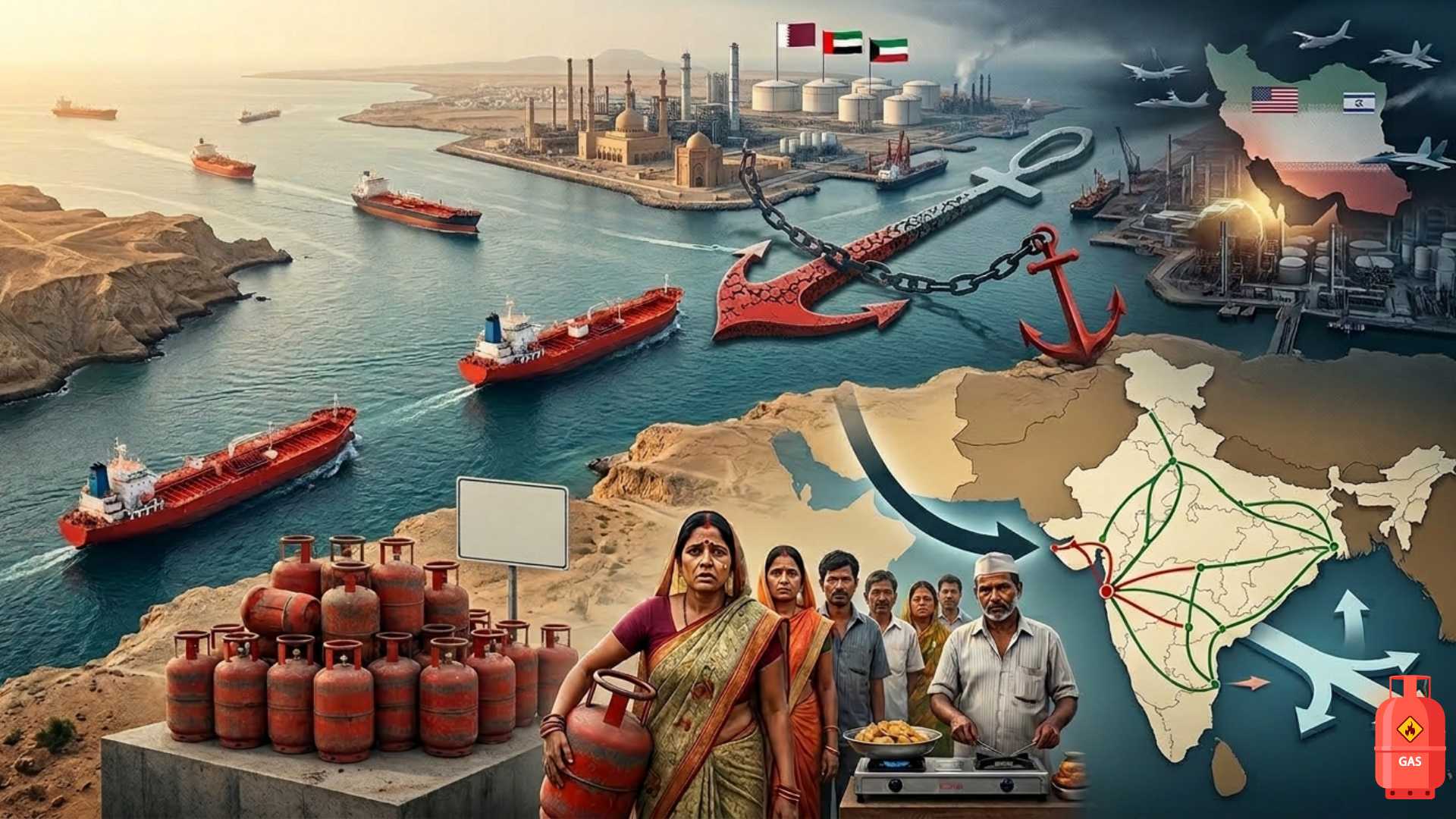
How the U.S.-Israel Conflict with Iran Affects India's LPG Supply

The ongoing conflict in the Middle East is straining India's LPG supply, leading to higher prices and concerns over energy security.
G
Gopi
3 mins read
West Asia conflict strains India’s LPG supply and imports

Background

  • India is heavily dependent on imported liquefied petroleum gas (LPG).
  • The country already required government subsidies to manage rising global LPG prices.
  • In the previous year, the Centre paid ₹30,000 crore to public sector oil marketing companies (OMCs) — Indian Oil Corporation (IOCL), Bharat Petroleum Corporation (BPCL), and Hindustan Petroleum Corporation (HPCL) — to offset losses from selling LPG at subsidised rates.

Government Response to Rising Prices

  • Purpose of subsidy: Protect domestic consumers from global LPG price fluctuations.
  • Domestic LPG prices increased by ₹60 per cylinder within a week of the conflict escalation.
  • Brent crude oil prices briefly rose to nearly $120 per barrel.

Measures by Ministry of Petroleum and Natural Gas

  • Directed domestic refiners to maximise LPG production.
  • Prohibited diversion of LPG for petrochemical production.
  • OMCs instructed to supply LPG exclusively to domestic consumers.

LPG Subsidy and Budget Allocation

  • Union budget cut LPG subsidy allocation by 27% for 2026-27 (from ₹15,121 crore to ₹11,085 crore).
  • Ministry of Petroleum and Natural Gas received ₹30,443 crore for 2026-27.

India’s LPG Production and Imports

  • India produces only about 40% of its LPG requirement.
  • Remaining 60% is imported, mainly from West Asia.
  • LPG imports have increased from over 16.48 million metric tonnes (MMT) in 2020-21 to over 18 MMT in 2025-26.

Rising Domestic LPG Demand

  • Active domestic LPG consumers increased from 1,486 lakh (2015) to 3,305 lakh (July 2025), a growth of over 120%.
  • LPG coverage nearly 100% of households, up from 62% in 2016 due to Pradhan Mantri Ujjwala Yojana.

Major LPG Suppliers

  • Qatar: 34% of imports in 2025
  • UAE: 26%
  • Kuwait: 8.3%
  • Historically, West Asia accounts for a significant share of Indian LPG imports.

Strategic Shipping Concerns

  • The Strait of Hormuz is a key shipping route for oil and gas, including India-bound LPG.
  • Closure of the Strait since March 1 has disrupted LPG imports.

LNG Imports and Usage

  • India’s liquefied natural gas (LNG) imports reached 27 MMT in 2024-25, doubling from 13.5 MMT in 2011-12.
  • Half of LNG imports come from Qatar.
  • LNG is used for fertiliser plants, electricity generation, gas pipelines for vehicles, and commercial kitchens.
  • Similar to LPG, India’s LNG supply is dependent on West Asia, now affected by the conflict.

Key Takeaways

  • India faces supply risks and potential price hikes due to West Asia conflict.
  • Heavy import dependence highlights the need for domestic production and strategic reserves.
  • Government measures focus on protecting domestic consumers and ensuring uninterrupted LPG supply.

Quick Q&A

Everything you need to know

India’s dependence on imported Liquefied Petroleum Gas (LPG) stems from a combination of rapidly rising domestic demand and limited domestic production capacity. LPG is widely used as a clean cooking fuel in Indian households and is also used in commercial kitchens and certain industries. While India produces roughly 40% of its LPG requirement domestically, the remaining 60% must be imported from international markets. This gap has widened because consumption has grown much faster than domestic production capabilities.

A major factor driving this increase in demand is the government’s effort to promote clean cooking energy. Schemes such as the Pradhan Mantri Ujjwala Yojana (PMUY), launched in 2016, significantly expanded LPG access among low-income households. According to data from the Petroleum Planning and Analysis Cell (PPAC), the number of active domestic LPG consumers increased from about 1,486 lakh in 2015 to more than 3,305 lakh by 2025. As a result, LPG coverage has reached nearly 100% of Indian households. While this represents a major public health and environmental achievement by reducing reliance on biomass fuels such as firewood and dung cakes, it has also increased India’s dependence on imported LPG.

The rapid growth in consumption has translated into a sharp rise in imports. India’s LPG imports increased from around 16.48 million metric tonnes (MMT) in 2020–21 to over 18 MMT in 2025–26. The International Energy Agency (IEA) has noted that India’s clean cooking transition is a key driver of global LPG demand growth. While this transition improves indoor air quality and public health outcomes, it also makes India more vulnerable to global energy market disruptions and geopolitical conflicts that affect supply chains.

Geopolitical tensions in West Asia have a significant impact on India’s energy security because the region is the primary source of India’s LPG and liquefied natural gas (LNG) imports. Countries such as Qatar, the United Arab Emirates (UAE), and Kuwait account for a large share of India’s LPG supply. For instance, Qatar alone supplies roughly one-third of India’s LPG imports, while the UAE contributes another major share. When conflicts or geopolitical disruptions occur in this region, they can directly affect the availability, price, and transportation of these energy resources.

Another crucial factor is the strategic importance of the Strait of Hormuz, a narrow maritime passage between Iran and Oman through which a significant portion of global oil and gas shipments pass. Many India-bound LPG and LNG cargoes travel through this route. If the Strait faces blockades, security risks, or military conflict, shipping routes may be disrupted, leading to delays, reduced supply, and higher transportation costs. In the present scenario, the closure of the Strait of Hormuz due to regional conflict has already affected LPG imports and pushed global energy prices upward.

The economic consequences can be substantial for India. Rising global crude oil prices tend to increase LPG costs, which in turn affects domestic fuel prices and government subsidies. Since LPG is an essential household fuel, especially for low-income families, the government often intervenes to cushion price shocks through subsidies or fiscal support to oil marketing companies (OMCs). Therefore, geopolitical instability in West Asia can quickly translate into energy supply risks, inflationary pressures, and fiscal challenges for India.

The Indian government uses a combination of fiscal support, regulatory interventions, and supply management strategies to deal with LPG price volatility and supply disruptions. One of the key measures involves providing financial compensation to public sector oil marketing companies (OMCs) such as Indian Oil Corporation (IOCL), Bharat Petroleum Corporation Limited (BPCL), and Hindustan Petroleum Corporation Limited (HPCL). These companies often sell LPG at prices lower than international market rates to protect consumers. For example, the government provided about ₹30,000 crore in compensation to OMCs to cover losses incurred during periods of high global energy prices.

Another important strategy is the regulation of domestic refining and distribution. In times of supply stress, the government can direct domestic refineries and petrochemical complexes to maximise LPG production and prioritise supply for household consumption. In the context of the current crisis, refiners were instructed to divert their entire LPG output to domestic consumers and avoid using it for petrochemical production. This ensures that essential cooking fuel remains available to households even when imports are disrupted.

Additionally, the government attempts to balance consumer affordability with fiscal sustainability. While subsidies are maintained for vulnerable groups, broader subsidy allocations may be adjusted depending on fiscal conditions. The government also encourages energy diversification and efficiency improvements to reduce long-term dependence on imported fuels. Through these measures, India seeks to maintain supply stability while protecting households from severe price shocks during global energy crises.

LPG prices tend to rise during international conflicts due to a combination of supply disruptions, market speculation, and higher transportation costs. When geopolitical tensions escalate in major energy-producing regions such as West Asia, investors and traders anticipate possible supply shortages. This expectation often drives up global crude oil and gas prices in commodity markets. For instance, during the recent conflict involving Iran and U.S.-Israel forces, Brent crude prices briefly approached $120 per barrel, triggering price increases across energy products, including LPG.

Another important reason is the disruption of critical shipping routes. Much of the world’s oil and gas trade passes through strategic chokepoints such as the Strait of Hormuz. If conflict threatens maritime security or leads to blockades, shipping companies may reduce operations, reroute vessels, or charge higher insurance premiums for cargo shipments. These additional costs are ultimately passed on to importing countries like India, resulting in higher domestic fuel prices.

Finally, domestic policy considerations also influence LPG price adjustments. Governments must balance the need to protect consumers with the financial health of oil marketing companies. If international prices remain high for prolonged periods, governments may increase domestic LPG prices to reduce subsidy burdens. In the recent case, domestic LPG prices in India increased by about ₹60 per cylinder shortly after the outbreak of conflict. Thus, rising LPG prices during geopolitical crises reflect the combined effects of global market dynamics, supply chain disruptions, and domestic fiscal considerations.

Balancing energy affordability with fiscal sustainability represents a major policy challenge for India’s LPG sector. On one hand, LPG is an essential cooking fuel used by millions of households, particularly after the expansion of the Pradhan Mantri Ujjwala Yojana. Ensuring affordable LPG access is therefore important for public health, gender equality, and environmental protection. Without affordable LPG, many households may revert to traditional biomass fuels, which cause indoor air pollution and health risks.

However, maintaining low LPG prices often requires substantial government subsidies. When global energy prices rise, oil marketing companies may incur losses if they sell LPG below market rates. To compensate these losses, the government must provide fiscal support, which can strain public finances. For example, the government allocated tens of thousands of crores to support OMCs during periods of high global prices. Such subsidies can compete with other development priorities such as healthcare, infrastructure, and education.

Another challenge arises from the need to target subsidies effectively. Universal subsidies may benefit wealthier households who do not require financial support, leading to inefficient use of public funds. Therefore, policymakers increasingly focus on targeted subsidy mechanisms that prioritise vulnerable households while gradually aligning market prices with international trends. Achieving this balance requires careful policy design that protects low-income consumers while ensuring the long-term financial sustainability of the energy sector.

The current LPG supply crisis highlights the importance of diversifying energy sources and strengthening long-term energy security. One major lesson is the risk associated with heavy dependence on a limited number of suppliers. Since a large share of India’s LPG and LNG imports comes from West Asian countries, geopolitical conflicts in this region can quickly disrupt supply chains. Diversifying import sources by building partnerships with additional suppliers across different regions could reduce vulnerability to regional instability.

Another important lesson relates to the development of domestic energy infrastructure and alternative fuels. Increasing domestic LPG production capacity, expanding natural gas infrastructure, and investing in renewable energy can help reduce reliance on imported fossil fuels. Programs promoting electric cooking technologies, biogas, and green hydrogen could also contribute to long-term energy resilience. Such measures align with India’s broader climate and sustainability commitments.

Finally, strategic energy planning must include building adequate reserves and improving supply chain resilience. Countries like Japan and South Korea maintain strategic petroleum reserves to protect against sudden supply shocks. Similarly, strengthening India’s strategic energy reserves and logistics networks could provide a buffer during crises. By combining diversification, domestic capacity building, and strategic reserves, India can enhance its ability to manage future energy disruptions while supporting sustainable economic growth.

Attribution

Original content sources and authors

Sign in to track your reading progress

Comments (0)

Please sign in to comment

No comments yet. Be the first to comment!