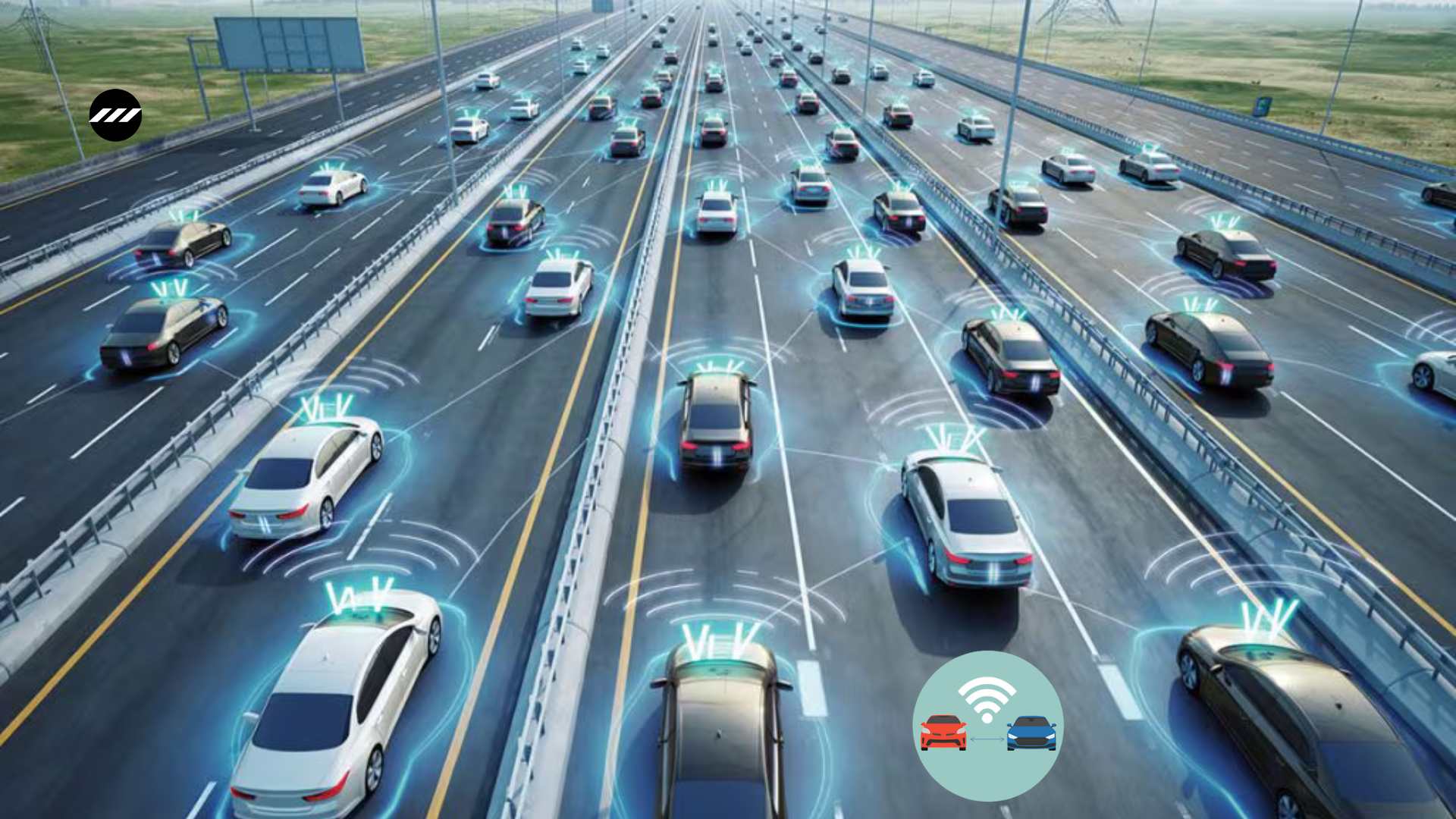
Transforming Road Safety: Vehicle-to-Vehicle Communication in India

Why Does India Need This?
India's road accident problem is not minor — it is a national crisis:
| Fact | Number |
|---|---|
| Annual road deaths in India | 1.5 lakh+ every year |
| Deaths in April 2026 alone | 50+ (Karnataka, Maharashtra, UP) |
| India's global rank in road deaths | Among top 3 countries globally |
| Economic cost of road accidents | ~3% of GDP annually |
| Primary causes | Speeding, wrong-side driving, sudden lane changes, poor visibility |
The core problem V2V is trying to solve:
Most accidents happen because drivers cannot see or react to danger in time.
A car overtaking blindly on a curve cannot see oncoming traffic.
A truck braking suddenly gives no warning to the vehicle behind it.
Human reaction time = 1.5 to 2.5 seconds — often too slow to prevent collision.
V2V tries to give drivers that extra warning time before human eyes can see the danger.
The Supreme Court in April 2026 said road safety is a right to life issue under Article 21 — meaning the state has a constitutional obligation to act, not just a policy preference to do so.
What Is V2V and How Does It Actually Work?
The simple version:
Imagine every vehicle on the road is constantly sending out a radio signal — like a phone constantly broadcasting "I am here, I am moving at this speed, in this direction." Every nearby vehicle receives all these signals and its onboard computer calculates: "Is any of these vehicles on a collision course with me?" If yes — it warns the driver immediately, before the driver can even see the danger.
Step-by-step of how it works:
Step 1: Your vehicle's V2V unit broadcasts your GPS location, speed,
        direction, and braking status 10 times per second.

Step 2: All V2V-equipped vehicles within 300 metres receive your broadcast.

Step 3: Each vehicle's onboard processor runs collision-risk calculations
        continuously in real time.

Step 4: If a collision risk is detected — dashboard alert + audio warning
        triggers in the at-risk vehicle.

Step 5: Driver gets 2-4 seconds of extra warning time to brake or steer clear.
        At highway speeds, 2 seconds = 55 metres of extra stopping distance.
Real-world scenarios where V2V saves lives:
| Scenario | How V2V Helps |
|---|---|
| Car runs red light at intersection | Cross-traffic vehicle warned before it enters intersection |
| Truck brakes hard on highway | Vehicle behind gets brake alert before it can visually see brake lights |
| Car overtakes on blind curve | Oncoming vehicle's signal detected even before visual contact |
| Pile-up in fog | Each vehicle in chain warns the next — cascade braking initiated |
| Emergency vehicle approaching | Ambulance/fire truck clears path automatically via priority signal |
What makes it different from existing technology:
Rear camera / parking sensors: works only when already very close — too late for highway speeds
GPS navigation: shows your route, not other vehicles' movements
V2V: works around corners, through buildings, in fog, at 300m range
     — warns you about dangers you literally cannot see yet
The Bigger Picture: V2X — Vehicle to Everything
V2V is just one part of a larger connected transport system called V2X:
| Technology | What It Does | Example |
|---|---|---|
| V2V — Vehicle to Vehicle | Cars warn each other | Truck warns car behind of sudden braking |
| V2I — Vehicle to Infrastructure | Cars talk to road systems | Traffic light tells cars it is about to turn red |
| V2P — Vehicle to Pedestrian | Cars detect people | Car warns driver of pedestrian about to cross |
Full V2X vision:
Your car knows the traffic light 500m ahead will turn red in 8 seconds.
It knows a pedestrian is about to step off the footpath 200m ahead.
It knows the truck in the next lane is braking hard around the blind bend.
All of this happens before your eyes can see any of it.
For V2V to work properly, all three layers must eventually function together. Right now India has none of them at any meaningful scale — and that is exactly the problem.
What Is Happening?
The Ministry of Road Transport and Highways wants to introduce V2V in India now. The intention is right. The sequencing is wrong.
Why now?
- Road accidents are rising sharply
- 50+ people died in April 2026 alone across Karnataka, Maharashtra, and UP
- Supreme Court took suo motu cognisance in 2025 — road safety declared a constitutional right to life issue
The Core Problem: Putting the Cart Before the Horse
Think of V2V like a WhatsApp group. It only works if everyone is in the group. If only 5 people out of 1,000 have the app, the group is useless.
V2V has the same problem:
V2V benefit rises with the number of vehicles using it.
Low adoption → sparse network → near-zero safety benefit.
High adoption → dense network → real safety benefit.
But early adopters pay full hardware cost for near-zero benefit.
So nobody adopts → network never grows → technology fails.
This is called the network effect problem — and India has no plan to solve it yet.
Five Specific Problems
Problem 1: India Has Not Even Decided the Basic Standard
V2V needs a common communication 'language' — like choosing between Hindi and English.
Two options exist globally:
- DSRC: Older, proven, but infrastructure-heavy
- C-V2X: Newer, uses cellular networks, still evolving
The Ministry has not decided which one India will use.
- Without a standard, vehicle manufacturers cannot build compatible hardware
- Without compatible hardware, no vehicle can "talk" to another
- This is the most basic first step — and it has not happened yet
Problem 2: Vehicle Owners Already Carry High Compliance Costs
Currently mandatory: GPS tracking device + high-security registration plate
No government subsidy. No competitive market to keep costs low.
V2V adds yet another hardware device to this list.
- A truck driver or small fleet owner already spends heavily on compliance
- Adding V2V hardware without subsidy means only wealthy vehicle owners adopt — network never reaches scale
- No subsidy plan has been announced
Problem 3: Drivers Are Not Trained to Use It
V2V generates real-time alerts on a dashboard interface.
Most commercial drivers in India: low digital literacy, no interface-driving experience.
Alert appears → driver does not understand it → ignores it or panics.
- An ignored alert = technology wasted
- A misunderstood alert = driver brakes suddenly on a highway = new accident caused
- The technology assumes a driving competency baseline that does not exist at scale in India
Problem 4: It Can Be Hacked
Every V2V-equipped vehicle = a node in a network = a potential attack point.
A bad actor can send a fake emergency brake signal to all vehicles on a highway stretch.
Result: mass panic braking → pile-up → worse than no technology at all.
No cybersecurity protocol has been announced alongside the V2V proposal.
- Security architecture must come before hardware deployment — not after
- This is not a hypothetical risk — it is a standard concern in all connected vehicle deployments globally
Problem 5: Indian Roads Are Not Built for This Technology
V2V is designed for: structured roads, motorised vehicles, clear lanes, consistent speeds.
Indian roads have: two-wheelers + pedestrians + cattle + potholes + no lane discipline.
A technology designed for German autobahns cannot simply be dropped onto Indian highways.
- Fixing road geometry, signage, and speed enforcement delivers more safety per rupee than V2V at this stage
- A smart city solution on a non-smart road adds no meaningful value
What Should Have Come First
| What India Needs First | Why It Matters More Right Now |
|---|---|
| Decide DSRC vs. C-V2X standard | Without this, nothing else can proceed |
| Fix road design & signage | Addresses majority of accident causes directly |
| Enforce speed limits properly | Enforcement gap is larger than technology gap |
| Train commercial drivers | Human error causes majority of fatal accidents |
| Build subsidy & vendor ecosystem | Solves the network effect bootstrapping problem |
| Develop cybersecurity protocols | Prevents technology from becoming a safety hazard |
The Bigger Pattern
India identifies a real problem (road deaths).
India jumps to an advanced technological solution (V2V).
The foundational requirements for that solution do not exist yet.
The technology gets announced without the ecosystem to support it.
Result: compliance costs imposed on citizens, safety benefit not delivered.
Same pattern seen elsewhere:
- Smart Cities Mission launched before basic water and sewage infrastructure fixed
- EV push without adequate charging infrastructure
- Digital payments push in areas with poor internet connectivity
Attribution
Original content sources and authors


Syllabus classification
How this article maps to GS papers
Main syllabus
GS3InfrastructureQuick Q&A
What is Vehicle-to-Vehicle (V2V) communication, and how does it fit within the broader V2X ecosystem?
In the V2X framework:
- V2V: Communication between vehicles to prevent collisions
- V2I: Interaction with traffic signals, toll booths, and road infrastructure
- V2P: Alerts involving pedestrians and cyclists
In the Indian context, the introduction of V2V is aimed at enhancing road safety amid rising accidents. However, its effectiveness depends on ecosystem readiness, including backend infrastructure, interoperability standards, and user adoption. Without these, V2V risks becoming a fragmented solution rather than a transformative one.
Why is the introduction of V2V technology considered important for India’s road safety framework?
The importance of V2V lies in:
- Preventive safety: Early warnings about collisions, blind spots, or sudden braking
- Reduced human error: Assisting drivers in complex or high-speed environments
- Data-driven governance: Enabling authorities to analyze traffic patterns and accident hotspots
However, its significance must be viewed alongside India’s structural challenges. A spate of fatal accidents in states like Karnataka and Uttar Pradesh highlights the urgency of systemic interventions.
Thus, while V2V offers technological promise, its importance lies not merely in innovation but in its potential to complement broader road safety reforms, including better infrastructure, enforcement, and driver training.
How does V2V communication function in practice, and what are the technical challenges in implementing it in India?
Technically, the system involves:
- Sensors and GPS modules to track vehicle dynamics
- Communication protocols like DSRC or C-V2X
- Processing algorithms to interpret and prioritize alerts
Despite its sophistication, India faces several implementation challenges. First, interoperability issues arise due to the absence of a standardized communication protocol. Second, backend infrastructure such as traffic management systems and cloud networks is underdeveloped.
Additional challenges include:
- Network congestion in the 5.9 GHz band leading to packet loss
- Cybersecurity risks such as spoofing or false alerts
- User adaptation issues due to low digital literacy among drivers
What are the key reasons why V2V technology may have limited effectiveness in India at present?
Key reasons include:
- High compliance costs: Vehicle owners already face expenses for tracking devices and registration systems
- Lack of infrastructure: Poor road design, inadequate signage, and weak enforcement mechanisms
- Mixed traffic conditions: Dominance of two-wheelers, pedestrians, and non-motorized vehicles reduces system predictability
Additionally, human factors play a critical role. Many drivers, especially in the commercial sector, lack training to interpret digital alerts, increasing the risk of misuse or confusion.
Therefore, without addressing foundational issues like road engineering and user capacity, V2V risks becoming a marginal intervention rather than a transformative solution in India’s road safety ecosystem.
Critically analyze the feasibility of implementing V2V technology in India in the current scenario.
Arguments in favor include:
- Potential to reduce accidents through real-time communication
- Alignment with Smart City initiatives and digital governance
- Long-term efficiency gains in traffic management
However, critical concerns are substantial:
- Low readiness: Lack of interoperability standards and backend systems
- Equity issues: High costs may exclude lower-income users
- Security risks: Vulnerability to hacking or signal interference
A comparative example can be drawn from developed countries where V2V trials succeeded due to robust infrastructure and regulatory clarity—conditions not fully present in India.
Thus, while V2V is conceptually sound, its feasibility depends on a phased, context-sensitive approach rather than immediate large-scale deployment.
Can you provide a real-world or hypothetical example illustrating the benefits and limitations of V2V technology in India?
However, the same scenario in India reveals limitations. Mixed traffic conditions—including two-wheelers and pedestrians—may not be part of the V2V network, reducing its effectiveness. Additionally, if only a few vehicles are equipped with V2V, the system fails to create a comprehensive safety net.
Another example involves cybersecurity risks: a malicious actor could send false alerts, causing unnecessary braking and traffic disruptions. Without robust encryption and authentication protocols, such risks remain significant.
Thus, while V2V can enhance safety in controlled environments, its real-world impact in India depends on widespread adoption, strong regulatory frameworks, and integration with broader traffic management systems.
As a policymaker, how would you design a phased strategy for implementing V2V technology in India?
Phase 1: Pilot and Standardization
- Conduct pilot projects in select urban corridors and highways
- Finalize communication standards (DSRC or C-V2X)
- Develop cybersecurity frameworks and interoperability protocols
Phase 2: Infrastructure and Incentives
- Invest in backend systems such as traffic management centers
- Provide subsidies or tax incentives for early adopters
- Integrate V2V with existing initiatives like FASTag and Smart Cities
Phase 3: Mass Adoption and Training
- Mandate V2V in new vehicles gradually
- Launch driver training programs to interpret alerts
- Ensure inclusion of vulnerable road users through V2P systems
A relevant example is the phased rollout of BS-VI emission norms, which allowed industry and consumers time to adapt.
In conclusion, a carefully sequenced strategy, supported by regulatory clarity and financial incentives, is essential to ensure that V2V technology delivers meaningful improvements in road safety.
Practice questions
3 questions for mains preparation