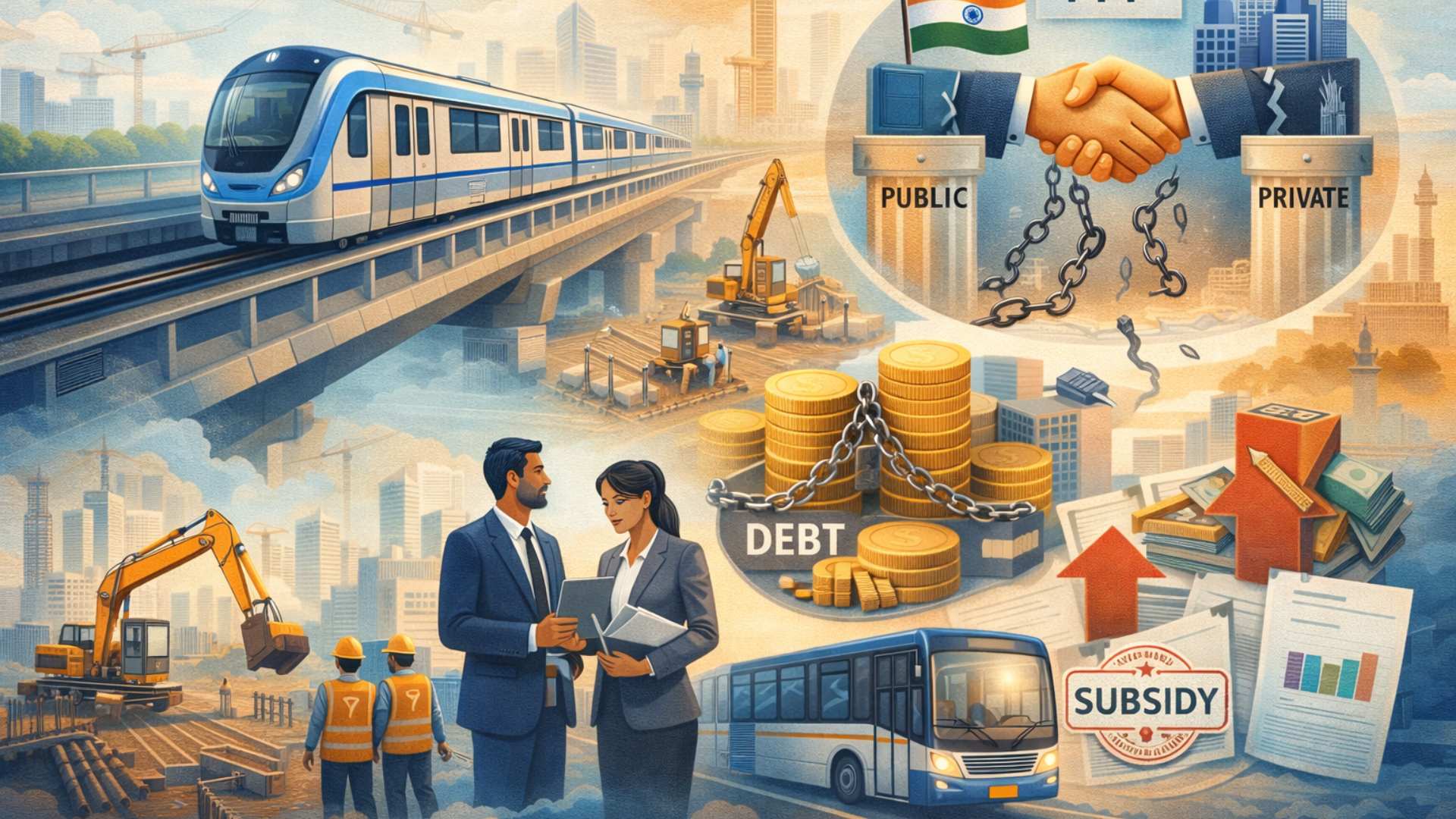
1. Context: Expansion of Metro Rail and the PPP Imperative
India is witnessing rapid expansion of metro rail systems across nearly 20 cities as part of its broader urban transformation agenda. Metro systems are central to addressing congestion, pollution, and mobility constraints in rapidly urbanising regions. Under the New Metro Rail Policy (2017), private sector participation through Public-Private Partnerships (PPP) was made mandatory to avail central assistance for new projects.
However, recent exits of major private players such as L&T (Hyderabad Metro) and Reliance Infrastructure (Mumbai Metro Line 1) indicate structural weaknesses in the PPP design. While governments view PPPs as a way to bridge fiscal gaps in capital-intensive infrastructure, private developers are struggling with financial sustainability.
The experience suggests that large-scale, city-wide metro concessions may not align well with commercial viability expectations. This raises important governance questions regarding risk allocation, viability gap funding, and long-term financial structuring of urban infrastructure.
"Cities are the engines of economic growth." — World Bank
Given that urban transport underpins productivity and inclusion, weaknesses in financing frameworks can directly affect economic growth trajectories.
- urban mass transit is a public good with high social returns but uncertain financial returns. If PPP risks are misallocated, private exits can create fiscal shocks, delays, and negative investor sentiment in infrastructure sectors.*
2. Case Study: Hyderabad Metro – Financial Stress in a Mega PPP
Hyderabad Metro Phase-I, once among the world’s largest PPP metro projects, is being taken over by the Telangana government. The government will refinance debt and acquire L&T’s entire equity stake.
-
One-time cash settlement to L&T: ₹2,000 crore
-
SPV-level debt assumed by government: ~₹13,000 crore
-
L&T’s investment (Q2 FY26): ~₹7,000 crore
-
FY25 losses: ₹626 crore
-
Q3 FY26 net loss: ₹185 crore (vs ₹203 crore in Q3 FY25)
-
Average daily ridership:
- Q3 FY26: 414,000
- Previous year: 445,000
Despite a fare hike in May 2025 and partial state support (only ₹900 crore disbursed out of ₹3,000 crore announced), losses persisted. Concessions for women in state buses led to reduced metro ridership, further stressing revenues.
The project reportedly generated around ₹600 crore in revenue against debt of nearly ₹13,000 crore, highlighting a severe mismatch between revenue generation and debt servicing obligations.
"The revenue gap is simply too large to bridge through fares." — Vijay Agrawal, Equirus Capital
The Hyderabad experience illustrates how high leverage combined with modest fare-box recovery can undermine even large flagship PPP projects.
The core issue is debt overhang combined with politically constrained fare revisions. When revenue projections fail to match financing structures, the burden ultimately shifts to the public exchequer, undermining PPP credibility.
3. Case Study: Mumbai Metro Line 1 – Cost Escalation and Insolvency Risks
Mumbai Metro Line 1, operated by Mumbai Metro One Pvt Ltd (MMOPL), also illustrates PPP fragility.
- Initial estimated cost: ₹2,356 crore
- Final cost: ₹4,321 crore
- Total standalone debt (FY24): ₹4,459 crore
- Revenue (FY24): ₹375 crore (22.5% YoY rise)
- Loss (FY24): ₹461 crore (vs ₹345 crore in FY23)
- Loans under stress: ₹1,226 crore
- Insolvency petitions (2023): SBI (₹416.08 crore), IDBI (₹133 crore)
The Maharashtra government approved a ₹4,000 crore buyout, but implementation stalled due to funding constraints. Although insolvency proceedings were dismissed after a one-time settlement, the project’s rising debt and widening losses reflect structural viability challenges.
Earlier PPP experiences such as Gurgaon Rapid Metro and Delhi Airport Express Line also faced financial distress, leading to government takeovers or exits by private developers.
"Infrastructure is the basic physical and organizational structures needed for the operation of a society or enterprise." — OECD
When these foundational systems become financially unstable, the broader economic ecosystem faces uncertainty.
Repeated distress signals indicate systemic design issues rather than isolated project failures. Persistent renegotiations and bailouts reduce investor confidence and create moral hazard concerns in infrastructure governance.
4. Structural Challenges in Metro PPPs
Metro systems are among the most capital-intensive urban assets, with construction costs averaging ₹250 crore per kilometre and gestation periods exceeding five years. Revenue stabilisation may take another decade.
- Structural Constraints:
- High upfront capital expenditure
- Long gestation before ridership stabilisation
- Politically sensitive fare hikes
- Competition from subsidised bus services
- Weak last-mile and multimodal integration
- Debt-heavy financing structures
Unlike road PPPs, where traffic stabilisation is relatively faster, metro systems depend heavily on behavioural shifts in commuter patterns. Moreover, last-mile connectivity is often outside the concessionaire’s control, limiting revenue optimisation.
Globally, metro systems are predominantly government-funded, with private participation restricted to selective components such as rolling stock supply, construction, and O&M.
"Transport is fundamental to supporting economic growth, creating jobs and connecting people to services." — OECD
Thus, metro viability must be assessed not only on commercial metrics but also on broader socio-economic returns.
Urban mass transit generates large positive externalities—reduced congestion, lower emissions, improved productivity—but these benefits are not fully monetisable through fares. Ignoring this public good character leads to unrealistic commercial expectations.
5. Policy Design Issues: Risk Allocation and Revenue Models
The New Metro Rail Policy (2017) mandated PPP components for central assistance. However, mandatory PPP without adequate risk-sharing mechanisms may deter quality private participation.
- Key Risk Misalignments:
- Revenue risk fully borne by private concessionaire
- Limited minimum revenue guarantees
- Uncertain state support disbursements
- Political control over fares
- No systematic backstop or guarantee structures
Private players are unlikely to sustain prolonged losses in projects where downside risks are unmitigated. As seen in Hyderabad, state support announcements did not fully materialise in time, exacerbating financial stress.
"The essence of strategy is choosing what not to do." — Michael Porter
For governments, this implies recognising sectors where full commercial risk transfer may be inappropriate.
PPP success depends not merely on private capital infusion but on optimal risk allocation. When revenue risk is asymmetrically loaded onto private partners in public goods sectors, exits become rational business decisions.
6. Emerging Alternatives and Recalibration of PPP Model
Experts suggest moving away from full concession PPPs toward unbundled and annuity-based models.
- Viable Reform Options:
- Government-funded construction with later asset monetisation
- Minimum revenue or ridership guarantees in initial years
- Rolling stock leasing with guaranteed availability payments
- Station redevelopment and transit-oriented development (TOD)
- Annuity-style O&M contracts with predictable cash flows
- Standardised concession frameworks and backstop guarantees
Private capital is expected to be more selective, focusing on:
- Airport links
- High-density corridors
- Station-centric commercial development
There is reported interest from global operators, infrastructure funds, and domestic conglomerates in specific value chain segments, subject to financial viability.
"Public–private partnerships are about sharing risk and sharing reward." — World Economic Forum
This principle underscores the need for calibrated risk allocation rather than full risk transfer.
The shift from “full-risk concession” to “hybrid and annuity models” aligns better with the public good nature of metro systems. Properly structured PPPs can crowd in capital without transferring unsustainable revenue risk.
7. Broader Governance and Economic Implications
Metro rail expansion is integral to India’s urbanisation trajectory and climate commitments (GS1, GS3). Efficient mass transit enhances productivity, reduces carbon emissions, and improves urban liveability.
However, fiscal stress from repeated takeovers may strain state budgets and undermine urban financial sustainability. Poorly designed PPPs can also dampen infrastructure investment sentiment.
From a federal perspective (GS2), clear central guidelines, standardised concession agreements, and institutionalised dispute resolution are essential to prevent fragmented approaches across states.
"Good governance is perhaps the single most important factor in eradicating poverty and promoting development." — Kofi Annan
Sound institutional design in infrastructure financing is therefore central to long-term development outcomes.
Urban infrastructure financing must balance fiscal prudence with developmental necessity. Without recalibration, recurring PPP failures may delay mobility goals and reduce long-term investor confidence.
Conclusion
Metro rail systems are critical to India’s urban future, yet their financial architecture must reflect their public good character. The experience of Hyderabad and Mumbai underscores the need for better risk-sharing, realistic revenue projections, and hybrid funding models.
A calibrated approach—combining public financing of core infrastructure with selective, well-structured private participation—can strengthen sustainability while preserving investor confidence. Over time, as data improves and ridership stabilises, private capital may return in more predictable and resilient formats, ensuring that urban mobility expansion remains both fiscally responsible and developmentally effective.