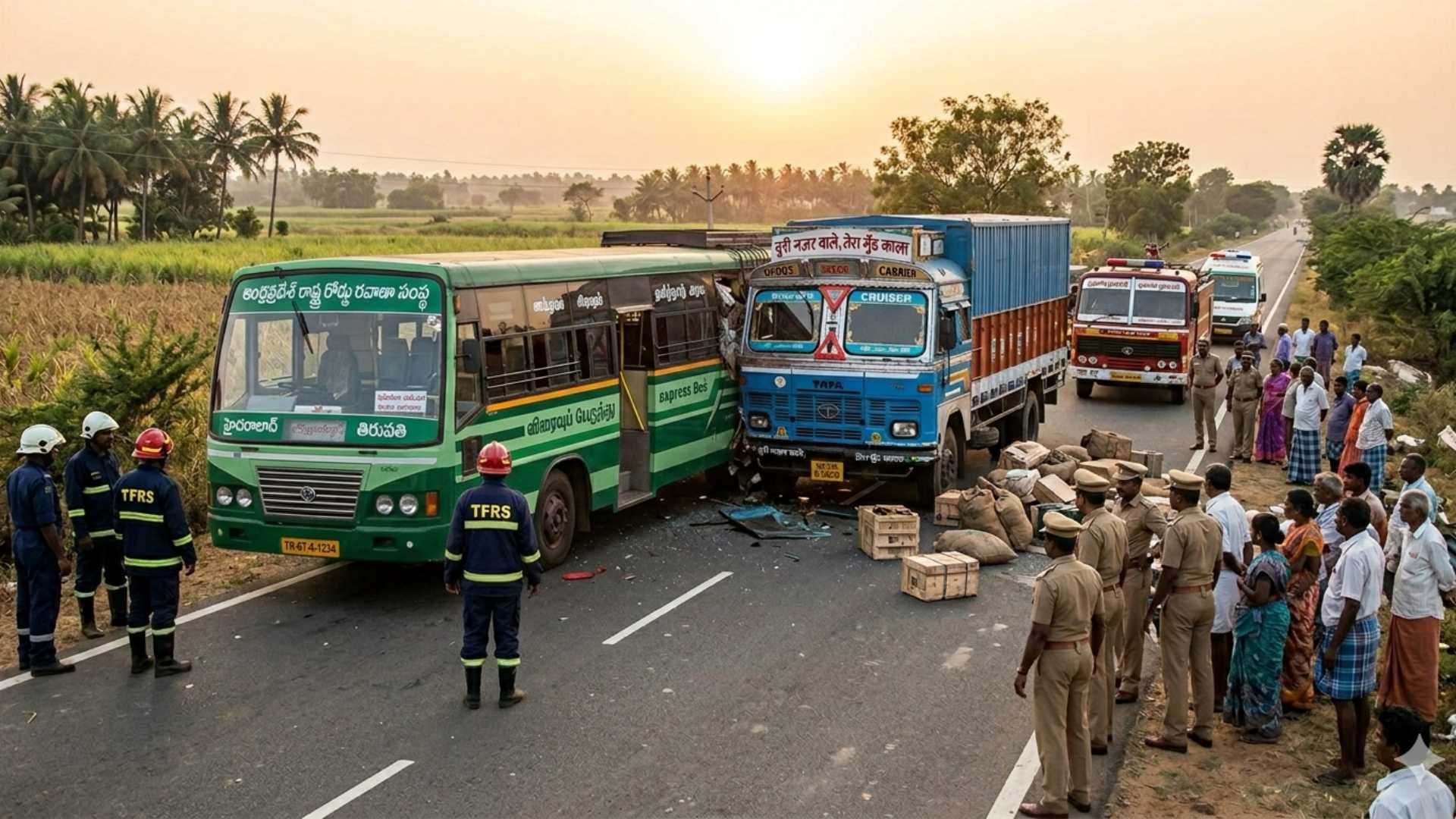
Tragic Bus Collision in Markapuram Claims 14 Lives

An early morning accident involving a private bus and lorry near Markapuram resulted in 14 fatalities and multiple injuries, raising concerns about road safety.
G
Gopi
5 mins read
Tragic bus-lorry collision in Markapuram kills 14, injures 28.

Introduction

India records ~1.5 lakh road deaths and 4.6 lakh accidents annually — the highest fatality count in the world. The Markapuram bus fire (March 26, 2026), which killed 14 passengers in Andhra Pradesh, is not an aberration but a symptom of deep structural failure in road transport governance.

"Road accidents are not accidents — they are predictable, preventable events that reflect failures of regulation, enforcement, and infrastructure."

IndicatorFigure
Annual road accident deaths (India)~1.5 lakh
Annual road accidents reported~4.6 lakh
Global rank in road fatalities1st (highest)
Markapuram tragedy — deaths14 charred; 28 injured
Probable causesWrong-lane driving, diesel tank rupture, AC battery short circuit

Incident Summary: Markapuram Bus Fire (March 26, 2026)

ParameterDetail
LocationRayavaram, Markapuram, Andhra Pradesh
Date & TimeMarch 26, 2026; ~5:30–6:00 AM
Vehicles involvedPrivate bus (Harikrishna Travels) + tipper lorry
RouteNirmal (Telangana) → Vinjamur, Nellore (AP)
Passengers42 (including a 5-month-old infant)
Deaths14 (charred)
Injured28 (5 critically)
Probable causeBus veered onto wrong lane; hit lorry's diesel tank → explosion → fire
Fire accelerantsDiesel tank, AC battery (short circuit), inflammable materials on bus

Key Concepts

Why Bus Fires Are Catastrophically Fatal: Unlike road impact alone, fire eliminates escape time. Three factors compounded the Markapuram tragedy:

  1. Diesel tank rupture on collision — instant ignition source.
  2. AC battery short circuit — a recurring hazard in overnight buses with high-capacity electrical systems.
  3. Inflammable materials on board — regulatory blind spot in private bus inspections.

Passengers in overnight sleeper buses are particularly vulnerable — unaware, disoriented, and physically constrained in berths during early-morning hours.

Human Error vs. Mechanical Failure: The driver cited a jammed steering wheel; officials pointed to overspeeding and wrong-lane driving. This dual ambiguity — driver negligence vs. vehicle fitness — is central to most road accident investigations in India and underscores the need for both driver monitoring and mandatory pre-trip vehicle certification.


Structural Causes of India's Road Safety Crisis

1. Regulatory Gaps in Private Bus Operations: Interstate private buses operate under national permits but face inconsistent safety inspections across state borders. Fitness certification is often procedural rather than substantive, with mechanical checks inadequately covering electrical systems, fire suppression equipment, and tyre integrity.

2. Driver Fitness and Fatigue: Long-distance overnight buses are frequently driven by a single driver without mandatory rest periods — a violation of Motor Vehicles Act provisions that remains poorly enforced. Driver fatigue is a leading cause of loss of vehicle control in pre-dawn accidents.

3. Road Design and Infrastructure: Accident-prone turning points, unmarked curves, inadequate lighting, and missing crash barriers on state highways create systemic risk that driver behaviour alone cannot mitigate.

4. Emergency Response Gaps: Despite police reaching the site within seven minutes in Markapuram, the fire had already claimed lives — highlighting that prevention, not response speed, is the critical variable in fire-related bus accidents.


Government Response: Immediate and Preventive

Immediate Relief:

AuthorityCompensation Announced
Andhra Pradesh Government₹5 lakh to kin of deceased; ₹2 lakh to injured
Central Government (PM)₹2 lakh ex-gratia to deceased families; ₹50,000 to injured
State GovernmentFull medical expenses for all injured

Preventive Measures Announced (AP Government):

  • 13 inter-state check posts activated to inspect buses with national permits.
  • Three-member inspection teams (Transport + Police + Fire departments) deployed.
  • Mobile application for real-time driver fitness assessment (vision, health parameters) — to be launched within days.

Implications and Challenges

Governance Challenge — Reactive vs. Proactive Regulation: Post-accident announcements of check posts and mobile apps reflect a reactive governance pattern endemic to road safety management in India. The Motor Vehicles (Amendment) Act, 2019 strengthened penalties but enforcement remains weak — particularly for interstate private operators who exploit jurisdictional gaps between states.

Technology as a Tool — Possibilities and Limits:

  • GPS-based vehicle tracking is already mandated for commercial vehicles under MV Act rules — compliance is uneven.
  • Driver fatigue monitoring technology (eye-tracking, biometric sensors) exists globally but is not yet mandated in India.
  • The proposed driver fitness app is a step forward — but app-based screening cannot substitute for structural enforcement at the operator level.

Centre-State Coordination: Road transport is a Concurrent List subject (Entry 35). Interstate private buses require Central government national permits but are regulated day-to-day by states. This jurisdictional overlap creates enforcement gaps — a bus that passes inspection in one state may operate unsafely in another.


  • Motor Vehicles Act, 1988 (amended 2019) — governs vehicle fitness, driver licensing, permits, and penalties.
  • National Road Safety Policy — mandates safer road design, enforcement, emergency care, and public awareness.
  • Bharat NCAP (New Car Assessment Programme) — crash safety ratings for passenger vehicles; not yet extended to buses.
  • AIS 135 & AIS 153 — Bureau of Indian Standards norms for bus body construction and fire safety — compliance enforcement is weak.

Conclusion

The Markapuram tragedy is a grim reminder that road safety in India remains a governance challenge as much as a technical one. Compensation announcements and reactive check posts address symptoms, not causes. Durable reform requires: mandatory fire suppression systems in all interstate buses, stringent pre-trip mechanical certification, enforceable driver rest norms, and real-time GPS and fatigue monitoring. Most critically, India needs a shift from event-driven enforcement to continuous, technology-aided, institutionalised oversight of commercial passenger transport. With 1.5 lakh lives lost annually on Indian roads, this is not merely a transport issue — it is a public health and governance emergency.

Quick Q&A

Everything you need to know

The Markapuram bus-lorry accident was a tragic incident resulting from a combination of human error, mechanical issues, and systemic safety lapses. According to preliminary findings, the bus allegedly veered onto the wrong side of the road and collided with a tipper lorry. Officials have pointed to driver negligence and overspeeding as primary causes, while the driver himself claimed a mechanical failure, stating that the steering wheel was jammed. Such conflicting accounts highlight the need for a thorough and scientific investigation.

Another major contributing factor was the design and condition of the road. The accident occurred at a turning point, which inherently increases the risk of collisions if not supported by proper signage, speed regulation, and road engineering. Early morning travel, possibly combined with fatigue, may also have impaired the driver's judgment. This reflects a broader issue of driver working conditions and enforcement of rest norms in the transport sector.

The severity of the accident was exacerbated by secondary factors such as the explosion caused by the lorry’s diesel tank and the presence of inflammable materials in the bus, including its air-conditioning battery system. These factors turned a collision into a deadly fire incident. Thus, the tragedy underscores the interplay of human, mechanical, and infrastructural failures in road accidents.

Road accidents involving public transport continue to be a major concern in India due to systemic gaps in enforcement, infrastructure, and institutional coordination. While policies such as the Motor Vehicles (Amendment) Act, 2019 aim to enhance road safety, their implementation remains uneven across states. Issues like over-speeding, driver fatigue, and poor vehicle maintenance persist due to weak regulatory oversight and lack of accountability mechanisms.

Another critical factor is the quality of road infrastructure. Many highways and rural roads lack proper signage, lighting, and engineering design, especially at curves and intersections. In the Markapuram case, the accident occurred at a turning point, highlighting the risks posed by inadequate road safety measures. Additionally, mixed traffic conditions, where heavy vehicles share roads with smaller vehicles, further increase vulnerability.

Institutionally, there is often a lack of coordination between transport, police, and urban planning authorities. Emergency response systems, though improving, still face delays in many regions. The recurrence of such accidents points to the need for a holistic approach involving stricter enforcement, better infrastructure, technological integration, and public awareness campaigns. Without addressing these structural issues, isolated policy measures will have limited impact.

Technology and governance reforms can play a transformative role in enhancing road safety and accident prevention. One key initiative mentioned in the article is the development of a mobile application to assess driver fitness, including vision and health parameters. Such tools can ensure that only medically fit individuals operate heavy vehicles, reducing the risk of accidents caused by fatigue or health issues.

Additionally, the use of Intelligent Transport Systems (ITS) can significantly improve monitoring and enforcement. Features like GPS tracking, speed governors, and real-time alerts can help authorities detect violations such as over-speeding or lane deviation. Automated enforcement through cameras and e-challans can reduce human discretion and increase compliance.

On the governance front, the establishment of inter-departmental teams involving transport, police, and fire services is crucial. The decision to set up check posts at inter-State entry points is a step in this direction. Regular vehicle inspections, driver training programs, and strict penalties for violations must be institutionalised. Combined with public awareness campaigns, these measures can create a culture of road safety, reducing the likelihood of such tragedies.

The unusually high fatality rate in the Markapuram accident can be attributed to a combination of fire-related factors and delayed escape opportunities. The collision led to an explosion when the bus hit the diesel tank of the lorry, triggering a massive fire. The presence of flammable materials, including fuel and the bus’s air-conditioning battery system, caused the flames to spread rapidly, engulfing the vehicle within minutes.

Another critical factor was the structural design of the bus. Many private buses are not equipped with adequate emergency exits or fire-resistant materials. In such situations, passengers often find it difficult to evacuate quickly, especially in a state of panic. The early morning timing of the accident may have further reduced reaction time, as many passengers were likely asleep.

This incident highlights the importance of vehicle safety standards, including fire suppression systems, emergency exits, and the use of non-flammable materials. It also underscores the need for passenger awareness and safety drills. Without such measures, even minor collisions can escalate into large-scale tragedies with high fatality rates.

The government’s response to the Markapuram accident demonstrates both immediate relief measures and long-term preventive intent. On the positive side, authorities acted swiftly in rescue operations, ensured medical treatment for the injured, and announced financial compensation for victims. High-level involvement by the Chief Minister and coordination among departments reflect administrative responsiveness and accountability.

Preventive measures such as setting up check posts at inter-State entry points and forming a three-member inspection team are also commendable. These steps aim to strengthen enforcement and ensure compliance with safety norms. The proposed mobile application for driver fitness assessment indicates a move toward technology-driven governance.

However, these measures also raise questions about reactive policymaking. Such interventions are often implemented after major accidents rather than as part of a sustained strategy. Issues like road design, vehicle safety standards, and driver working conditions require deeper structural reforms. Moreover, the effectiveness of check posts depends on consistent enforcement and absence of corruption. Thus, while the response is necessary and timely, it must be complemented by systemic and long-term reforms to ensure lasting impact.

The Markapuram accident offers several important lessons for improving road safety management in India. First, it highlights the need for a multi-dimensional approach that addresses human, vehicular, and infrastructural factors simultaneously. Focusing solely on driver error without improving road design or vehicle standards will yield limited results.

Second, the incident underscores the importance of emergency preparedness and response systems. The quick arrival of police and rescue teams helped save lives, but the scale of fatalities indicates that more robust systems, including fire safety mechanisms in vehicles, are needed. Countries like Sweden, under the Vision Zero policy, have demonstrated how integrated safety measures can significantly reduce road deaths.

Finally, the case emphasises the role of data-driven policymaking. Systematic analysis of accident data can help identify high-risk zones, common causes, and effective interventions. For example, identifying accident-prone curves and improving their design can prevent future incidents. Overall, the tragedy serves as a reminder that road safety must be treated as a public health and governance priority, requiring sustained commitment and innovation.

Attribution

Original content sources and authors

Sign in to track your reading progress

Comments (0)

Please sign in to comment

No comments yet. Be the first to comment!