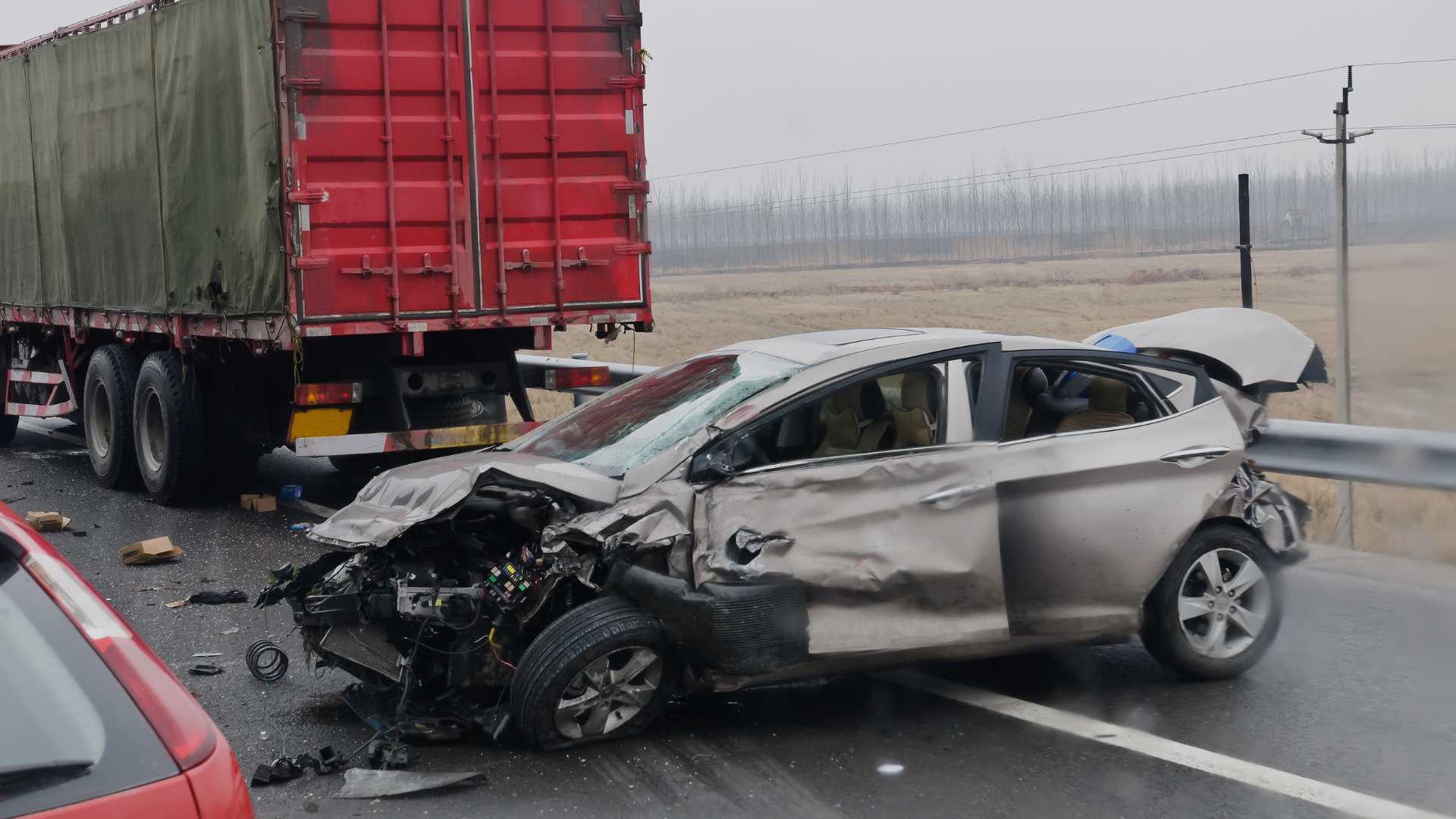
Fatal Crash Highlights Insurance Gaps in Road Accident Law

A tragic accident reveals critical issues in India's compensation framework for uninsured vehicles and deceased drivers.
G
Gopi
3 mins read
Uninsured car crash exposes legal gap in compensation for road accident victims
Not Started

The case highlights a serious policy vacuum in India’s road accident compensation regime—particularly in situations where:

  • The offending vehicle has no third-party insurance
  • The driver-cum-owner dies in the same accident
  • There is no recoverable estate or attachable assets
  • The case does not qualify as hit-and-run

This creates a legal dead-end for victims’ families, as seen in the tragic death of cyclist Surender Kumar Ahirwar.


Core Legal Issues

1. Mandatory Insurance Under the MV Act

  • Section 146, Motor Vehicles Act, 1988 mandates third-party insurance.
  • However, enforcement is weak—~45% of vehicles remain uninsured.
  • Insurance is the primary mechanism ensuring victim compensation.
  • When insurance is absent, recovery depends on the financial capacity of the tortfeasor.

2. Non-Applicability of Existing Schemes

The present case falls outside:

  • Hit-and-Run Compensation Scheme (2021) → Applicable only when the offender is untraced.
  • Cashless Treatment of Road Accident Victims Scheme (2025) → Limited to emergency medical treatment.
  • Motor Vehicle Accident Fund (current design) → Mainly structured around hit-and-run cases.

Thus, there is no statutory fallback in uninsured-but-identified cases with no recoverable estate.


Why This Is a Structural Problem

This case reflects three systemic weaknesses:

(1) Enforcement Gap

Despite mandatory insurance, compliance remains poor—especially among two-wheelers.

(2) Compensation Linked to Financial Status of Offender

If the wrongdoer is poor or dies insolvent, victims effectively lose compensation rights.

(3) Scheme Design Gap

The Motor Vehicle Accident Fund is not structured as a universal safety net.


National Significance

  • Over 14 crore uninsured vehicles on Indian roads.
  • High share among economically vulnerable segments.
  • Accident victims are often from lower-income households.
  • Without compensation, families fall into intergenerational poverty traps.

This undermines:

  • Social justice
  • Road safety accountability
  • Welfare state principles under Article 38 & 41 (Directive Principles)

Possible Legal & Policy Solutions

1️⃣ Expand the Motor Vehicle Accident Fund

Cover cases where:

  • Vehicle is uninsured

  • Offender identified

  • Recovery impossible

  • Later recover through state enforcement where feasible.

2️⃣ Create a “Compensation of Last Resort” Clause

Statutory amendment to MV Act providing:

State-funded compensation where enforcement fails.

3️⃣ Strengthen Insurance Enforcement

Link insurance validity to:

  • Fuel purchase
  • FASTag renewal
  • PUC certificate
  • Vehicle fitness

4️⃣ Introduce Road Safety Social Insurance Pool

  • Nominal levy on fuel/vehicle registration.
  • Creates a universal compensation pool.

5️⃣ Judicial Innovation

Courts could:

  • Invoke Article 21 (Right to Life with dignity)
  • Recommend compensatory jurisdiction expansion

Broader Constitutional Dimension

This issue intersects with:

  • Article 21 – Right to life includes livelihood security.
  • Welfare State obligation – Protect vulnerable families.
  • Access to Justice (Article 39A) – Meaningful compensation.

The court’s observation that “the family cannot be left to struggle with fate” reflects a rights-based concern beyond strict statutory interpretation.


Conclusion

This case exposes a critical gap in India’s road accident compensation framework: When insurance fails and recovery is impossible, the system offers no fallback protection.

Unless the Motor Vehicle Accident Fund or a similar mechanism is expanded, thousands of similarly placed families may be left uncompensated—not due to lack of liability, but due to lack of recoverability.

This is not merely a legal anomaly; it is a public policy failure requiring urgent legislative correction.


Quick Q&A

Everything you need to know

Under Section 146 of the Motor Vehicles Act, 1988, every motor vehicle operating in a public place must carry valid third-party insurance. The objective is to ensure that victims of road accidents receive compensation irrespective of the financial capacity of the vehicle owner. The Supreme Court, in S. Rajaseekaran vs Union of India (2018), further strengthened compliance by mandating long-term third-party insurance for new vehicles to reduce the number of uninsured vehicles on roads.

Despite this framework, a significant gap exists when a vehicle involved in a fatal accident is uninsured, and the driver-cum-owner dies or leaves no recoverable estate. Existing compensation schemes, such as the Motor Vehicle Accident Fund and the Scheme for Compensation to Victims of Hit and Run Motor Accidents, 2021, are primarily designed for hit-and-run cases where the offender is untraced. In cases where the offender is identified but insolvent or deceased, victims may be left without effective remedy.

This creates a “policy vacuum,” as seen in the Patiala House Court case. The legal mandate exists, but enforcement gaps and lack of fallback compensation mechanisms undermine the protective intent of the law.

Data presented before Parliament indicates that nearly 45% of vehicles in India are uninsured, with two-wheelers constituting the largest share. This undermines the very rationale of mandatory third-party insurance — to create a social risk-pooling mechanism ensuring that victims are compensated without prolonged litigation.

From a social justice perspective, road accident victims often belong to economically weaker sections, such as daily wage workers, cyclists, or pedestrians. When compensation depends on the financial solvency of the offender, it creates inequity. Families like that of the deceased cyclist in the present case may fall into chronic poverty due to loss of the sole earning member.

Institutionally, widespread non-compliance weakens the deterrent value of Section 146 and indicates enforcement failures. It also increases the burden on courts and legal aid authorities. Therefore, uninsured vehicles represent not just a legal lapse but a structural governance challenge affecting equity, accountability, and road safety outcomes.

The Motor Vehicles Act and associated schemes aim to create a victim-centric compensation framework. Mechanisms like the Motor Vehicle Accident Fund and hit-and-run compensation schemes provide immediate relief in specific circumstances. The Cashless Treatment Scheme, 2025, also seeks to ensure prompt medical care for accident victims.

However, these schemes are narrowly tailored. They often apply only when the offender is untraced (hit-and-run) or during emergency medical treatment phases. In cases where the offender is identified but uninsured and insolvent, there is no automatic fallback compensation pool. This leaves courts to rely on recovery from the vehicle’s auction or personal estate, which may be negligible.

Thus, while the framework reflects progressive intent, its design gaps reveal an over-reliance on private insurance compliance. Without universal coverage enforcement or a broader social insurance backstop, victims’ rights remain contingent rather than guaranteed.

The Patiala House Court case involving the death of a cyclist highlights the human consequences of regulatory gaps. The victim, a sole earning member, left behind a wife and two minor children. The offending driver also died and left no attachable assets, while the uninsured vehicle’s auction would not generate meaningful compensation.

This situation illustrates how legal remedies can become ineffective when economic insolvency intersects with regulatory non-compliance. Even though liability may be established, enforceability becomes illusory. The involvement of the New Delhi District Legal Services Authority shows how legal aid mechanisms attempt to bridge such gaps, yet their jurisdictional limitations restrict relief.

The judge’s observation of a “clear policy vacuum” underscores that access to justice must extend beyond formal adjudication to substantive relief. This case exemplifies how vulnerable families can fall through institutional cracks despite existing statutory protections.

A key reform would be expanding the scope of the Motor Vehicle Accident Fund to cover cases where the offender is identified but uninsured and financially incapable of paying compensation. This would transform the fund into a universal fallback mechanism rather than limiting it primarily to hit-and-run cases.

Second, stricter enforcement of mandatory insurance through digital integration of Vahan databases, automated penalties, and linking insurance validity to fuel purchases or annual fitness certificates could reduce non-compliance. Enhanced coordination between insurers, traffic police, and transport authorities is crucial.

Third, a contributory social insurance model—funded through a small cess on fuel or vehicle registration—could create a sustainable compensation pool. International models, such as the UK’s Motor Insurers’ Bureau, provide precedents where industry-funded schemes compensate victims of uninsured drivers. Such reforms would align India’s road safety governance with principles of equity and social protection.

When accident victims’ families receive no compensation, the consequences extend beyond individual hardship. The sudden loss of an earning member can push households into intergenerational poverty, affecting children’s education, health, and social mobility. In low-income families, compensation often determines whether basic needs can be sustained.

At a macro level, uncompensated accidents increase dependence on informal borrowing, welfare schemes, and charitable aid, indirectly burdening the state. It also erodes public trust in the legal system’s ability to deliver substantive justice.

Therefore, the issue is not merely about motor insurance compliance but about strengthening India’s broader social security architecture. Ensuring guaranteed compensation in such cases would reinforce constitutional commitments to dignity, equality, and social welfare.

Attribution

Original content sources and authors

Sign in to track your reading progress

Comments (0)

Please sign in to comment

No comments yet. Be the first to comment!