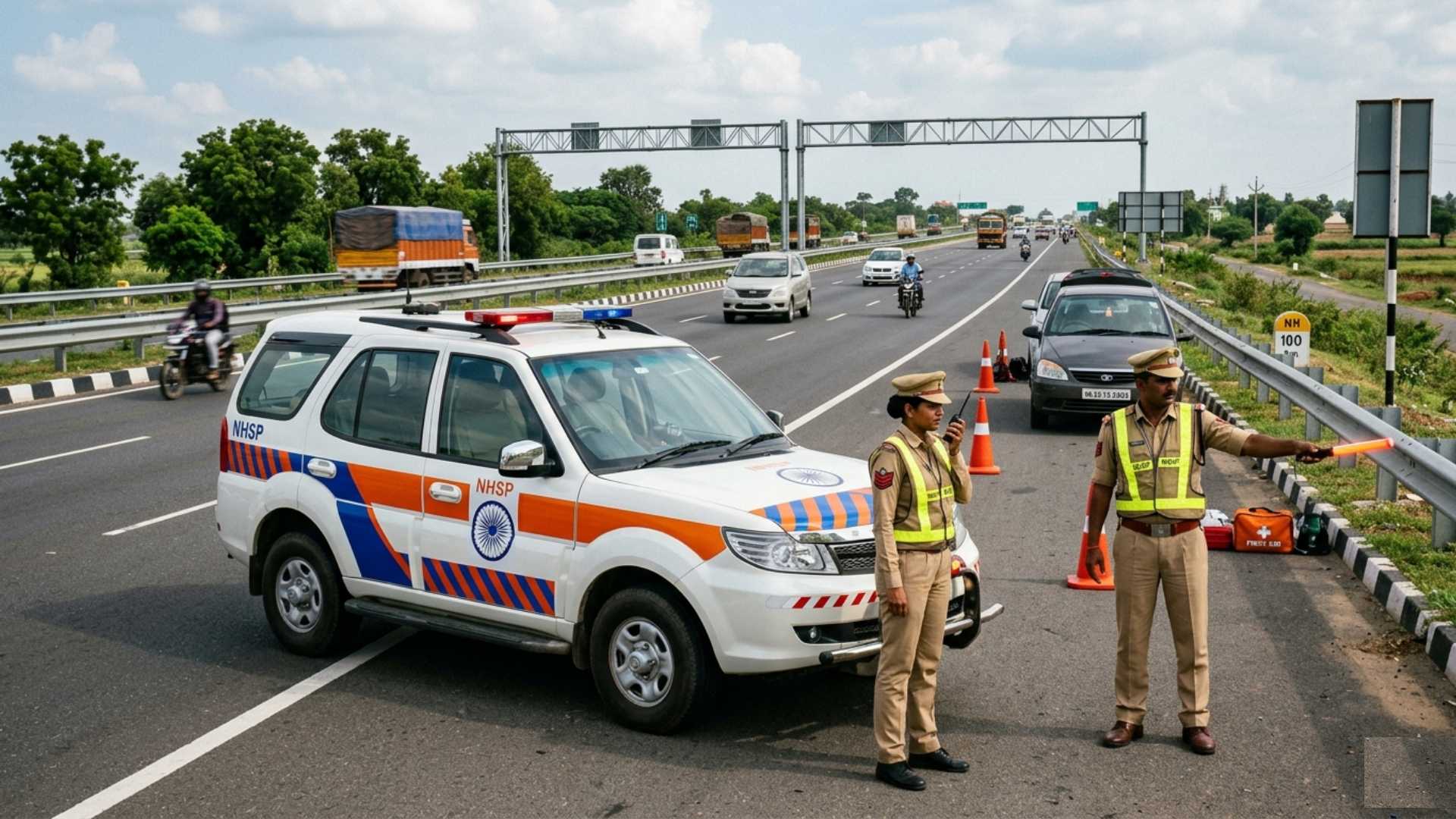
Parliamentary Panel Advocates National Highway Safety Patrol

A dedicated force could significantly enhance highway safety and accident response in India’s expanding road network.
G
Gopi
4 mins read
Parliament panel urges National Highway Safety Patrol to curb accidents and protect road assets

Introduction

India recorded 4.73 lakh road accidents and 1.70 lakh fatalities in 2024 — with National Highways alone accounting for 52,600+ deaths, despite forming only ~2% of the total road network. A Parliamentary Standing Committee (March 2026) has recommended a dedicated National Highway Safety Patrol, modelled on the Railway Protection Force, to fill the institutional vacuum in highway enforcement.

"The present dependence on State Police forces, whose jurisdiction and priorities extend well beyond highway safety, is insufficient for the scale of the National Highway network — a dedicated institutional mechanism warrants serious consideration." — Parliamentary Standing Committee on Transport, Tourism and Culture, 2026


Background and Context

India's Road Safety Crisis — Scale:

Indicator2024 Data
Total road accidents4.73 lakh
Total road fatalities1.70 lakh
NH-specific deaths52,600+
NH share of road network~2% of total roads
NH share of fatalitiesDisproportionately high

Source: Transport Research Wing, Ministry of Road Transport and Highways.

The Institutional Gap: National Highways are centrally built and maintained (NHAI/MoRTH), but traffic enforcement on them falls under State Police — which has broader law-and-order mandates, limited highway-specific training, and no dedicated deployment on NH corridors. This mismatch between infrastructure ownership and enforcement responsibility is a core governance gap.


Key Recommendation: National Highway Safety Patrol

What is Proposed: A dedicated institutional force — the National Highway Safety Patrol — with a specific mandate covering:

  • Real-time accident response during the "golden hour" (critical first 60 minutes post severe trauma)
  • Speed and lane discipline enforcement on access-controlled roads and expressways
  • Protection of highway infrastructure from encroachment and damage
  • Complementing digital systems under the Intelligent Traffic Management System (ITMS)

Institutional Model Referenced: Railway Protection Force (RPF) The committee explicitly drew the analogy with the RPF — a dedicated central force that has demonstrated effectiveness in asset protection and passenger safety across the railway network. The proposed patrol would replicate this model for the highway domain.

Pilot Rollout Suggested: The committee recommended beginning with high-accident corridors and expressways — allowing proof-of-concept before nationwide scaling.


Key Concepts

The Golden Hour: In trauma medicine, the "golden hour" refers to the critical 60-minute window after a severe injury during which prompt medical intervention dramatically improves survival outcomes. On national highways — which often run through remote stretches far from hospitals — delayed response is a leading cause of preventable deaths. A dedicated patrol with trained first-responders and rapid deployment capacity can directly reduce golden-hour fatalities.

Black Spot Remediation — The Accountability Gap: The committee separately flagged the absence of post-rectification data on treated accident-prone locations (black spots). Without structured safety audits after treatment, there is no way to verify whether engineering interventions have actually reduced accidents.

Proposed fix: locations where accident rates remain above acceptable levels post-treatment should be reclassified for advanced engineering interventions — grade separation or geometric realignment — rather than minor fixes.

Intelligent Traffic Management System (ITMS): A technology-based enforcement framework being deployed on National Highways — includes speed cameras, variable message signs, and incident detection systems. The proposed patrol would function as the human enforcement layer complementing this digital infrastructure.


Analytical Assessment

Why State Police Dependence is Inadequate:

ParameterState PoliceProposed NH Safety Patrol
JurisdictionEntire state; multiple prioritiesDedicated to National Highways
TrainingGeneral law enforcementHighway safety, trauma response
DeploymentReactive; not highway-specificProactive; corridor-based
AccountabilityState governmentCentral mandate (MoRTH/NHAI)
Asset protectionSecondary functionCore mandate

Strengths of the Recommendation:

  • Addresses the jurisdiction mismatch between central NH ownership and state enforcement.
  • Golden-hour focus is evidence-based — most NH fatalities involve delays in first response.
  • RPF analogy is apt: Railways faced similar challenges before a dedicated force was institutionalised.
  • Pilot-first approach reduces fiscal and administrative risk.

Challenges:

  • Centre-State friction: Traffic enforcement is a state subject; creating a central patrol force may require legislative clarity on jurisdiction.
  • Fiscal cost: A nationwide dedicated force involves significant recurring expenditure on personnel, vehicles, and communication infrastructure.
  • Coordination complexity: Parallel operation with State Police on the same road stretches requires clearly defined roles to avoid overlap and conflict.

Conclusion

The Parliamentary Committee's recommendation for a National Highway Safety Patrol is institutionally sound and operationally overdue. India cannot continue to build world-class highway infrastructure while leaving enforcement to a fragmented, overburdened State Police system with no highway-specific mandate. The RPF model demonstrates that a dedicated central force can meaningfully improve safety outcomes in linear transport infrastructure. Equally important is the committee's push for evidence-based black spot management — ensuring that engineering interventions are audited for effectiveness rather than treated as one-time fixes. Taken together, these recommendations represent a shift from reactive accident management to proactive, institutionalised highway safety governance — a shift India's roads urgently need.

Quick Q&A

Everything you need to know

The proposed National Highway Safety Patrol (NHSP) is a dedicated institutional mechanism recommended by a Parliamentary Standing Committee to improve safety and enforcement on India’s expanding national highway network. It is envisioned as a specialised force, similar in concept to the Railway Protection Force (RPF), focusing exclusively on highway safety, traffic discipline, and protection of road infrastructure.

The NHSP aims to address several critical gaps. First, it seeks to ensure rapid response during accidents, particularly within the ‘golden hour’, which is crucial for saving lives. Second, it would enforce traffic rules such as speed limits and lane discipline, especially on high-speed corridors and expressways. Third, it would help prevent encroachments and damage to highway assets, thereby preserving infrastructure quality.

By complementing existing digital enforcement systems like Intelligent Traffic Management Systems (ITMS), the NHSP would create a more integrated and proactive safety framework. Overall, it represents a shift from a fragmented approach to a dedicated and specialised model of highway governance.

The need for a dedicated highway safety mechanism arises from the alarming scale of road accidents and fatalities in India. With approximately 4.73 lakh accidents and 1.70 lakh deaths recorded in 2024, road safety has become a major public policy concern. National Highways, despite constituting a small percentage of total road length, account for a disproportionately high number of fatalities, highlighting systemic vulnerabilities.

Currently, highway safety enforcement largely depends on State Police forces, whose responsibilities extend far beyond traffic management. This leads to issues such as limited manpower, competing priorities, and inconsistent enforcement. As a result, critical aspects like speed monitoring, lane discipline, and quick accident response often suffer.

A dedicated mechanism like NHSP would ensure focused attention, specialised training, and accountability. It would also enable better coordination with national-level policies and technological systems. Thus, the creation of NHSP is essential to move toward a professionalised and efficient road safety regime capable of addressing India’s growing transportation challenges.

The NHSP can significantly improve accident response and enforcement through a combination of specialisation, technology integration, and proactive monitoring. One of its key roles would be ensuring rapid response during the golden hour, which can drastically reduce fatalities. Dedicated patrol units stationed along highways can reach accident sites quickly, provide first aid, and coordinate with emergency medical services.

In terms of enforcement, NHSP can focus on real-time monitoring of traffic violations such as over-speeding, lane indiscipline, and reckless driving. By integrating with Intelligent Traffic Management Systems (ITMS), the patrol can use tools like speed cameras, GPS tracking, and automated alerts to detect and penalise violations effectively.

Additionally, NHSP can play a preventive role by identifying high-risk zones, managing traffic flow during peak hours, and ensuring compliance with safety norms. For example, countries like the United States use highway patrol units effectively to maintain discipline and respond to emergencies. A similar model in India could lead to systematic improvements in road safety outcomes.

The high incidence of accidents on National Highways can be attributed to a combination of behavioral, infrastructural, and enforcement-related factors. High-speed travel on highways increases the severity of accidents, especially when drivers violate speed limits or fail to maintain lane discipline. Human factors such as fatigue, distracted driving, and lack of awareness further exacerbate the risk.

Infrastructure-related issues also play a significant role. Although highways are designed for efficiency, problems such as poorly designed intersections, inadequate signage, and presence of black spots increase accident likelihood. Encroachments and mixed traffic conditions, where slow-moving vehicles share space with high-speed traffic, further compromise safety.

Another critical factor is weak enforcement. The reliance on State Police, combined with limited resources, results in inconsistent monitoring. Emergency response systems are often inadequate, leading to delays in medical assistance. Thus, the high fatality rate reflects a systemic failure across multiple dimensions, necessitating comprehensive reforms like the NHSP.

The proposal to establish a National Highway Safety Patrol is both timely and necessary, given India’s poor road safety record. Its feasibility is supported by successful models like the Railway Protection Force, which demonstrates the effectiveness of a dedicated institutional framework. A specialised patrol can bring uniformity in enforcement and improve coordination across states.

However, several challenges must be addressed. First, the issue of federalism may arise, as law and order is a State subject. Coordinating between central and state authorities could be complex. Second, the creation of a new force requires significant financial investment in terms of recruitment, training, infrastructure, and technology.

Additionally, there is a risk of overlapping jurisdictions with existing agencies, which could lead to inefficiencies if not clearly defined. Ensuring accountability and preventing corruption are also critical concerns. Despite these challenges, with proper planning, pilot projects, and stakeholder consultation, the NHSP can evolve into a transformative reform in India’s road safety governance.

India can learn valuable lessons from global best practices in highway safety enforcement, particularly from countries like the United States, Sweden, and Australia. In the U.S., dedicated highway patrol agencies operate with advanced technology, ensuring strict enforcement of traffic laws and rapid emergency response. Their success lies in specialisation, training, and use of data-driven strategies.

Sweden’s Vision Zero approach focuses on eliminating road fatalities through a combination of engineering, enforcement, and education. It emphasises designing roads that minimise human error and implementing strict safety standards. Similarly, Australia has adopted integrated systems combining enforcement with public awareness campaigns.

For India, the key takeaway is the importance of a holistic and integrated approach. This includes dedicated enforcement agencies like NHSP, improved road engineering, and sustained behavioral change initiatives. Adapting these practices to Indian conditions can significantly enhance road safety outcomes and reduce fatalities.

As a policy maker, designing a pilot project for NHSP would involve a targeted and evidence-based approach. The first step would be identifying high-accident corridors and black spots on National Highways, where the pilot can have maximum impact. Dedicated patrol units should be deployed in these areas with clearly defined roles and responsibilities.

The second component would involve integration with technology. Tools such as speed cameras, GPS-enabled patrol vehicles, and real-time monitoring systems should be deployed. Coordination with emergency services, including ambulances and trauma care centers, is essential to ensure effective response during the golden hour.

Finally, the pilot should include a robust evaluation framework. Key performance indicators such as reduction in accident rates, response time, and compliance levels should be monitored. Feedback from stakeholders, including commuters and local authorities, should be incorporated. If successful, the pilot can be scaled up nationwide, making NHSP a cornerstone of India’s road safety strategy.

Attribution

Original content sources and authors

Sign in to track your reading progress

Comments (0)

Please sign in to comment

No comments yet. Be the first to comment!