GS3 Infrastructure

Floating Solar: Unlocking India’s Reservoir Power Potential

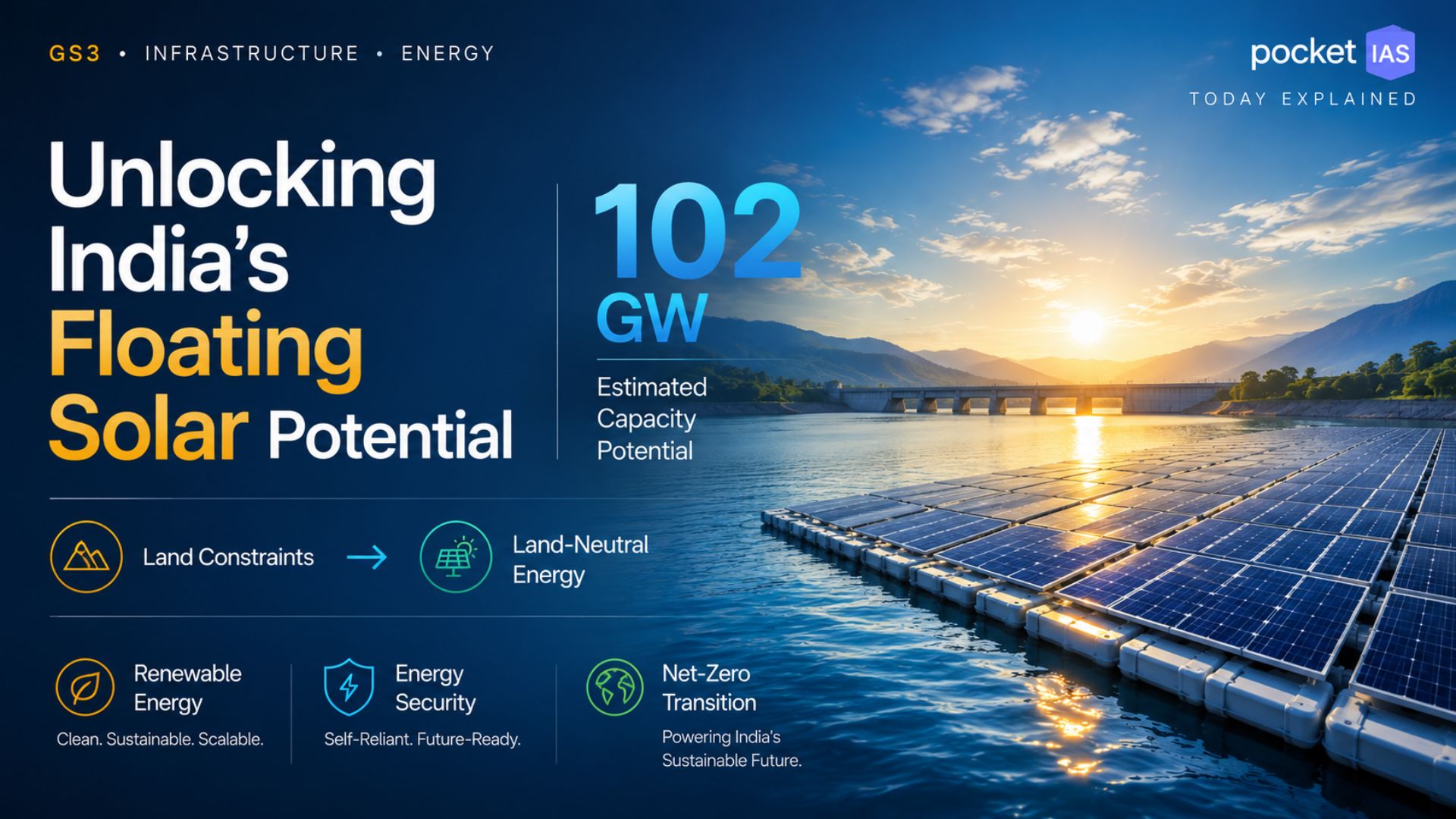
Unlocking India's Floating Solar Potential: 102 GW Capacity

A national assessment reveals how floating solar can address land acquisition challenges and boost renewable energy capacity in India.
Gopi Gopi
3 mins read

“Floating solar offers a land-neutral pathway for expanding renewable energy capacity while reducing pressure on scarce land resources.” — National Institute of Solar Energy (NISE)

India's transition towards 500 GW of non-fossil fuel capacity by 2030 faces a persistent challenge: land acquisition. To address this constraint, the National Institute of Solar Energy (NISE) has identified a significant opportunity in floating solar photovoltaic (FPV) systems, estimating a national potential of 102.18 GW across reservoirs and inland water bodies.

Why Floating Solar?

Traditional ground-mounted solar parks require extensive land, often competing with agriculture, habitation, and ecological uses.

Ground-Mounted SolarFloating Solar
Requires large land parcelsInstalled on water bodies
Land acquisition delaysLand-neutral solution
Potential conflicts with agricultureMinimal competition for land
Easier maintenanceRequires specialized anchoring and waterproofing

Key Challenge Addressed

  • Land acquisition remains one of the biggest bottlenecks in solar expansion.
  • Ground-mounted systems require 3–4 times more area per MW than the actual panel footprint.
  • Floating solar utilizes existing water surfaces without additional land conversion.

How Did NISE Estimate the Potential?

NISE conducted the first comprehensive national assessment using geospatial analysis.

Selection Criteria

Only water bodies meeting the following conditions were considered:

  • Area larger than 10 hectares
  • Water availability for at least 11 months annually
  • Depth between 3–30 metres
  • Solar irradiance above 4.5 kWh/m²/day
  • Located within 10 km of roads
  • Located within 10 km of electrical substations

Case Study: Hirakud Reservoir (Odisha)

StageArea
Total Reservoir Surface499 sq. km
Technically Suitable Area99.5 sq. km

To avoid ecological and operational concerns, NISE imposed a cap of 20% reservoir surface coverage, leading to a national estimate of 1,946 sq. km of feasible area and 102.18 GW potential.


State-wise Floating Solar Potential

StatePotential (GW)
Maharashtra16.28
Madhya Pradesh14.89
Karnataka13.69
Odisha12.81
Telangana10.72

These states account for a major share of India's identified floating solar capacity.


India's Flagship Project: Omkareshwar Floating Solar Park

Located on the Narmada River in Madhya Pradesh's Khandwa district, Omkareshwar represents India's largest floating solar initiative.

Project: Omkareshwar Floating Solar Park
Current Capacity: 278 MW
Planned Expansion: 600 MW
Location: Narmada River, Madhya Pradesh

Operational Lessons

NISE field observations highlighted several technical challenges:

  • Loosening float joints
  • Platform misalignment
  • Uneven buoyancy
  • Electric cable breakages

These findings indicate that while the technology is promising, long-term durability and maintenance require greater attention.


Economic Considerations

A major limitation of the report is the absence of a detailed cost assessment for India.

According to a 2021 U.S. National Renewable Energy Laboratory (NREL) benchmark:

Floating solar installations generally involve around 25% higher upfront costs than ground-mounted systems.

Reasons for Higher Costs

  • Floating structures
  • Anchoring systems
  • Waterproof electrical components
  • Specialized installation requirements

Despite higher initial costs, savings from avoided land acquisition may improve overall project viability.


Global Experience

Floating solar is rapidly expanding worldwide.

Country/RegionNotable Development
China120 MW plant on Poyang Lake fish farm
SingaporeTengeh Reservoir testbed
NetherlandsMajor installations on quarry lakes
AsiaNearly 90% of global capacity

Global Status (2024)

Total Global Floating Solar Capacity:
≈ 9.6 GW

Share Located in Asia:
≈ 90%

International experiences demonstrate the technology's scalability across diverse climatic and geographical conditions.


Way Forward

  • Develop India-specific cost and financing frameworks.
  • Strengthen standards for floats, anchoring systems, and electrical infrastructure.
  • Integrate floating solar with hydropower reservoirs for hybrid generation.
  • Promote research on ecological impacts and reservoir management.
  • Accelerate policy support for floating solar and agri-photovoltaic systems.
  • Encourage domestic manufacturing of floating solar components.

Conclusion

Floating solar represents a strategic opportunity to overcome India's land constraints while accelerating renewable energy deployment. The NISE assessment identifies a substantial 102 GW potential, capable of contributing significantly to national energy targets. However, realizing this opportunity will require addressing cost concerns, strengthening technical reliability, and creating supportive policy and financing mechanisms for large-scale adoption.

Attribution

Original content sources and authors

Jacob Koshy Author Jacob Koshy The Hindu Source The Hindu

Syllabus classification

How this article maps to GS papers

Main syllabus

GS3Infrastructure

Quick Q&A

What is floating solar technology and why is it emerging as a significant component of India's renewable energy strategy?
Floating solar, also known as floating photovoltaic (FPV) technology, refers to solar panels installed on floating structures anchored on reservoirs, lakes and other inland water bodies. Unlike conventional ground-mounted systems, floating solar projects utilise water surfaces and are therefore considered land-neutral. This characteristic has made the technology increasingly attractive in countries facing land scarcity and competing demands from agriculture, industry and urbanisation. In India, the National Institute of Solar Energy (NISE), an autonomous body under the Ministry of New and Renewable Energy (MNRE), estimated in 2026 that the country possesses around 102.18 GW of floating solar potential. The assessment identified about 1,946 sq. km. of feasible water surface after applying geospatial filters related to water availability, depth, solar irradiance and proximity to infrastructure. States such as Maharashtra, Madhya Pradesh, Karnataka, Odisha and Telangana account for a major share of this potential. The importance of floating solar must be understood in the context of India's target of achieving 500 GW of non-fossil fuel capacity by 2030. Since land acquisition remains one of the biggest obstacles to solar expansion, floating solar offers a practical alternative. Globally, floating solar capacity reached approximately 9.6 GW by 2024, with Asia accounting for nearly 90% of installations. Countries such as China, Singapore and the Netherlands have emerged as pioneers in this field. For UPSC GS-III, floating solar is relevant to energy security, infrastructure development, climate change mitigation and sustainable development. It illustrates how technological innovation can address resource constraints while advancing India's clean energy transition.
Why has land acquisition emerged as a major challenge for India's solar energy expansion and how does floating solar address this problem?
Land acquisition has historically been one of the most significant bottlenecks in India's renewable energy transition. Ground-mounted solar systems, which currently dominate India's approximately 100 GW of installed solar capacity, require three to four times more land area per megawatt than the actual space occupied by solar panels. Acquiring such vast tracts of land is often expensive, time-consuming and socially contentious. Conflicts frequently arise with agriculture, forest conservation, habitation and local livelihoods. These challenges have become increasingly important as India pursues its ambitious target of 500 GW of non-fossil fuel capacity by 2030 under its climate commitments. Floating solar technology offers a solution by utilising reservoirs and lakes instead of scarce terrestrial land. Since the systems are installed on water surfaces, they minimise competition with agriculture and reduce the need for displacement. The 2026 NISE assessment identified 102.18 GW of floating solar potential across India's reservoirs, demonstrating the scale of opportunities available. Supporters argue that floating solar can also reduce water evaporation and improve solar panel efficiency because of the cooling effect of water. However, critics point out that the technology currently involves higher capital costs, estimated to be around 25% greater than ground-mounted systems according to the U.S. National Renewable Energy Laboratory's 2021 benchmark. Technical challenges related to anchoring, waterproofing and maintenance also remain. From a GS-III perspective, the issue connects with infrastructure development, environmental sustainability and resource management. Floating solar exemplifies how innovative solutions can help reconcile developmental needs with ecological and social considerations in India's energy transition.
How did the National Institute of Solar Energy estimate India's floating solar potential and what methodology was adopted?
The National Institute of Solar Energy (NISE) undertook India's first comprehensive assessment of floating solar potential in 2026 using a scientific and geospatial methodology. The objective was to identify reservoirs and lakes capable of supporting large-scale floating photovoltaic installations while ensuring technical feasibility and economic accessibility. The study applied six major filters to India's inland water bodies. First, only reservoirs and lakes larger than 10 hectares were considered. Second, water availability had to be maintained for at least 11 months of the year. Third, water depths between 3 and 30 metres were considered suitable for installation. Fourth, areas had to receive solar irradiance exceeding 4.5 kWh per square metre per day. Fifth and sixth, sites had to be located within 10 kilometres of roads and electricity substations to facilitate construction and grid connectivity. The methodology was demonstrated using Odisha's Hirakud reservoir. Although the reservoir covers 499 sq. km., only 99.5 sq. km. was identified as technically suitable after applying the filters. At the national level, around 1,946 sq. km. of feasible surface area was identified. To minimise ecological impacts, NISE imposed a cap limiting solar panels to 20% of a reservoir's surface area. This resulted in an estimated potential of 102.18 GW. Maharashtra, Madhya Pradesh, Karnataka, Odisha and Telangana emerged as leading States. For UPSC GS-III, the methodology highlights the growing importance of geospatial technologies, scientific planning and evidence-based policymaking in infrastructure development. It also demonstrates how technological assessments support India's energy security and climate objectives.
Critically analyse the opportunities and challenges associated with the development of floating solar projects in India.
Floating solar technology presents immense opportunities but also poses several economic, technical and environmental challenges. Among its major advantages is the ability to overcome land constraints, which have become a critical obstacle for renewable energy expansion. Floating solar systems utilise reservoirs and lakes, thereby reducing conflicts with agriculture and human settlements. They may also decrease water evaporation and improve panel efficiency through natural cooling. Such benefits make the technology attractive for achieving India's target of 500 GW of non-fossil fuel capacity by 2030. Nevertheless, the technology faces important limitations. According to the U.S. National Renewable Energy Laboratory's 2021 benchmark cited by NISE, floating solar projects involve approximately 25% higher upfront costs than ground-mounted systems because of expenses related to floats, anchoring and waterproofing. Technical reliability remains another challenge. Field observations at the Omkareshwar floating solar park in Madhya Pradesh recorded issues such as loosening float joints, uneven buoyancy, misaligned platforms and cable failures. Environmental concerns also deserve attention. Large-scale coverage of water bodies could potentially affect aquatic ecosystems, fish habitats and water quality. Moreover, India currently lacks detailed cost assessments and long-term performance data. Supporters argue that technological advancements and economies of scale will gradually reduce costs, as witnessed in conventional solar energy. Critics, however, stress the need for environmental safeguards and stronger engineering standards. For UPSC GS-III, the debate is relevant to energy security, sustainable infrastructure and climate resilience. A balanced approach involving innovation, regulatory oversight and environmental assessments will be essential for ensuring that floating solar becomes a viable and sustainable component of India's clean energy future.
What lessons can be derived from the Omkareshwar floating solar park as a case study in renewable energy infrastructure development?
The Omkareshwar floating solar park located on the Narmada River in Madhya Pradesh's Khandwa district represents India's flagship floating solar project and offers valuable lessons for infrastructure planning and renewable energy development. With an installed capacity of 278 MW and plans to expand to 600 MW, it is currently the country's largest floating solar installation. The project demonstrates India's commitment to diversifying renewable energy technologies and reducing dependence on land-intensive infrastructure. However, the project also highlights the practical challenges involved in implementing innovative technologies. Field observations conducted by the National Institute of Solar Energy identified several technical issues, including loosening float joints, uneven buoyancy, platform misalignment and electric cable failures. These findings underline the importance of engineering resilience, maintenance systems and quality control mechanisms. The Omkareshwar experience shows that successful implementation requires continuous monitoring and adaptation rather than merely installing capacity. From a policy perspective, the project illustrates the importance of pilot projects in generating operational knowledge and reducing technological uncertainties. Similar experiences in Singapore's Tengeh reservoir and China's floating solar projects have contributed significantly to improving global best practices. The Omkareshwar case also demonstrates the importance of integrating infrastructure development with environmental and economic considerations. For UPSC GS-III, the project is relevant to themes of renewable energy, infrastructure planning and technological innovation. It highlights that large-scale transitions to sustainable energy require not only ambitious targets but also robust institutions, technological learning and effective maintenance systems. Consequently, the Omkareshwar project serves as an important example of both the opportunities and limitations associated with emerging clean energy technologies.
What international experiences and examples provide important insights for the future expansion of floating solar technology in India?
Global experiences with floating solar technology provide valuable lessons for India's efforts to expand renewable energy infrastructure. By 2024, worldwide floating solar capacity had reached approximately 9.6 GW, with nearly 90% concentrated in Asia. China has emerged as the global leader in floating solar installations. One notable example is the 120 MW floating solar project on a fish farm in Poyang Lake, which demonstrates how renewable energy generation can coexist with other economic activities. Singapore has played a pioneering role in research and technological experimentation. The 1 MW Tengeh reservoir testbed has provided important performance data regarding durability, efficiency and environmental impacts. Such information has contributed significantly to the evolution of floating solar technologies worldwide. In Europe, the Netherlands accounts for nearly three-fourths of the continent's floating solar capacity. Most installations have been developed on quarry lakes, reflecting innovative approaches to utilising unused water surfaces. These international experiences indicate that floating solar can be adapted to diverse geographical and climatic conditions. However, they also reveal the importance of robust engineering standards, environmental assessments and long-term maintenance. Countries that have succeeded in scaling up floating solar have generally relied on supportive regulatory frameworks and continuous technological innovation. For India, these examples are particularly relevant because the country possesses an estimated 102.18 GW of floating solar potential. Lessons from China, Singapore and the Netherlands can guide policymaking, improve engineering practices and reduce implementation risks. From a UPSC GS-III perspective, comparative analysis highlights the importance of international cooperation, technology transfer and sustainable infrastructure development in addressing climate change and ensuring energy security.

Practice questions

1 question for mains preparation

Land availability has emerged as a critical constraint in India's renewable energy transition. In this context, examine the potential of floating solar photovoltaic systems in enhancing energy security while ensuring sustainable resource utilization.

10 marks · 150 words · 8 mins
