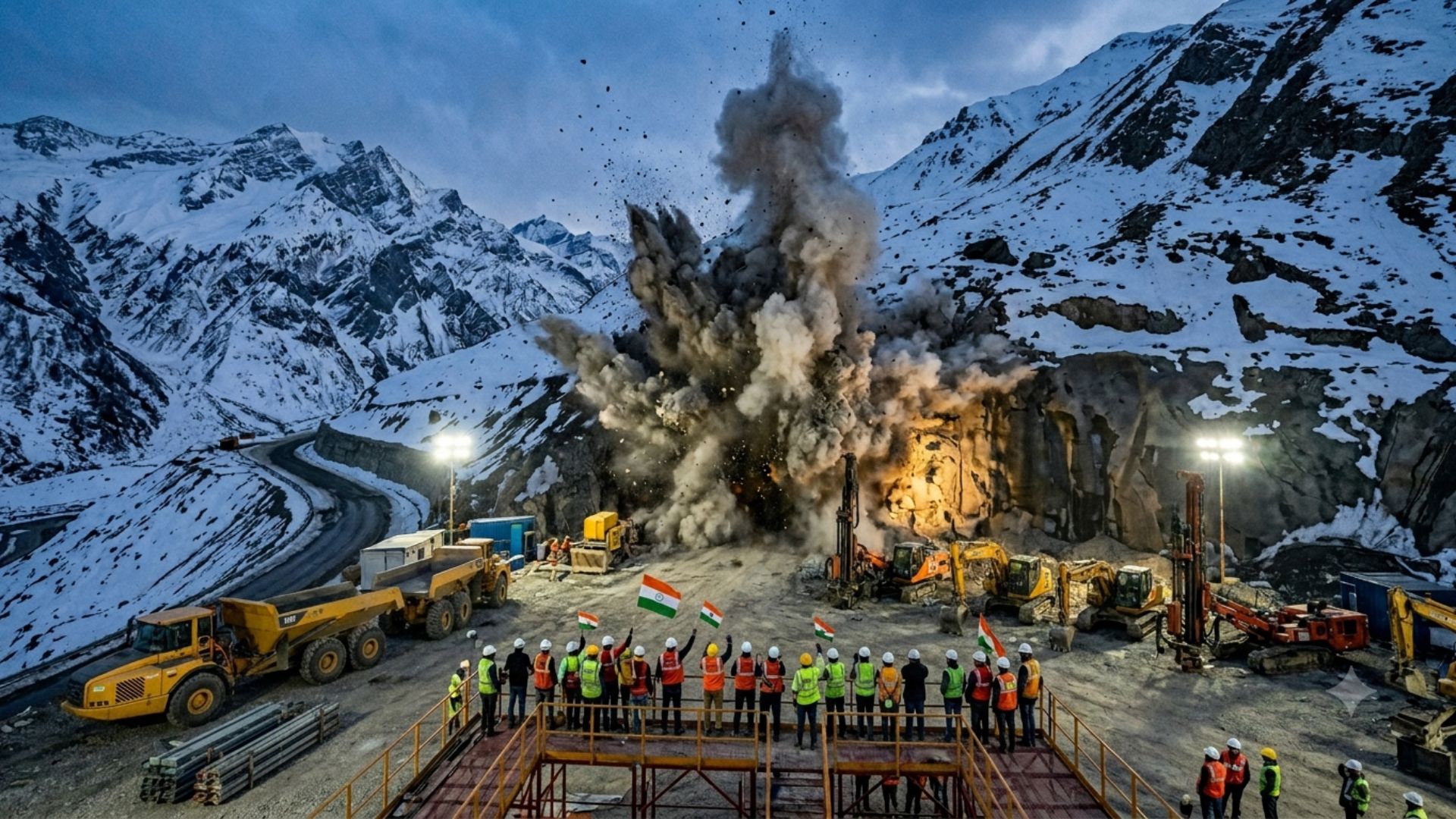
Zojila Tunnel: A Gamechanger for National Security and Integration

“This project will prove to be a gamechanger from the perspective of national security and national integration.” — Nitin Gadkari
Why is Zojila Tunnel in News?
Union Minister for Road Transport and Highways Nitin Gadkari on June 9, 2026, oversaw the breakthrough of the 13.14 km Zojila Tunnel, marking the completion of the main excavation through one of the most challenging Himalayan terrains.
The tunnel is expected to provide all-weather connectivity between Jammu & Kashmir and Ladakh, overcoming decades of disruptions caused by heavy snowfall and avalanches.
Zojila Tunnel at a Glance
| Feature | Details |
|---|---|
| Length | 13.14 km |
| Cost | ₹6,800 crore |
| Initial Estimate | ₹12,000 crore |
| Altitude | 11,578 ft (2,900 m – 3,310 m) |
| Type | Single-tube, bi-directional road tunnel |
| Connectivity | Sonamarg (J&K) – Minamarg (Ladakh) |
| Travel Time Reduction | ~2 hours to ~30 minutes |
| Executing Agency | Megha Engineering & Infrastructure Ltd. (MEIL) |
| Client Agency | NHIDCL |
Why was the Tunnel Needed?
The Zojila Pass remains inaccessible for several months every year due to:
- Heavy snowfall
- Avalanches
- Harsh winter conditions
- Difficult mountainous terrain
As a result:
- Civilian movement gets disrupted.
- Essential supplies face delays.
- Military logistics become challenging.
- Economic activities slow down significantly.
The tunnel seeks to eliminate these bottlenecks through year-round road connectivity.
Strategic Importance for National Security
The tunnel holds immense significance for India's northern frontier.
Key Security Benefits
- Faster deployment of armed forces.
- Improved transportation of military equipment and supplies.
- Enhanced operational readiness in border areas.
- Reliable connectivity during adverse weather conditions.
“The movement of the Indian Army and logistics will become faster, safer and more effective, strengthening strategic preparedness.” — Nitin Gadkari
Example:
During heavy winter snowfall, surface routes across
Zojila Pass often become inaccessible.

With the tunnel:
Army personnel, fuel, ammunition and emergency
supplies can move throughout the year without
weather-related disruptions.
Economic and Social Significance
The tunnel is expected to become a catalyst for regional development.
Benefits for Local Communities
- Improved market access.
- Better healthcare and emergency services.
- Enhanced educational connectivity.
- Greater employment opportunities.
- Improved quality of life.
Tourism Potential
The project is expected to:
- Increase tourist inflow into Ladakh and Kargil.
- Support hospitality and transport sectors.
- Promote winter tourism.
Omar Abdullah described it as a “dream come true for the people of Kargil”.
Engineering Achievement
The project is regarded as a major feat of Indian engineering.
Challenges Faced
- Extreme snowfall
- Sub-zero temperatures
- High-altitude construction
- Complex geological formations
- Remote working conditions
Despite these difficulties, engineers successfully completed the breakthrough.
“This breakthrough is a symbol of India’s technical expertise, engineering prowess and indomitable resolve.” — Nitin Gadkari
Example:
Construction was carried out between elevations
of 2,900 m and 3,310 m, making it one of the
most challenging infrastructure projects in India.
Passenger Safety Features
The tunnel incorporates modern safety mechanisms:
- Advanced ventilation system
- Automatic fire detection system
- CCTV surveillance network
- Emergency communication systems
- Pedestrian cross-passages for evacuation
Expected Outcomes
- Reduced accident risks
- Lower avalanche exposure
- Fuel savings
- Faster and safer travel
Contribution to National Integration
The tunnel goes beyond physical connectivity.
Integration Benefits
- Strengthens links between Kashmir and Ladakh.
- Improves movement of people, goods and services.
- Enhances access to remote regions.
- Promotes balanced regional development.
“The tunnel is not only connecting mountains but also possibilities.” — Nitin Gadkari
Way Forward
- Complete associated approach roads and supporting infrastructure.
- Strengthen multimodal connectivity, including air connectivity to Kargil.
- Promote sustainable tourism in the region.
- Develop logistics and warehousing hubs along the corridor.
- Ensure regular maintenance and disaster-resilient operations.
- Leverage the tunnel for greater economic integration of border regions.
Conclusion
The Zojila Tunnel represents a landmark achievement in India's infrastructure journey. By ensuring all-weather connectivity between Jammu & Kashmir and Ladakh, it strengthens national security, promotes regional development, enhances tourism, and deepens national integration. Beyond being an engineering marvel, the tunnel symbolizes India's capacity to overcome geographical barriers and connect remote regions with opportunities and growth.
Attribution
Original content sources and authors


Syllabus classification
How this article maps to GS papers
Main syllabus
GS3InfrastructureAlso covers
Quick Q&A
What is the Zojila Tunnel project and why is it regarded as a landmark achievement in India’s infrastructure development and national integration efforts?
Why is the Zojila Tunnel considered strategically important for national security and the operational preparedness of the Armed Forces?
How will the Zojila Tunnel transform regional connectivity, economic development and tourism in Jammu and Kashmir and Ladakh?
What are the major engineering and geographical challenges involved in constructing the Zojila Tunnel in the Himalayan region?
Critically analyse the developmental benefits and environmental concerns associated with large-scale infrastructure projects in the Himalayan region using the Zojila Tunnel as an example.
How can the Zojila Tunnel project be studied as a case study of infrastructure-led development and regional integration in India?
Practice questions
1 question for mains preparation