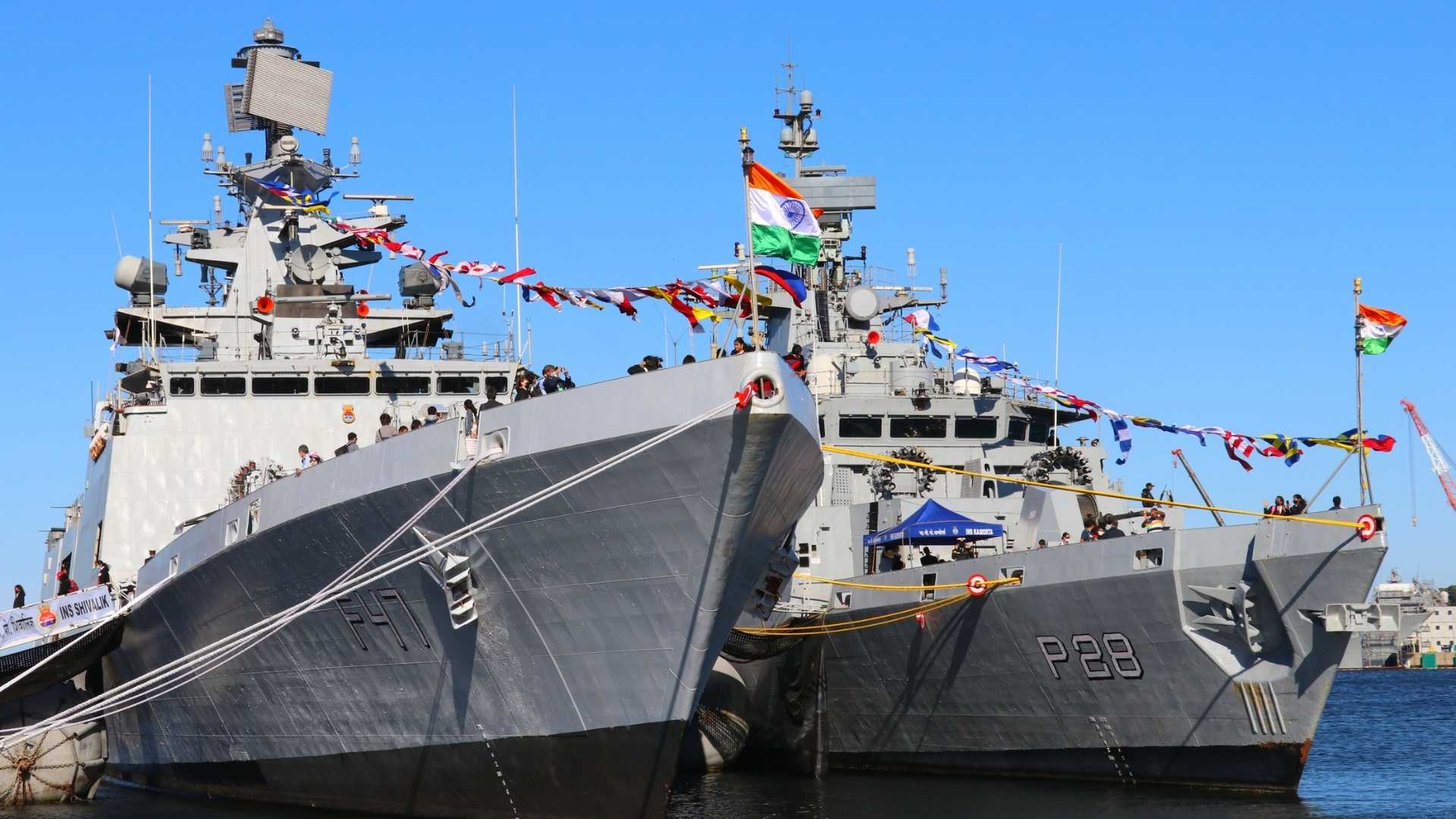
1. Strategic Maritime Autonomy and Shipbuilding Expansion
India’s trade is heavily dependent on maritime transport, yet a significant share of cargo is carried by foreign shipping lines. This dependence has implications for freight costs, supply chain resilience, and strategic autonomy. The Union Minister for Ports, Shipping and Waterways has emphasised the need to build a comprehensive domestic maritime ecosystem under the broader vision of Atmanirbhar Bharat.
The government has articulated two long-term frameworks — Maritime India Vision 2030 and Maritime Amrit Kaal Vision 2047 — to transform India from a service-dependent maritime nation into a global maritime power. The objective is not merely port modernisation, but capacity creation in shipbuilding, shipping services, and associated logistics.
A key target is to become one of the top 10 shipbuilding nations by 2030, and among the top five by 2047. This signals a structural shift from dependence on foreign-built vessels to domestic manufacturing, enhancing industrial depth and strategic resilience.
If this transition is not pursued, India risks continued freight outflows, vulnerability to global shipping disruptions, and limited bargaining power in international maritime trade.
The governance logic is that maritime strength underpins economic security and trade competitiveness. Without indigenous shipbuilding and fleet capacity, India’s aspiration to become a global manufacturing and export hub would remain structurally constrained.
Implications:
- Reduced dependence on foreign carriers
- Lower freight outflow and improved balance of payments
- Strengthening of coastal industrial clusters
- Enhanced strategic autonomy in times of geopolitical disruptions
Cross-linkages:
- GS3: Infrastructure, logistics, industrial policy
- GS2: Federal coordination in port-led development
- IR: Maritime geopolitics and Indo-Pacific strategy
2. Green Hydrogen, E-Methanol and India’s Bid for Green Shipping Leadership
Global shipping is under pressure to decarbonise, with green fuels such as hydrogen, ammonia, and e-methanol emerging as alternatives to conventional bunker fuels. India’s National Hydrogen Mission aligns with this transition, aiming to position the country as a supplier and bunkering hub for green maritime corridors.
The government plans to develop infrastructure to support green hydrogen and ammonia production, storage, and distribution at ports. The long-term ambition is to make India a primary bunker destination for global green shipping routes by 2030, integrating renewable energy with maritime logistics.
This initiative aligns with India’s broader climate commitments and the concept of a “blue economy,” where economic growth from ocean resources is balanced with environmental sustainability. By linking renewable energy expansion with maritime fuel infrastructure, India seeks to capture emerging global value chains.
Failure to invest early in green maritime infrastructure may result in India missing out on the next wave of shipping transformation, locking its ports into carbon-intensive systems while competitors transition to cleaner fuel ecosystems.
The development logic is that decarbonisation is not merely an environmental necessity but an economic opportunity. Ports that fail to adapt to green fuel standards risk losing traffic as global shipping regulations tighten.
Policy Anchors:
- National Hydrogen Mission
- Maritime India Vision 2030
- Promotion of hydrogen, ammonia, and renewable-linked fuels
Potential Outcomes:
- Positioning India in global green shipping corridors
- Integration of renewable energy with port infrastructure
- Contribution to climate mitigation goals
Cross-linkages:
- GS3: Environment, energy security, climate action
- IR: Global climate commitments and maritime cooperation
- Essay: Growth with sustainability; Blue Economy
3. Sagarmala Programme and Federal Infrastructure Commitments
The Sagarmala Programme aims at port-led development through port modernisation, connectivity enhancement, and coastal community development. Concerns have emerged regarding reduced fund allocation and its potential impact on ongoing projects, including in Tamil Nadu.
The Union Minister has clarified that projects already approved and committed will be completed within timelines. This assurance reflects the Centre’s emphasis on continuity in infrastructure execution, which is crucial for investor confidence and state-level economic planning.
Given Tamil Nadu’s strategic coastline and industrial base, Sagarmala projects hold significance for export competitiveness, coastal shipping, and employment generation. Any delay could slow regional industrial growth and weaken coastal logistics integration.
The governance logic is that infrastructure credibility depends on predictability. If committed projects are stalled due to funding constraints, it undermines federal trust, private investment, and long-term development planning.
Importance of Sagarmala:
- Port modernisation
- Enhanced multimodal connectivity
- Coastal economic zones
- Employment generation in maritime states
Federal Dimension:
- Centre–State coordination
- Long-term capital-intensive infrastructure commitments
- Regional industrial development (e.g., Tamil Nadu)
Cross-linkages:
- GS2: Cooperative federalism
- GS3: Infrastructure, logistics efficiency, regional development
4. Blue Economy and Long-Term Maritime Vision
The maritime push is framed within the larger concept of the “blue economy,” integrating sustainable ocean-based growth with climate objectives. India’s approach combines green fuels, shipbuilding expansion, port-led industrialisation, and strategic autonomy.
The dual timeline approach — 2030 (near-term transformation) and 2047 (Amrit Kaal vision) — indicates phased capacity building. By synchronising decarbonisation, industrial expansion, and infrastructure development, India aims to move from a trade-dependent maritime nation to a maritime leader.
However, success depends on coherent policy execution, financial sustainability, technological capability, and global market integration. Without systemic reform and implementation efficiency, targets may remain aspirational.
The developmental logic is that maritime capability multiplies economic power. Ignoring this domain would constrain trade competitiveness, energy transition goals, and India’s Indo-Pacific strategic ambitions.
Conclusion
India’s maritime transformation agenda reflects a strategic shift from dependence to leadership — spanning shipbuilding, green shipping fuels, and port-led development. If implemented effectively, it can enhance trade resilience, climate leadership, and industrial competitiveness. The long-term outcome will depend on sustained policy coherence, infrastructure execution, and integration with global maritime transitions.