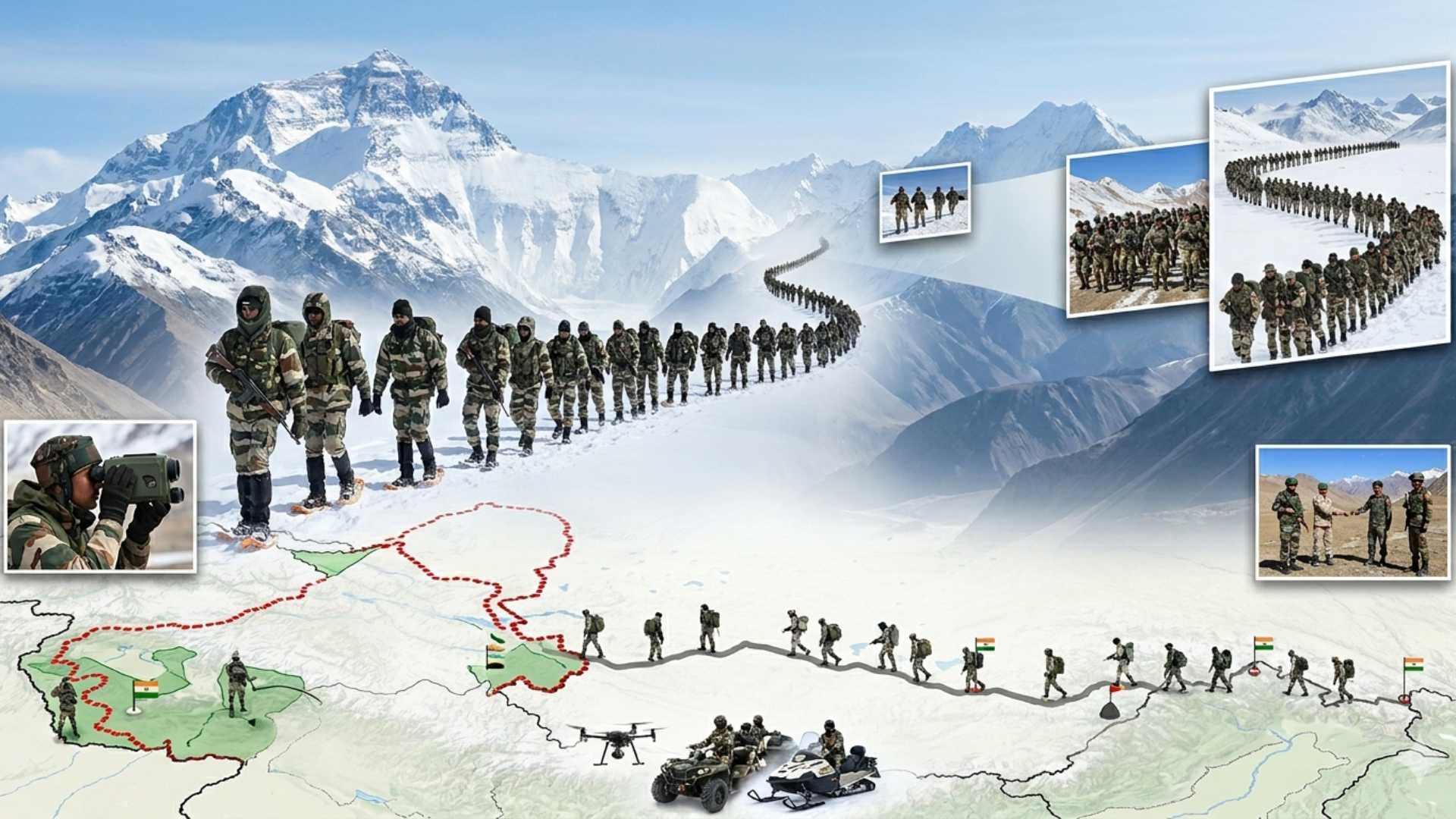
Significant Increase in China Border Patrols Post Galwan Clash
Introduction
The 3,488 km India-China LAC — undefined, undelimited, and contested — remains India's most complex security frontier. The Galwan clash of 2020 transformed border patrolling from routine vigil to strategic assertion.
"Patrols were interrupted and there was no commonly delineated LAC — that is why face-offs happened." — Rajnath Singh, Defence Minister, 2020
| Parameter | Value |
|---|---|
| Total India-China border length | 3,488 km |
| ITBP Border Outposts | 180 |
| Total Patrolling Points (PPs) in eastern Ladakh | 65 |
| PPs inaccessible post-2020 | 26 (till 2023) |
| Monthly patrols (2017–18) | ~173 |
| Monthly patrols (Apr–Dec 2024) | ~500 |
| Soldiers killed in Galwan (June 2020) | 20 |
Background & Context
The Line of Actual Control (LAC) Unlike the Line of Control (LoC) with Pakistan — which is a formally demarcated ceasefire line — the LAC with China is undefined and mutually undelimited across several stretches. This ambiguity is the structural root of recurring face-offs. Both sides patrol up to their perceived LAC, creating overlapping claim zones where confrontations occur.
The 2020 Galwan Turning Point The June 2020 Galwan Valley clash — the deadliest India-China border incident since 1967 — fundamentally altered India's border management posture:
- 20 Indian soldiers killed; Chinese casualties acknowledged at 4 (widely believed to be higher)
- Defence Minister Rajnath Singh confirmed face-offs occurred because "patrols were interrupted" and there was no commonly delineated LAC
- India accelerated infrastructure development, forward deployment, and patrol frequency along the entire LAC
Key Concepts
1. Patrolling Points (PPs) Designated locations along the LAC where troops conduct regular patrols to assert territorial claims and prevent encroachment. In the absence of a formally demarcated border, physical presence through patrolling is the primary mechanism for establishing de facto control.
2. Buffer Zones Areas where both Indian and Chinese troops have mutually withdrawn following standoff agreements. While reducing immediate friction, buffer zones effectively freeze India's access to previously patrolled areas — creating de facto Chinese gains without formal territorial concession.
3. Types of ITBP Patrols
- Short-range patrols: Frequent, localised — maintain presence near outposts
- Long-range patrols: Extended — dominate unmanned gaps between outposts
- Special missions: Intelligence-driven — respond to specific threat inputs
- Joint patrols: Coordinated — conducted with Army units in sensitive sectors
Patrol Data — Trend Analysis
| Period | Total Patrols | Monthly Average | Context |
|---|---|---|---|
| Full Year 2017–18 | 2,083 | ~173 | Pre-Doklam baseline |
| Apr–Dec 2022 | 2,899 | ~322 | Post-Galwan escalation |
| Jan 2023–Mar 2024 (15 months) | 6,561 | ~437 | Sustained high alert |
| Apr–Dec 2024 (9 months) | 4,503 | ~500 | Highest recorded average |
The data reveals a nearly threefold increase in monthly patrol intensity since 2017–18 — a sustained, structural shift in border management posture, not a temporary spike.
Strategic Implications
1. Assertive Presence Over Passive Defence The surge in patrols reflects a doctrinal shift: India has moved from reactive border management (responding to incursions) to proactive domination (continuous presence across unmanned gaps). This is consistent with the broader infrastructure push — roads, tunnels, helipads — enabling faster troop mobilisation.
2. Buffer Zone Problem Buffer zones, while preventing immediate clashes, create a strategic dilemma:
- They restrict Indian access to 26 previously patrolled points in eastern Ladakh
- Chinese infrastructure development continues in buffer zone peripheries
- Diplomatic normalisation risks cementing these temporary arrangements into permanent territorial losses
3. Diplomatic-Security Tension India-China ties are in a phase of cautious normalisation post-2024 disengagement agreements at Depsang and Demchok. Yet:
- Patrolling intensity remains at historic highs — signalling continued mistrust
- The LAC remains undelimited — ensuring structural friction persists
- India must balance economic re-engagement with China against territorial vigilance
ITBP: Institutional Profile
- Raised: 1962 (after Sino-Indian War)
- Jurisdiction: Entire 3,488 km China border — Karakoram Pass (Ladakh) to Jachep La (Arunachal Pradesh)
- Deployment sectors: Western (Ladakh), Middle (Himachal, Uttarakhand), Eastern (Sikkim, Arunachal)
- Under: Ministry of Home Affairs (not Ministry of Defence — a significant governance distinction)
- Key role: First responder to border intrusions; enables Army's strategic reserve posture
Challenges in LAC Management
- Undefined boundary: No mutually agreed LAC map — India and China have exchanged maps only for the Middle sector
- Infrastructure gap: Despite acceleration, China's border infrastructure in Tibet remains significantly more developed
- Altitude and terrain: Patrolling at 14,000–18,000 feet creates severe physiological stress on troops
- Buffer zone freeze: 26 PPs inaccessible since 2020 represent unresolved territorial access denial
- Intelligence gaps: Unmanned gaps between outposts remain vulnerable despite long-range patrols
- Diplomatic complexity: Security imperatives must be balanced against India's need for stable economic and diplomatic ties with China
Way Forward
- Expedite LAC clarification: Resume boundary talks with a focus on exchanging maps for western and eastern sectors
- Convert buffer zones: Negotiate time-bound withdrawal of buffer zones with reciprocal verification mechanisms
- Infrastructure parity: Accelerate BRO projects — roads, tunnels, advanced landing grounds — to match Chinese Tibet infrastructure
- Modernise ITBP: Equip with surveillance drones, satellite communication, all-terrain vehicles, and high-altitude warfare gear
- Joint patrolling protocols: Formalise agreed patrol schedules at friction points to reduce unintended face-offs
- Integrated theatre command: Coordinate ITBP, Army, and Air Force operations under unified LAC management
Conclusion
India's surge in LAC patrolling — from 173 to 500 sorties per month — is not merely a security statistic; it is a strategic statement. The Galwan shock forced a fundamental reassessment of India's border management doctrine, producing a shift toward continuous, assertive territorial presence. Yet patrolling intensity alone cannot resolve the structural ambiguity of an undefined LAC, the frozen access of 26 patrolling points, or the quiet consolidation enabled by buffer zones. India's China border strategy must integrate military vigilance with diplomatic clarity — pursuing LAC delimitation, infrastructure parity, and verifiable disengagement, while resisting the temptation to let normalisation paper over unresolved territorial realities. On the LAC, presence is policy — and India cannot afford to blink.
Attribution
Original content sources and authors
Syllabus classification
How this article maps to GS papers
Main syllabus
GS3Internal SecurityQuick Q&A
What is the role of the Indo-Tibetan Border Police (ITBP) in securing the India-China border, and how has it evolved in recent years?
Core functions of ITBP:
- Conducting short- and long-range patrols to assert presence
- Securing border outposts (BOPs) and monitoring infiltration
- Undertaking special missions and joint patrols
- Maintaining dominance over unmanned or disputed areas
Since the Galwan Valley clash in 2020, the role of ITBP has become more proactive and intensive. Patrol frequency has significantly increased, reflecting heightened vigilance and a shift from passive border guarding to active territorial assertion.
Evolution: Earlier, patrols averaged around 173 per month (2017–18), but recent figures show a rise to nearly 500 patrols per month (2024–25). This indicates a strategic recalibration in response to evolving security challenges. The ITBP has thus transformed into a more dynamic force, integrating surveillance, deterrence, and rapid response mechanisms to manage tensions along an undefined and contested border.
Why has there been a significant increase in ITBP patrolling along the India-China border after the Galwan Valley incident?
Key reasons for increased patrolling:
- Deterrence: Frequent patrols signal India’s intent to assert territorial claims
- Preventing encroachments: Regular presence reduces chances of Chinese troop ingress
- Monitoring buffer zones: Areas where both sides have disengaged require surveillance
- Intelligence gathering: Helps track PLA movements and infrastructure development
For example, patrols increased from about 322 per month in 2022 to nearly 500 per month in 2024–25, reflecting a systematic effort to strengthen border control.
Strategic importance: The LAC is not clearly demarcated, leading to overlapping claims. In such a scenario, physical patrolling becomes a tool of sovereignty assertion. Reduced patrolling, as seen before 2020, contributed to face-offs due to differing perceptions of the boundary.
Conclusion: The rise in patrolling is not merely a tactical adjustment but part of a broader strategy to prevent future conflicts, maintain status quo, and reinforce India’s territorial claims in a sensitive geopolitical environment.
How do patrolling points (PPs) and buffer zones influence border management along the Line of Actual Control?
Role of Patrolling Points:
- Serve as reference markers for patrol routes
- Help establish physical presence in contested areas
- Act as indicators of territorial control
However, after the 2020 standoff, several areas in eastern Ladakh were converted into buffer zones, where neither side patrols. While this reduces immediate conflict, it also limits India’s access to areas it previously patrolled.
Implications of buffer zones:
- Short-term peace: Reduces risk of clashes
- Long-term concerns: May weaken India’s claim over certain areas
- Operational constraints: Limits patrolling flexibility
For instance, reports indicate that at least 26 out of 65 PPs in eastern Ladakh were not being patrolled after 2020, highlighting a shift in ground realities.
Conclusion: While PPs and buffer zones are tools of conflict management, they also reflect the complexities of an undefined border. Effective border management requires balancing de-escalation with sustained assertion of territorial claims.
What are the underlying reasons for recurring face-offs between Indian and Chinese troops along the LAC?
Key reasons:
- Undefined LAC: Differing perceptions of the boundary line
- Patrolling overlaps: Both sides patrol up to their claimed lines
- Infrastructure competition: Road and military build-up increases tensions
- Strategic mistrust: Broader geopolitical rivalry
In 2020, the Defence Minister noted that face-offs occurred because patrols were interrupted, indicating that lack of coordination and communication exacerbates tensions.
Example: The Galwan Valley clash occurred in a disputed area where both sides had differing claims, leading to violent confrontation despite existing agreements on disengagement.
Broader context: The India-China relationship is shaped by competition in Asia, trade imbalances, and strategic alliances. Border tensions often reflect these larger dynamics.
Conclusion: Addressing face-offs requires not only increased patrolling but also diplomatic efforts, confidence-building measures, and eventually, a mutually agreed boundary settlement.
Provide an example of how increased patrolling has impacted India’s border security strategy in recent years.
Observed changes:
- Monthly patrols increased from around 173 (2017–18) to nearly 500 (2024–25)
- Greater coordination between ITBP and the Indian Army
- Improved monitoring of sensitive areas and buffer zones
This shift has strengthened India’s deterrence posture by ensuring a continuous presence along critical stretches of the LAC.
Case study: In areas where patrolling resumed or intensified, there has been better situational awareness and quicker response to PLA movements. However, in buffer zones, restricted access has posed challenges in maintaining earlier levels of control.
Strategic outcome: Increased patrolling has become a cornerstone of India’s border management strategy, complementing infrastructure development and diplomatic engagement.
Conclusion: While not a complete solution, enhanced patrolling has significantly improved India’s ability to manage border tensions and assert its territorial claims effectively.
Critically analyse whether increased patrolling alone is sufficient to ensure long-term stability along the India-China border.
Advantages:
- Improved vigilance: Reduces chances of surprise incursions
- Assertion of sovereignty: Demonstrates India’s presence in disputed areas
- Operational readiness: Enhances coordination between forces
Limitations:
- Escalation risk: Frequent encounters may increase chances of confrontation
- Does not resolve disputes: Boundary ambiguity remains
- Resource-intensive: Requires significant manpower and logistics
For example, despite increased patrolling, tensions persist in eastern Ladakh, indicating that military measures alone cannot ensure peace.
Way forward: A comprehensive strategy should include
- Diplomatic negotiations for boundary resolution
- Confidence-building measures (CBMs)
- Infrastructure development in border areas
Conclusion: Patrolling is necessary but not sufficient. Sustainable peace requires a combination of military vigilance, diplomatic engagement, and strategic trust-building between the two nations.
Examine the Galwan Valley incident as a case study to understand the challenges of border management along the LAC.
Key issues highlighted:
- Ambiguity of LAC: Differing perceptions led to confrontation
- Breakdown of agreements: Existing protocols failed to prevent escalation
- Lack of real-time coordination: Miscommunication aggravated the situation
The incident occurred despite multiple confidence-building agreements, showing their limitations in high-tension scenarios.
Aftermath:
- Increased military deployment and infrastructure development
- Creation of buffer zones in certain areas
- Significant rise in ITBP and Army patrolling
Lessons learned: The incident underscored the need for clear demarcation of boundaries, stronger communication mechanisms, and robust conflict management strategies.
Conclusion: The Galwan case illustrates that border management is not merely a military challenge but a complex interplay of diplomacy, strategy, and ground-level coordination. It continues to shape India’s approach to securing the LAC.
Practice questions
4 questions for mains preparation