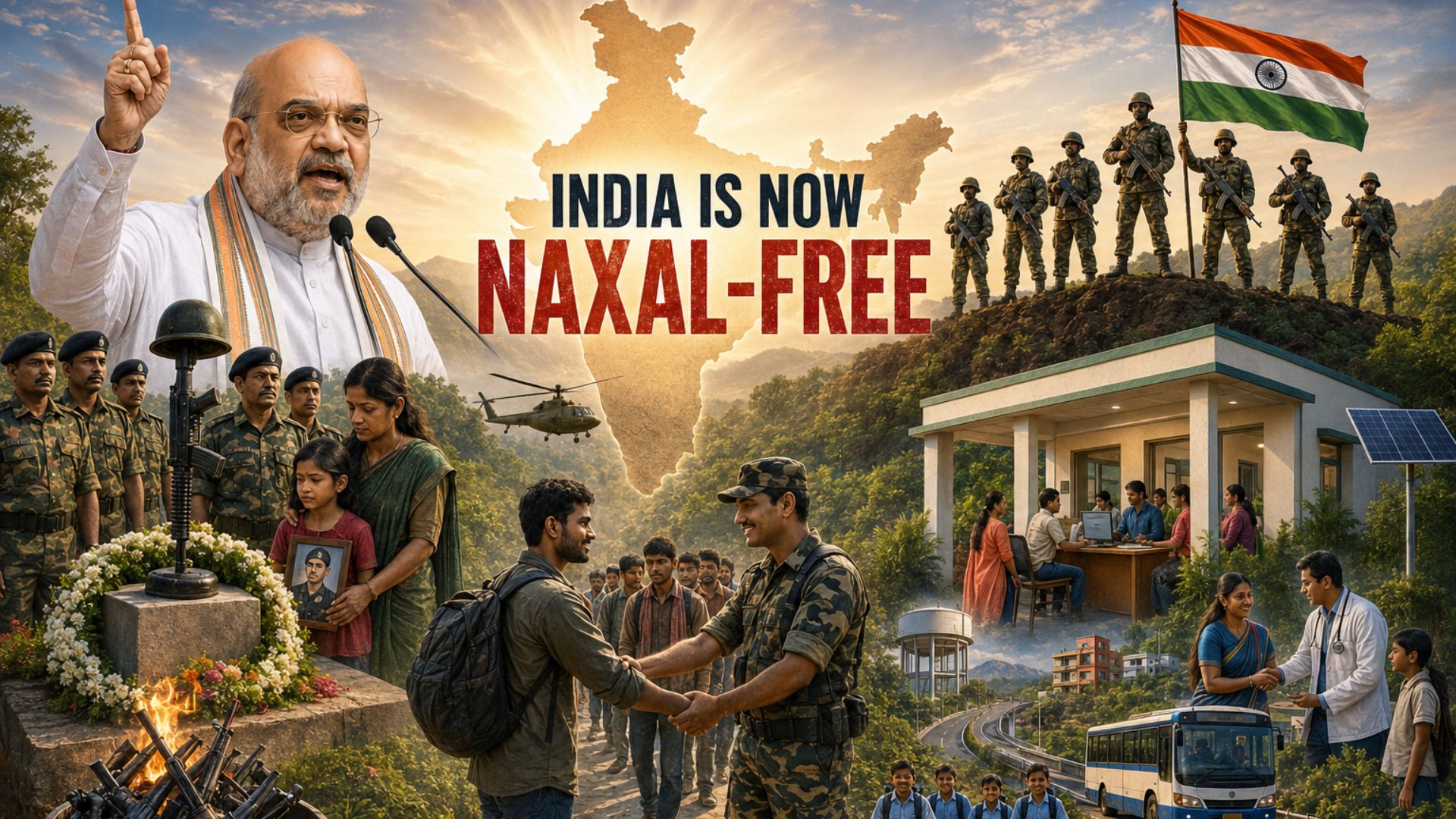
India Free from Maoism

"I am declaring with pride, India is now Naxal-free." — Union Home Minister Amit Shah, Bastar, May 18, 2026
On May 18, 2026, Union Home Minister Amit Shah made a landmark declaration from Bastar — once the heartland of Left-Wing Extremism (LWE) in India — that the country had been freed from Maoism. The announcement, made in the presence of security personnel, bereaved families, and civilians, marks the culmination of a decades-long counter-insurgency effort and opens a new chapter for one of India's most conflict-scarred regions.
The Weight of the Declaration
Bastar was not a symbolic backdrop — it was a deliberate choice. For decades, the region served as the operational citadel of Naxal movements, witnessing some of the most intense guerrilla conflict on Indian soil. Shah's visit on May 18 was his first to the region after March 31, 2026 — the deadline the Centre had earlier set for eliminating LWE from the country.
Timeline of the conflict:
- 1967: Naxalbari uprising — origin of the movement
- 1971 onwards: Spread across central and eastern India
- 2004–2010: Peak violence; Red Corridor stretched across 9+ states
- 2014: Modi government assumes power; renewed anti-LWE push begins
- March 31, 2026: Centre's self-set deadline for Naxal elimination
- May 18, 2026: Shah declares India "Naxal-free" from Bastar
The Human Cost Behind the Victory
Shah did not shy away from acknowledging the magnitude of the sacrifice involved:
"There is hardly any force in the country whose jawans have not laid down their lives… From 1971 till 2026, the public suffered it like a nightmare. Three generations got wasted."
The declaration was made before an audience that included families of security personnel and civilians killed in Naxal violence — grounding the political moment in its human reality. The Minister credited the bravery of personnel from multiple forces for achieving what he described as a target that "could not be finished in a lifetime" but was met "in three to four years."
Rehabilitation: The Other Half of the Strategy
Victory in counter-insurgency is incomplete without a credible rehabilitation framework. Shah announced that approximately 3,000 Naxals have surrendered in Chhattisgarh and urged the people of Bastar to accept them back into mainstream society.
- The Modi government has committed to a comprehensive plan to provide surrendered cadres a "respectable place in society"
- Security camps in formerly Maoist-affected areas are being repurposed — 70 of 196 camps will be converted into public service centres within 18 months
- These centres have been named after Veer Gundadhur, a tribal freedom fighter — a deliberate nod to local identity and pride
Development as the Counter-Narrative
One of the most significant aspects of Shah's address was its ideological rebuttal of the Maoist justification for armed struggle:
"For decades, the Naxalites spread the misconception that they have taken up arms because there has been no development. The truth is that this region has not developed because the Naxalites took up arms."
The government's roadmap for Bastar includes:
- Bringing urban-level civic facilities to villages within one year
- Recovering lost developmental ground within three to five years
- Ensuring tribal communities have equal access to government services as citizens of major cities
Shah also drew a broader picture of India's internal security landscape, noting that challenges in Jammu & Kashmir, the Northeast, and LWE — all acute in 2014 — had been substantially addressed under the current government.
Way Forward
The declaration of a Naxal-free India is significant, but consolidation demands sustained effort:
- Rehabilitation must be institutionalised — surrendered cadres need skill development, legal protection, and social reintegration support, not just policy intent
- Governance vacuum must be filled quickly — areas vacated by Naxals are vulnerable to re-infiltration if state presence remains thin
- Tribal rights and forest governance must be strengthened under frameworks like PESA and the Forest Rights Act to address the underlying grievances the movement historically exploited
- Security camps-to-service centres conversion must be monitored for actual delivery, not just optics
Conclusion
The declaration from Bastar is a defining moment in India's internal security history. Three generations endured the cost of an insurgency that combined ideological appeal with genuine socio-economic neglect. The hard-won peace now demands an equally hard-won development compact. Eliminating the armed movement is the first step — ensuring that the conditions which once gave it oxygen are permanently addressed is the true measure of this victory.
Attribution
Original content sources and authors


Syllabus classification
How this article maps to GS papers
Main syllabus
GS3Internal SecurityQuick Q&A
What is Left-Wing Extremism (LWE) in India, and what are the key reasons behind the rise of Maoism in regions like Bastar?
The rise of Maoism can be traced to structural governance deficits. These include lack of land rights, displacement due to mining, poor infrastructure, weak access to healthcare and education, and historical neglect of tribal communities. Maoists capitalised on these grievances and presented themselves as protectors of tribal interests, often establishing parallel systems of control in remote areas.
Key drivers included:
- Alienation of tribal communities from natural resources
- Poor implementation of welfare schemes
- Administrative absence in remote regions
- Exploitation by local intermediaries
- Use of violence to sustain insurgent influence
Case example: Bastar witnessed decades of conflict where infrastructure projects such as roads and schools were repeatedly targeted by Maoists to prevent state penetration. This shows that insurgency was sustained not only by ideology but also by governance vacuums.
Thus, Maoism is both a security issue and a developmental challenge. Lasting peace depends not merely on eliminating armed cadres but also on addressing root causes like inclusion, justice, and sustainable tribal development.
Why is the declaration of India as 'Naxal-free' significant from the perspective of internal security and governance?
From an internal security perspective, the decline of Maoist influence indicates successful coordination among central and state agencies, intelligence-led operations, infrastructure expansion, and local engagement. It also reflects improvements in road connectivity, telecom, and camp-based administration, which weakened insurgent safe zones.
Governance implications include:
- Expansion of public service delivery in remote regions
- Strengthening democratic participation
- Greater access to welfare schemes
- Improved investor confidence in affected areas
Example: Converting security camps into public service centres in Bastar reflects a transition from conflict control to governance restoration. Such centres symbolize the replacement of coercive state presence with service-oriented administration.
However, significance must be critically assessed. Declaring victory does not automatically remove underlying socio-economic discontent. Sustainable peace requires continued development, rehabilitation of surrendered cadres, and institutional trust-building among tribal populations.
How should rehabilitation of surrendered Naxals be integrated into India’s broader counter-insurgency strategy?
A comprehensive strategy should include:
- Vocational training and employment opportunities
- Psychological counselling and social reintegration
- Housing and livelihood support
- Educational access for families
- Community acceptance programmes
In Bastar, the appeal to accept 3,000 surrendered Naxals acknowledges that social acceptance is as important as state support. Many surrendered individuals face stigma and fear of retaliation, making local participation essential for successful reintegration.
Case study: In Andhra Pradesh, the surrender-and-rehabilitation policy combined financial incentives with police-community engagement, significantly weakening extremist networks. Similar models can be adapted in Chhattisgarh.
Therefore, rehabilitation should be viewed as a governance process, not a welfare measure. It bridges security operations with social reconciliation and ensures that former conflict zones transition into stable democratic spaces.
What explains the persistence of Maoism for nearly five decades despite repeated security operations?
The deeper reason was weak state legitimacy. In many tribal areas, the state was absent except during policing. Development projects often led to displacement without adequate rehabilitation. This enabled Maoists to project themselves as defenders of local rights.
Factors sustaining Maoism included:
- Administrative neglect
- Land alienation and displacement
- Limited education and healthcare
- Cross-border movement between states
- Recruitment among vulnerable youth
Example: Bastar remained a stronghold because roads, schools, and telecom networks were scarce, allowing insurgents to maintain control over large territories.
Thus, persistence was not due to insurgent strength alone but due to systemic state weaknesses. Lasting solutions require governance reforms alongside security operations.
Critically analyse the relationship between development and insurgency in tribal regions like Bastar.
One perspective argues that underdevelopment led to alienation among tribal communities. Lack of roads, schools, and employment created a vacuum in which Maoists mobilised support. Another perspective, as highlighted by the government, is that Maoist violence actively prevented development by attacking roads, telecom towers, and schools.
Critical dimensions:
- Development projects without consultation may worsen displacement
- Insurgency blocks service delivery
- State trust deficit hampers policy acceptance
- Security presence alone may not ensure inclusion
Case example: In some districts, road projects were delayed for years due to repeated Maoist attacks, restricting access to health and education.
Therefore, development should not be seen only as infrastructure creation. It must involve rights-based inclusion, community participation, and culturally sensitive governance for tribal populations.
What lessons can India draw from Bastar as a case study in resolving long-term internal security conflicts?
Key lessons include:
- Security operations must be coordinated across states
- Infrastructure enables governance access
- Surrender policies reduce insurgent recruitment
- Community trust is essential for legitimacy
- Public services must replace military footprints over time
The transformation of camps into public service centres is particularly significant. It represents a shift from conflict management to peace consolidation, showing how institutions can reclaim space through service delivery.
Comparative example: Similar integrated strategies in the Northeast combined dialogue, autonomy arrangements, and infrastructure expansion to reduce insurgency.
Hence, Bastar shows that durable peace is achieved not by force alone but by integrating development, justice, and democratic governance into conflict resolution frameworks.
Practice questions
1 question for mains preparation