
Introduction
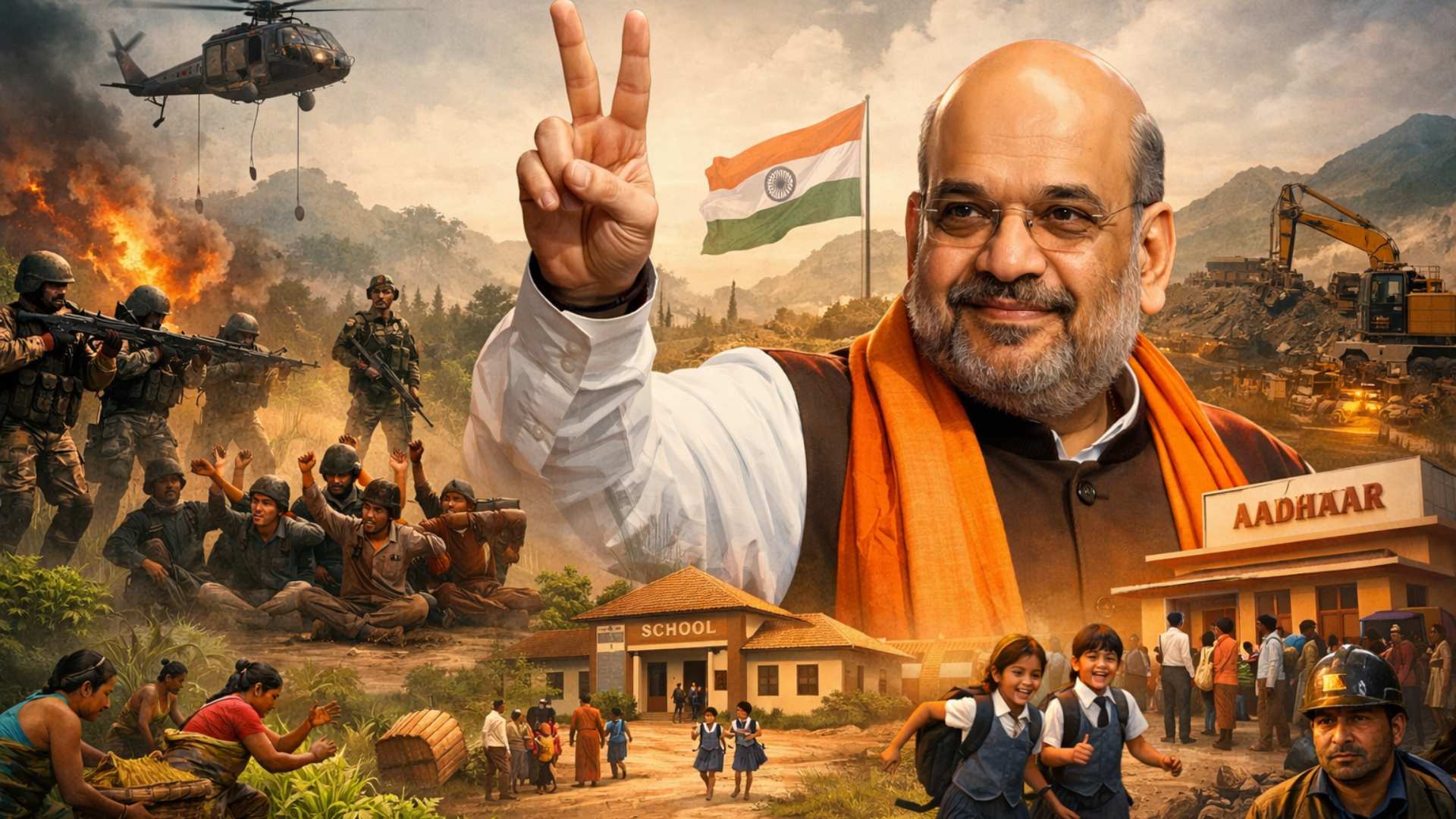
India has declared itself free of Left-Wing Extremism (LWE) — an insurgency that former PM Manmohan Singh once called "the biggest internal security challenge" facing the nation. Home Minister Amit Shah made the announcement on March 30, 2025 in the Lok Sabha, a day before his self-set deadline, marking the culmination of three years of sustained paramilitary operations across the erstwhile Red Corridor.
"The government had a dual approach — dialogue and rehabilitation for those who surrendered arms, and no mercy for those who refused." — Home Minister Amit Shah, Lok Sabha, March 30, 2025
| Metric | Figure |
|---|---|
| Maoists surrendered | 4,839 |
| Arrested | 2,218 |
| Neutralised in encounters | 706 |
Background & Context
| Parameter | Details |
|---|---|
| Peak LWE influence | 180+ districts across Bihar, Jharkhand, Chhattisgarh, Odisha, Andhra Pradesh, Maharashtra |
| UPA response | Operation Green Hunt (2009–10) — expansive paramilitary offensive, faced criticism from allies |
| NDA response | Uncompromising militarist strategy + rehabilitation for surrendered cadres |
| Deadline | Amit Shah's self-set deadline: March 31, 2025 |
LWE, rooted in Maoist ideology, emerged as an armed movement claiming to represent the rights of tribals and marginalised communities against state neglect and exploitative resource extraction. The insurgency thrived in India's "Red Corridor" — a geography of governance deficit, forest cover, and mineral wealth.
Key Policy Approaches: UPA vs. NDA
| Dimension | UPA Approach | NDA Approach |
|---|---|---|
| Strategy | Hesitant, measured; mindful of human costs | Uncompromising militarist + dual track (dialogue + force) |
| Flagship operation | Operation Green Hunt (2009–10) | Sustained paramilitary offensive (2022–25) |
| Civil society stance | Relatively tolerant | Branded critics as "Urban Naxals" |
| Judicial process | Standard legal framework | Went beyond anti-terrorism law provisions |
| Rehabilitation | Limited | Structured surrender + rehabilitation scheme |
Dual-Track Strategy of the NDA Government
The government pursued two simultaneous tracks:
1. Security Track — Intensive paramilitary operations decapitated the military leadership and operational capacity of Maoist organisations, particularly the CPI (Maoist).
2. Development Track — Campaigns to establish schools in every village; distribution of Aadhaar and ration cards in worst-affected areas; expansion of road and communication infrastructure in tribal belts.
Critical Concerns & Challenges
Human Rights & Civil Liberties
- Police measures reportedly exceeded even the harsh provisions of UAPA and other anti-terror statutes.
- Academics and activists were labelled "Urban Naxals," leading to arrests under sedition and UAPA — raising concerns about shrinking dissent space.
- Judicial processes were allegedly distorted during the operational phase.
Post-LWE Risks: Crony Capitalism & Tribal Rights
- Mineral-rich tribal areas (coal, iron ore, bauxite) now become accessible to state and corporate interests.
- Risk of accelerated resource extraction without adequate tribal consent or benefit-sharing.
- Fifth Schedule protections and PESA (Panchayats Extension to Scheduled Areas Act, 1996) must be enforced robustly.
Ideological Residue
- Maoists are ideologically opposed to parliamentary democracy — a position not contingent on development outcomes alone.
- Eliminating the armed movement does not automatically address the underlying ideology.
Governance Significance: Key Frameworks at Stake
| Framework | Relevance |
|---|---|
| PESA Act, 1996 | Gram Sabha rights over forest land and resources in tribal areas |
| Forest Rights Act, 2006 | Individual and community forest rights of tribal communities |
| Fifth Schedule (Art. 244) | Protects tribal areas from arbitrary laws and exploitation |
| UAPA, 1967 | Anti-terror law; used extensively in LWE operations |
Broader Implications
- State Presence Expansion: Security vacuum in previously ungoverned tribal regions can now be filled with administrative infrastructure — schools, courts, health centres, panchayats.
- Democratic Participation: Meaningful inclusion of tribals in parliamentary democracy is now both possible and necessary.
- Accountability in Resource Extraction: Corporate mining interests must operate under democratic oversight and tribal consent frameworks, not in a post-conflict power vacuum.
- Reconciliation Imperative: Military victory must be followed by political reconciliation — addressing historical grievances of displacement, forest rights denial, and cultural marginalisation.
Conclusion
The declaration of an LWE-free India is a significant milestone in internal security governance. The operational success reflects sustained political will and coordinated security strategy. However, the harder task lies ahead: converting military victory into developmental justice. The defeat of Maoism must not become an opportunity for extractive capitalism to replace ideological extremism as a source of tribal alienation. What India now needs is a politics of reconciliation — genuine enforcement of tribal rights, participatory governance, and accountable resource management in the Red Corridor. The test of this success will not be measured in encounters and surrenders, but in the quality of life and constitutional rights of India's forest-dwelling communities.