
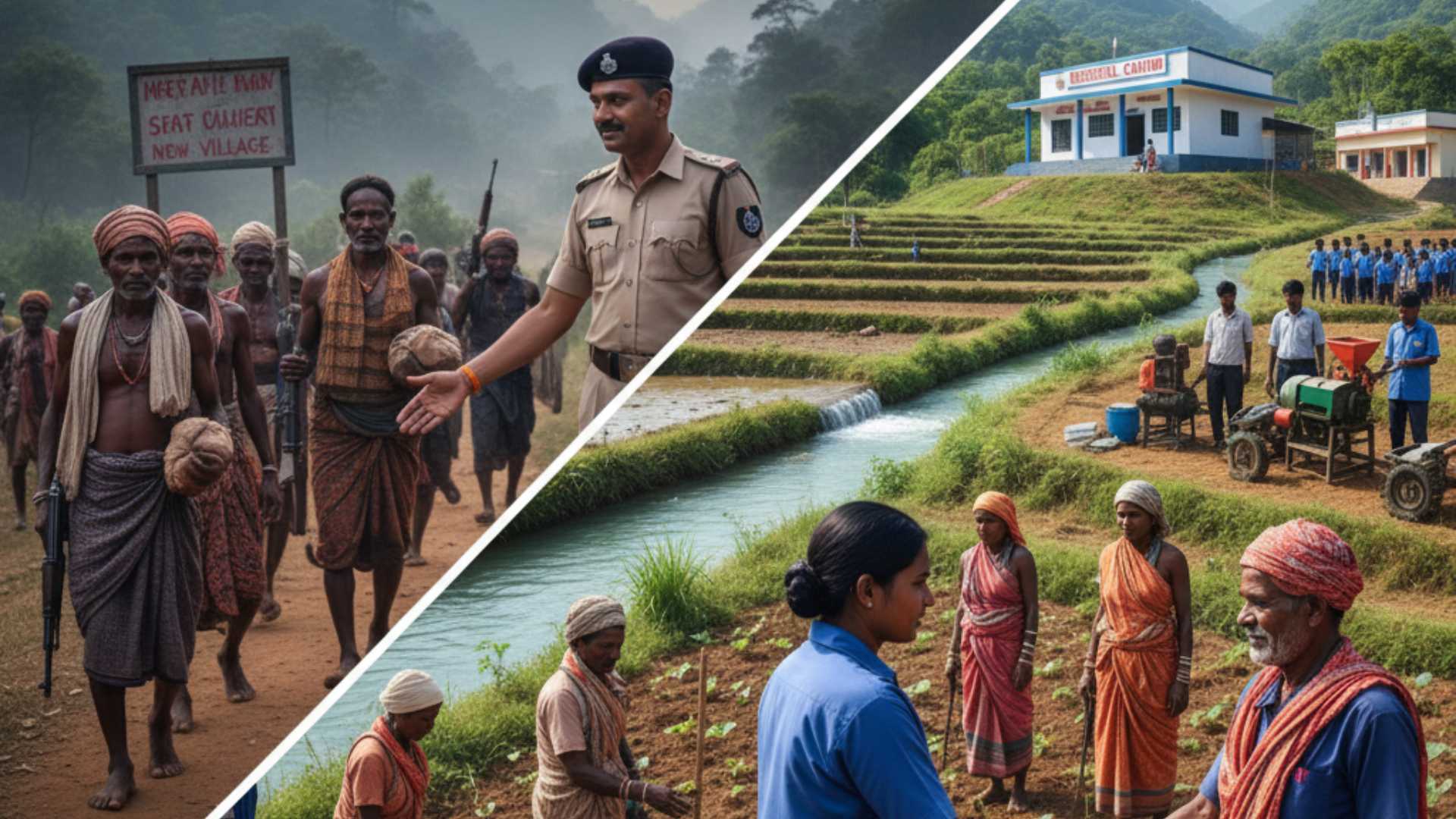
1. Decline of Maoism in Dandakaranya: Context and Strategic Shift
The Maoist movement in the Dandakaranya (DK) region has been in structural decline since 2011–12, with periodic setbacks accelerating its weakening. The article situates recent mass surrenders since October 2025 as part of a longer trajectory rather than a sudden collapse, highlighting cumulative pressure from sustained counter-insurgency operations.
A significant organisational shift occurred in August 2024, when the CPI (Maoist) Polit Bureau decided to fragment the party into smaller units and adopt a defensive posture to avoid encirclement. This move reflected strategic desperation rather than strength, as it weakened command coherence and internal discipline.
The killing of General Secretary Nambala Keshava Rao (Basavaraju) in May 2025 in Narayanpur, along with much of his security detail, marked a decisive leadership decapitation. This event intensified internal dissent and accelerated surrenders by senior leaders and cadres across Chhattisgarh, Maharashtra, Andhra Pradesh, and adjoining regions.
However, organisational decline has not automatically translated into ideological resolution. Some leaders favoured peace talks, while others advocated continued armed struggle, revealing fragmentation between political and military wings of the movement.
The governance logic is that leadership decapitation and territorial control can dismantle insurgent capability, but without addressing underlying grievances, the vacuum risks either relapse or alternative forms of mobilisation.
2. Internal Fragmentation, Surrenders and State Security Assessment
Following internal splits, several senior Maoist leaders surrendered with cadres and weapons, signalling loss of morale and legitimacy. Notable among them were Venugopal alias Sonu with 60 armed cadres in Gadchiroli and ‘Rupesh’ with 210 Maoists in Jagdalpur.
Simultaneously, the elimination of key military figures such as Madvi Hidma, in-charge of PLGA Battalion-1, weakened the armed wing. Yet, the article notes that some factions, particularly under the Central Military Commission, remain committed to armed struggle.
The Ministry of Home Affairs (MHA) assessment in October 2025 classified only 7 districts nationwide as LWE-affected, with 3 districts in Chhattisgarh labelled ‘most affected’. This indicates significant contraction of Maoist influence.
Nevertheless, security success has been uneven across sub-regions, with parts of West Bastar and adjoining areas still witnessing residual presence. This unevenness underscores the limits of security-centric metrics.
The reasoning here is that numerical decline and territorial shrinkage are necessary but insufficient indicators of conflict resolution; ignoring residual pockets risks strategic complacency.
3. Governance Vacuum and the Origins of Maoist Mobilisation
The article reiterates that Maoist mobilisation was rooted in a persistent governance vacuum in tribal-dominated forest regions. Absence of basic state services allowed insurgents to present themselves as alternative providers of justice, welfare, and livelihood support.
Maoists undertook activities such as digging ponds, creating orchards, land levelling, and enforcing better wages for tendu-patta collection. These actions, though coercive in parts, addressed immediate economic insecurities and built local legitimacy.
Parallel governance structures like the krantikari jantana sarkar filled institutional gaps, particularly in dispute resolution and informal education. Over time, this blurred the distinction between coercion and consent in Maoist-held areas.
The article implies that state neglect, rather than ideology alone, enabled insurgent entrenchment, making development failure a core internal security challenge.
The governance logic is that insurgency thrives where the state is absent; if structural neglect persists, coercive actors can regain relevance even after military defeat.
4. Health Infrastructure Deficit in Post-Conflict Tribal Areas
A central concern raised is the acute lack of healthcare infrastructure in interior DK villages. Tribals face high prevalence of anaemia, cerebral malaria, dysentery, and frequent snakebite incidents, all exacerbated by lack of accessible medical facilities.
The absence of safe drinking water has directly contributed to disease outbreaks, while distance from functional health centres delays treatment and increases preventable mortality.
With Maoist influence receding, the article argues that the state must rapidly expand medical networks into previously inaccessible areas to consolidate peace dividends.
Failure to prioritise health delivery risks perpetuating human insecurity even after armed conflict subsides.
- Health challenges highlighted:
- Anaemia among tribal populations
- Cerebral malaria in forested pockets
- Water-borne diseases due to unsafe drinking water
- Snakebite envenomation in jungle areas
The development reasoning is that human security underpins state legitimacy; neglecting health outcomes can undermine post-conflict stabilisation and trust-building.
5. Livelihoods, Forest Economy and Economic Reintegration
Most tribals in DK depend on agriculture and minor forest produce for subsistence. Maoists leveraged this dependence by intervening in pricing, labour relations, and productivity-enhancing activities.
While governments notify Minimum Support Prices for forest produce, the article points out the lack of easily accessible processing and procurement units, limiting real income gains for tribals.
The suggested way forward includes supply of quality seeds (including fish seeds), construction of check dams, and expansion of irrigation to improve productivity and income stability.
Economic revitalisation is presented as essential to prevent relapse into insurgent influence by addressing material deprivation.
- Key livelihood measures implied:
- Improved seed distribution
- Irrigation through check dams
- Local processing units for forest produce
The reasoning is that sustainable peace requires economic alternatives; without livelihood security, security gains remain fragile and reversible.
6. Education Deficit and Human Capital Rehabilitation
The article highlights the role of education in both Maoist mobilisation and post-conflict recovery. Sparse populations made conventional village schools impractical, leading to reliance on residential ashram schools.
Maoist-run schools imparted ideological indoctrination rather than formal education, leaving many cadres illiterate. Post-surrender rehabilitation must therefore include basic education and skill upgradation.
Several surrendered cadres possess vocational skills acquired during their time in the movement, which can be repurposed for constructive economic activity.
Undoing ideological indoctrination while building human capital is presented as a long-term governance challenge.
The governance logic is that education transforms former combatants into stakeholders; ignoring this risks social marginalisation and recidivism.
7. Surrender, Rehabilitation and Reproductive Justice
While the Surrender and Rehabilitation (S&R) policy provides financial aid, housing, and employment, the article draws attention to overlooked social consequences of insurgency life.
Many male cadres were reportedly forced to undergo vasectomy, severely affecting their ability to reintegrate socially and start families. The article argues for free reverse vasectomy procedures in district hospitals.
Similarly, women cadres and spouses require access to reproductive health services and assisted reproductive technologies.
These concerns broaden rehabilitation from economic reintegration to social and personal dignity.
The reasoning is that incomplete rehabilitation undermines reintegration; ignoring bodily and social harms perpetuates invisible injustice even after surrender.
8. Gender, Social Norms and Tribal Society
The article notes that many women joined the Maoist movement to escape forced marriages, highlighting entrenched patriarchal norms in tribal societies.
Post-conflict governance must therefore engage with community elders (siyan) to promote respect for women’s consent in marriage decisions.
Addressing social practices is positioned as complementary to security and development, rather than secondary.
Failure to reform social norms risks reproducing conditions that push women toward extremist alternatives.
The social logic is that dignity and agency are as critical as welfare; ignoring them sustains latent conflict drivers.
9. State Development Schemes and Spatial Expansion
The Chhattisgarh government’s Niyad Nellanar (‘Your Good Village’) scheme aims to deliver benefits of about 25 government schemes to villages within 5 km of remote security camps.
While effective in security-linked zones, the article argues that as districts become Maoist-free, the scheme must be extended to previously affected villages beyond the immediate camp radius.
This transition from security-driven to universal development coverage is essential to normalise governance.
- Scheme-related features:
- Coverage linked to security camp proximity
- Multi-scheme convergence approach
The governance reasoning is that selective development can entrench inequalities; scaling up ensures peace consolidation and administrative normalcy.
Conclusion
The article underscores that the decline of Maoism represents a tactical victory but a strategic test for the Indian state. Durable peace in Dandakaranya depends on transforming security gains into inclusive governance through health, livelihoods, education, social justice, and institutional reach. Long-term stability will hinge not on the absence of insurgents, but on the presence of a responsive and capable state.